
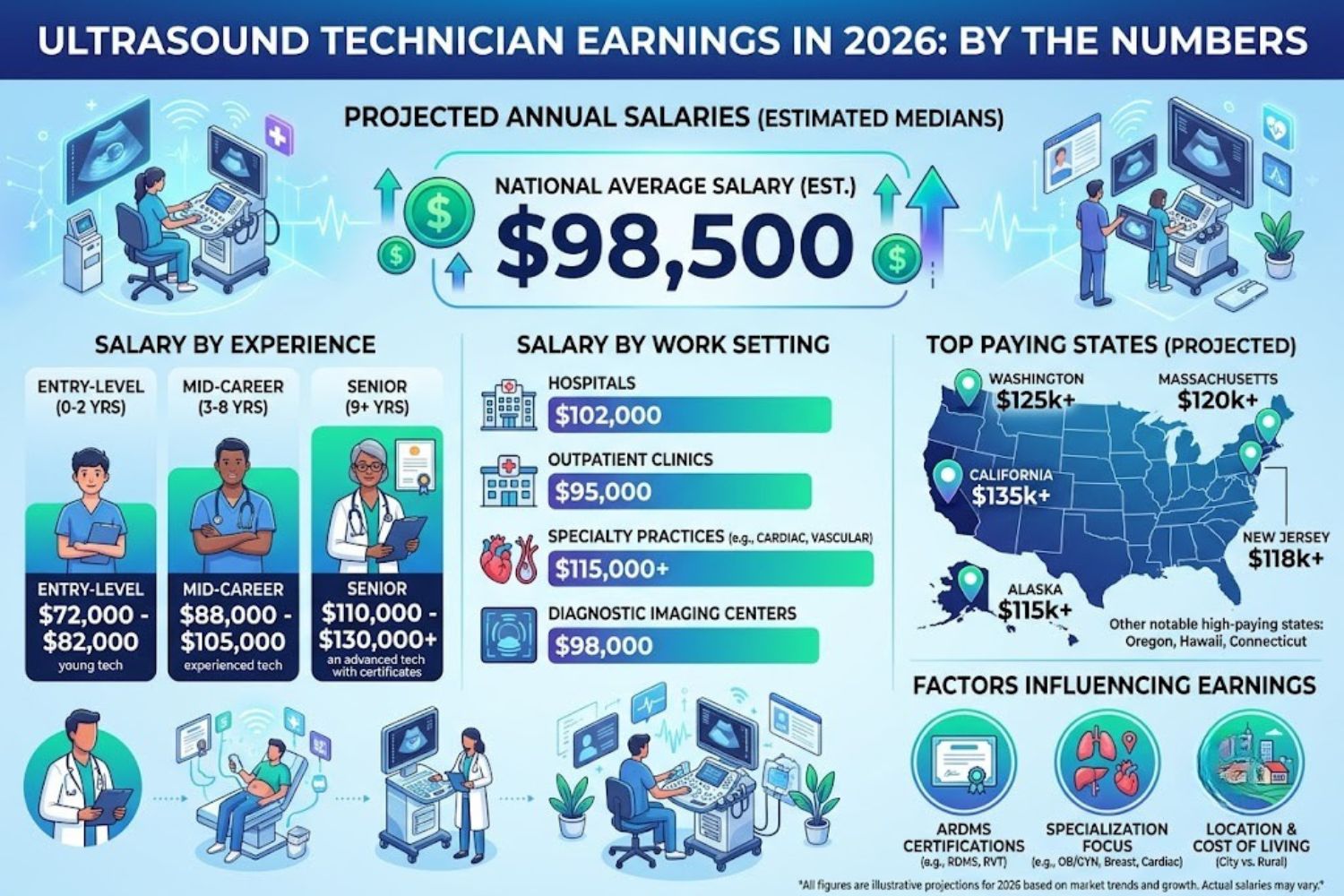
Quick answer: The median ultrasound tech salary in the United States is $89,340 per year, or about $42.95 an hour, according to the most recent Bureau of Labor Statistics data. Pay typically ranges from roughly $64,000 for newer techs to over $116,000 for experienced sonographers in high-paying specialties and states.
If you’ve searched “ultrasound tech salary” and landed on ten different pages with ten different numbers, you’re not imagining things. Salary sites pull from different years, mix in outdated averages, or blend sonographers together with unrelated roles. That’s frustrating when you’re trying to decide whether to enroll in a program, negotiate a raise, or switch employers.
This guide fixes that. Every number here traces back to a labeled source, and we break pay down by the four things that actually change your paycheck: experience, location, specialty, and work setting. We’ll also cover what most guides skip entirely — how call pay works, which certifications are worth the exam fee, and a real negotiation approach you can use in your next offer conversation.
Ultrasound Tech Salary at a Glance
The Bureau of Labor Statistics tracks this occupation as “diagnostic medical sonographer” (SOC code 29-2032), which is the official title for what most people call an ultrasound tech. As of the most recent full-year data, the median annual wage was $89,340, or roughly $42.95 an hour.
An earlier BLS wage survey reported a mean annual wage of $89,020 ($42.80/hour) and a median of $84,470, with the following percentile breakdown:
| Percentile | Hourly Wage | Annual Wage |
|---|---|---|
| 10th (entry-level) | $30.61 | $63,680 |
| 25th | $36.36 | $75,640 |
| 50th (median) | $40.61 | $84,470 |
| 75th | $48.35 | $100,580 |
| 90th (experienced/specialized) | $55.91 | $116,300 |
Key Takeaway: Even the lowest-earning 10% of sonographers out-earn the median for all U.S. occupations combined, which sits around $49,500. This is a genuinely strong-paying career for a role that typically requires only an associate degree.
One nuance worth understanding: mean (average) and median (the middle value) tell you different things. The mean gets pulled upward by a smaller number of very high earners — think cardiac sonographers in California hospitals. The median is usually the more honest number for “what will I actually make,” because half of all sonographers earn more and half earn less.
Ultrasound Tech Salary by Experience Level
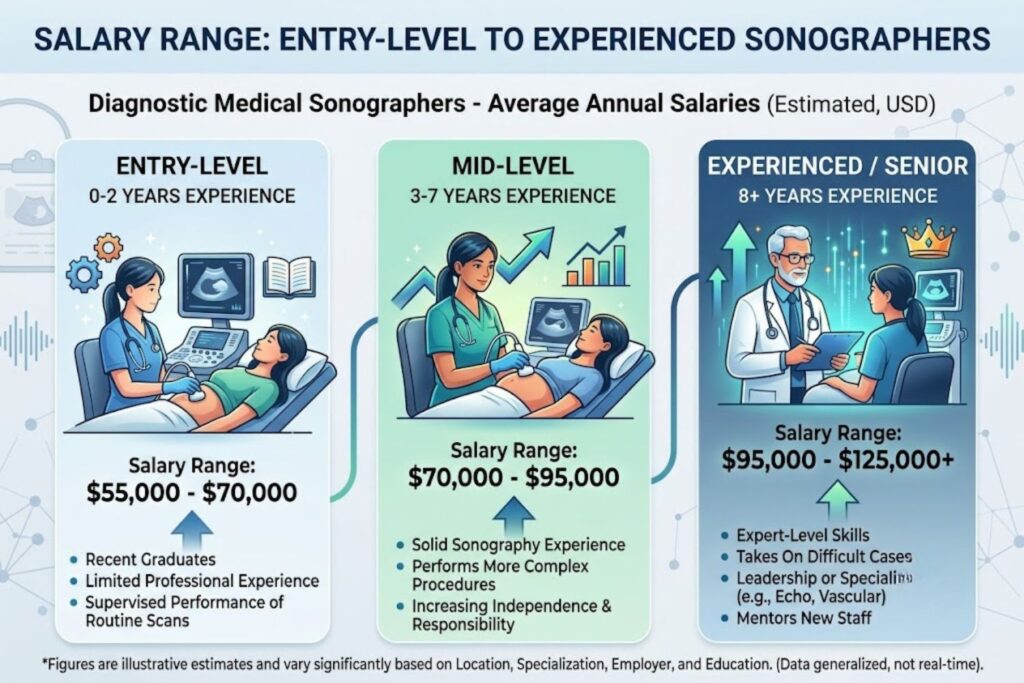
Experience affects sonographer pay more gradually than in some other healthcare roles, because a two-year associate degree already qualifies you for full scope-of-practice work on day one. Still, the gap between a new grad and a 15-year veteran with a second credential is substantial.
| Experience Level | Typical Salary Range | What Changes |
|---|---|---|
| Entry-level (0–2 years) | $55,000 – $70,000 | Building speed, accuracy, and confidence with protocols |
| Mid-career (3–9 years) | $70,000 – $95,000 | Often adds a second ARDMS specialty credential |
| Experienced (10+ years) | $95,000 – $120,000+ | Lead tech, education roles, or high-acuity cardiac/vascular work |
Two things move you through these bands faster than time alone: adding a specialty credential, and moving into a setting or region that pays better for the same work. We cover both below.
Ultrasound Tech Salary by State
Location changes your paycheck more than almost any other single factor — sometimes by 30% or more between neighboring regions. Cost of living explains part of this, but not all of it; some high cost-of-living states still pay comparatively modest wages, while a few moderate cost-of-living states pay surprisingly well due to hospital system demand.
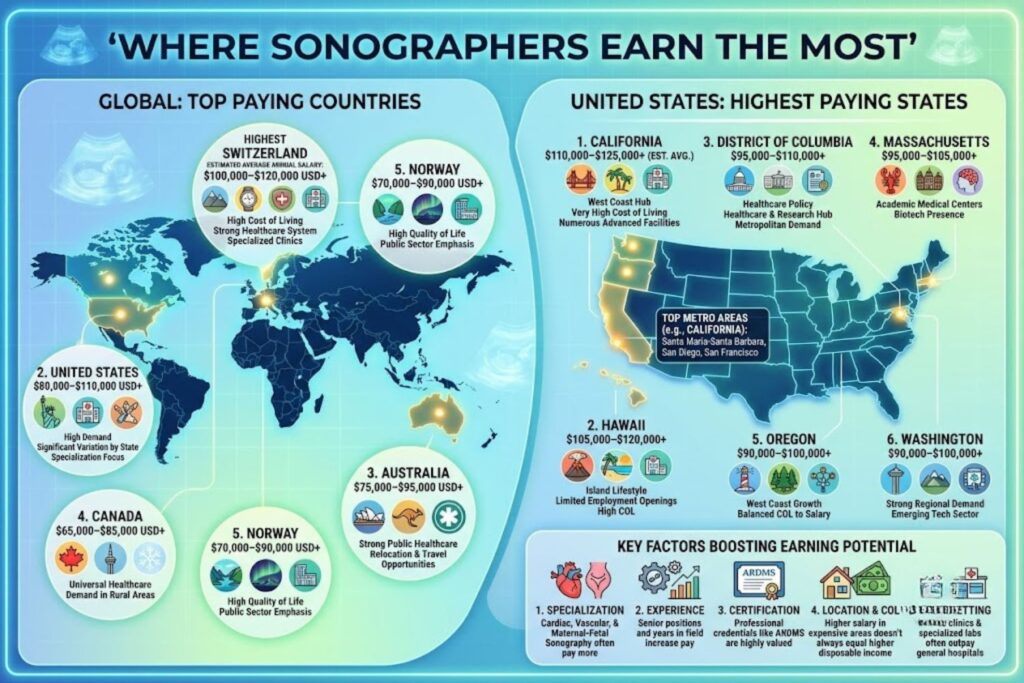
Based on BLS wage data, the states that typically report the highest mean annual wages for diagnostic medical sonographers include:
| State | Approx. Mean Annual Wage |
|---|---|
| California | ~$109,000+ |
| District of Columbia | ~$99,800+ |
| Hawaii | ~$99,400+ |
| Washington | Above national mean |
| Massachusetts | Above national mean |
| Oregon | Above national mean |
States with lower reported wages tend to cluster in parts of the South and rural Midwest, where cost of living is also lower. Before comparing two job offers in different states, run both numbers through a cost-of-living calculator — a $75,000 offer in a low cost-of-living metro can outperform a $90,000 offer in an expensive one after housing and taxes.
Expert tip: Don’t just Google “average sonographer salary in [state].” State-level averages blend general sonographers with highly-paid cardiac and vascular specialists, which can make an entry-level offer look low by comparison. Ask a prospective employer for the pay range specific to your specialty and experience band, not the state average.
Ultrasound Tech Salary by Specialty
This is the biggest information gap in most salary guides. “Ultrasound tech” isn’t one job — it’s a family of specialties, and they don’t pay the same.

| Specialty | Typical Pay Range | Entry Difficulty | Notes |
|---|---|---|---|
| General/Abdominal | $60,000 – $85,000 | Lower | Broadest training path, most job openings |
| OB/GYN | $60,000 – $88,000 | Lower–Moderate | High patient volume, steady demand |
| Cardiac (Echocardiography) | $65,000 – $110,000+ | Higher | Requires RDCS credential; steep learning curve, strong pay ceiling |
| Vascular | $65,000 – $105,000+ | Higher | RVT credential; growing demand tied to cardiovascular disease rates |
| Breast/MSK | $60,000 – $90,000 | Moderate | Smaller niche, growing in outpatient imaging |
Cardiac and vascular sonography consistently sit at the top of the pay range because the training curve is steeper and fewer techs pursue the additional certification. If you’re weighing a second specialty purely for salary growth, these two typically offer the strongest return.
Ultrasound Tech Salary by Work Setting
Where you work changes your pay just as much as what you scan.
| Setting | Typical Pay Impact | Trade-Off |
|---|---|---|
| Hospitals | Average to above-average, plus call pay | Nights, weekends, on-call rotations |
| Outpatient imaging centers | Often above average | Higher patient volume, more predictable schedule |
| Physician offices/clinics | Average to below-average | Best work-life balance, least overtime opportunity |
| Travel/contract sonography | Highest short-term pay | No benefits continuity, frequent relocation |
Outpatient care centers frequently report some of the highest average wages in the field, in part because they combine high patient throughput with fewer of the lower-paying academic or public-health settings that pull hospital averages down.
Travel sonography deserves its own mention. Contract assignments can pay significantly more per week than a staff position, especially during regional staffing shortages, but the trade-offs are real: no PTO accrual between contracts, self-funded health insurance gaps, and constant relocation. Treat travel pay as a multi-year strategy, not just a bigger number on a job board.
Hourly Pay, Overtime, and On-Call Differentials
Most salary guides quote an annual number and stop there. In practice, a large share of sonographers are paid hourly, and understanding the extras matters as much as the base rate.
- Call pay: Hospital-based sonographers are frequently required to take call — being reachable to come in for emergency scans outside normal hours. Call pay is often a flat stipend (commonly in the $2–$5/hour range while on call) plus a higher rate for hours actually worked.
- Shift differentials: Evening, night, and weekend shifts often add a percentage or flat amount on top of base hourly pay.
- Overtime: Non-exempt sonographers are entitled to overtime pay under federal law for hours worked beyond 40 in a week, which can meaningfully boost take-home pay during staffing shortages.
Warning: When comparing job offers, always ask whether the quoted number includes call pay estimates or is base rate only. A “$95,000” hospital offer that assumes heavy call hours may pay less predictably than an $85,000 outpatient role with a fixed schedule.
Ultrasound Tech vs. Other Healthcare Careers (Pay Comparison)
| Career | Typical Median Salary | Typical Education Required |
|---|---|---|
| Diagnostic Medical Sonographer | ~$89,000 | Associate degree (2 years) |
| Registered Nurse | ~$86,000 | Associate or Bachelor’s degree |
| Radiologic Technologist | ~$70,000 | Associate degree |
| EKG Technician | ~$70,000 | Certificate program (months) |
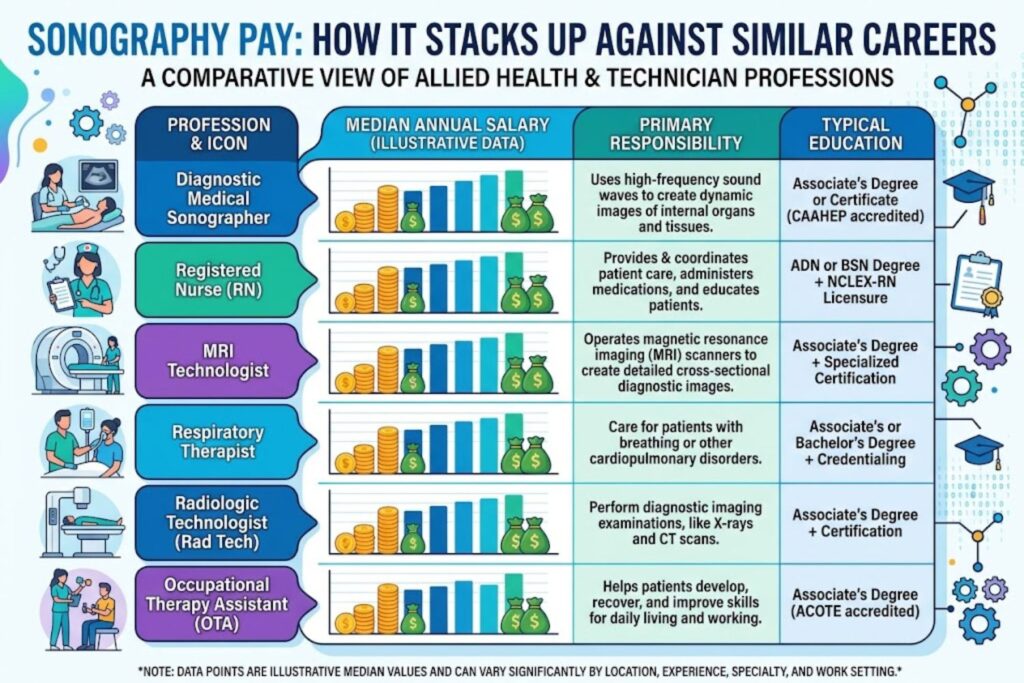
For the amount of formal education required, sonography consistently ranks among the stronger-paying entry points into clinical healthcare. It doesn’t require the bachelor’s-level path that many nursing tracks now favor, yet it lands in a similar or higher pay band.
What Actually Moves Your Salary Up
Waiting for an annual raise is the slowest way to grow sonographer pay. Here’s what actually works, based on how the field is structured.
1. Add a second ARDMS credential. Techs who hold more than one specialty certification (for example, general plus vascular, or general plus cardiac) are typically more valuable to employers because they can be scheduled more flexibly and cover more scan types. This is consistently one of the highest-leverage moves for pay growth.
2. Move settings strategically, not randomly. If you’re in a physician’s office with limited upside, a lateral move to an outpatient imaging center or hospital often unlocks a meaningfully higher pay band — even before adding experience or credentials.
3. Understand your market rate before you negotiate. Pull actual wage data for your metro area and specialty (not a national average) before any salary conversation. Vague requests (“can I get more money?”) rarely work. Specific requests backed by data usually do.
4. Negotiate the full package, not just base pay. Call pay structure, shift differential rates, CE reimbursement, and credential exam fee coverage are all negotiable and often overlooked. A modest base salary with strong call pay can outperform a slightly higher base with none.
Salary Negotiation Prep Checklist
- Pull your specialty’s local pay range (not the national median)
- List your certifications and how they map to employer needs
- Ask about call pay structure before accepting a base number
- Confirm whether shift differentials apply to your schedule
- Get the full offer in writing before comparing to another offer
Common Mistakes That Cost Sonographers Money
- Comparing national averages to a local offer. A “below-average” offer in a low cost-of-living market may actually be competitive locally.
- Staying in one specialty too long without adding a credential. Single-credential techs plateau earlier.
- Accepting the first offer without asking about call pay. This is frequently the single biggest gap between a “good” and “great” total compensation package.
- Overlooking travel contracts as a strategic tool. Even one or two travel assignments can accelerate savings goals if timed well.
- Not tracking continuing education requirements. Letting a credential lapse can quietly cap your eligibility for higher-paying specialty roles.
Ultrasound Tech Salary Outlook Through 2034
Employment of diagnostic medical sonographers is projected to grow 13% from 2024 to 2034 — much faster than the average for all occupations, according to the BLS. That growth is driven largely by an aging population that needs more diagnostic imaging, along with sonography’s continued expansion as a lower-cost, radiation-free alternative to other imaging methods.
For job seekers, faster-than-average growth generally translates into steadier demand and more leverage in salary negotiations, particularly in cardiac and vascular sonography, where the supply of credentialed techs hasn’t kept pace with demand in many metro areas.
Is Ultrasound Tech a Good Career Financially? A Decision Framework
| Pros | Cons |
|---|---|
| Strong median pay for a 2-year degree | Physically demanding (repetitive strain risk) |
| Faster-than-average job growth | Pay varies significantly by region |
| Multiple specialty paths to grow income | Call/weekend rotations common in hospitals |
| Lower entry cost than many healthcare degrees | Plateau risk without added certifications |
A simple way to decide:
- If you want strong pay without a 4-year degree and don’t mind occasional on-call work → sonography is a strong financial fit.
- If you need a fully predictable 9-to-5 schedule with zero call rotation → target outpatient or physician-office settings specifically, and confirm this in the interview.
- If your top priority is maximum long-term earning ceiling → plan toward cardiac or vascular specialization from the start.
Key Takeaways
- The national median ultrasound tech salary is $89,340 per year (about $42.95/hour), per the most recent BLS Occupational Outlook Handbook data.
- Pay realistically ranges from about $64,000 for newer techs to over $116,000 for experienced, specialized sonographers.
- Cardiac and vascular sonography offer the highest pay ceilings but require additional certification.
- Location can shift your pay by 20–30% or more — always compare offers using local, specialty-specific data.
- Call pay, shift differentials, and CE reimbursement are negotiable and often add more value than a slightly higher base salary.
- The field is projected to grow 13% through 2034, giving techs real leverage in job and salary negotiations.
Frequently Asked Questions
What is the average ultrasound tech salary in the US?
The median annual wage for diagnostic medical sonographers is $89,340, according to the most recent Bureau of Labor Statistics data, which works out to roughly $42.95 per hour.
How much do ultrasound techs make an hour?
Hourly pay typically ranges from about $30 for newer techs to $56 or more for experienced sonographers in high-paying specialties, based on BLS percentile wage data.
What is the highest-paying state for ultrasound techs?
California consistently reports among the highest mean wages for diagnostic medical sonographers, with the District of Columbia and Hawaii also ranking near the top.
Do cardiac sonographers make more than general sonographers?
Yes. Cardiac (echocardiography) and vascular sonographers typically earn more than general abdominal or OB/GYN sonographers, largely because the additional certification requires more training and fewer techs pursue it.
Is ultrasound tech a good career financially?
For the two-year education requirement, yes — the median pay outperforms many careers requiring similar or even greater time investment, and job growth is projected well above the national average.
Do ultrasound techs make more than nurses?
Median pay for the two fields is close, with sonographers often at or slightly above the RN median, though this varies by state, setting, and nursing specialty.
How much do entry-level ultrasound techs make?
Entry-level sonographers typically earn between $55,000 and $70,000 per year, depending on location and work setting.
Does travel sonography pay more?
Travel and contract assignments often pay more per week than staff positions, especially in high-demand regions, but typically come without benefits continuity between contracts.
What certifications increase ultrasound tech pay the most?
Adding a second ARDMS specialty credential — particularly RDCS (cardiac) or RVT (vascular) — is consistently associated with higher pay compared to holding a single general credential.
Do ultrasound techs get paid for being on call?
Many hospital-based sonographers receive a stipend for on-call availability plus a higher hourly rate for hours actually worked when called in, though structures vary by employer.
How long does it take to become an ultrasound tech?
Most sonographers complete an associate degree program in about two years, though certificate programs and bachelor’s-level tracks also exist.
Will ultrasound tech salaries keep growing?
Employment for the occupation is projected to grow 13% from 2024 to 2034, a rate the BLS reports as much faster than the average for all occupations, which generally supports continued wage growth alongside demand.
Final Word
Ultrasound tech pay isn’t one number — it’s a range shaped by where you work, what you scan, and which credentials you hold. The techs who out-earn the median aren’t necessarily the ones with the most years on the job; they’re the ones who added a second specialty, understood their local market rate, and negotiated the full package instead of just the base number.
Ready to plan your next move in healthcare tech? Explore more career and salary breakdowns for in-demand tech and healthcare roles on TechWoid to compare your options before you commit to a training path or job offer.