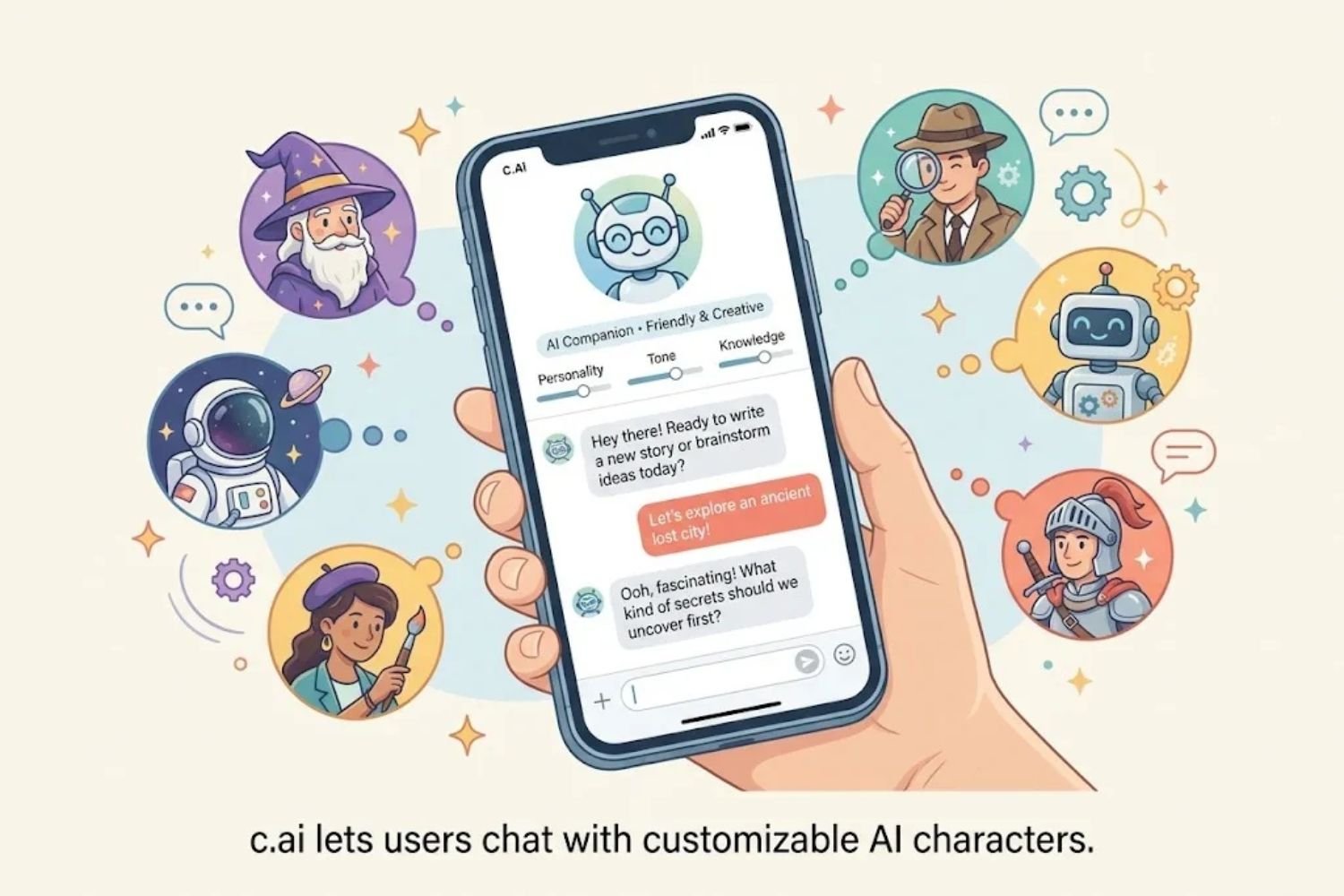
c.ai is the short name for Character.AI, a platform where people chat with AI-powered characters. Users can build their own customizable characters or talk to ones other people created. The service is popular for roleplay and storytelling, but its rules for younger users changed sharply in late 2025, and that change still matters today.
What c.ai Is (and How It Differs From Other Chatbots)
Most general-purpose chatbots act as one assistant. c.ai works differently. Each character is a persona with its own name, backstory, speaking style, and behavior rules, written by its creator. The underlying model generates the replies, but the persona shapes tone and direction.
That structure explains the platform’s range. Its uses span imaginative play to mock job interviews. Some users run fantasy adventures. Others rehearse hard conversations or practice interview answers.
Expert tip: Character behavior depends on two things: the creator’s written setup and the model’s responses during a conversation. Two characters with the same name can behave very differently, so judge a character by its actual replies, not its title.
The Platform’s Shift Toward Entertainment
The product has moved away from its early “always-on companion” image. CEO Karandeep Anand, a former Meta executive, described the company as pivoting from an “AI companion” model to a “role-playing platform” focused on creative content generation rather than conversational relationships. folio3
This matters for anyone evaluating the service. The product’s core is now creative play and content, not ongoing one-on-one relationships.
What Changed for Users Under 18
This is the most important update for most readers.
Timeline of the restrictions
- October 29, 2025: The company announced that it would end open-ended chats for users under 18. The changes were set to take effect by Nov. 25, and a two-hour daily limit would start immediately.
- Transition period: Teen access was reduced in steps. The company said it was working to build an under-18 experience that still gives teen users ways to be creative.
- Scale of impact: The CEO said under-18 users previously made up about 10% of its roughly 20 million monthly active users, so the change affected a meaningful share of the audience.
What teens can still do
Under-18 users can still use creative tools that don’t involve open-ended chat. The company pointed to creating videos, stories, and streams with Characters. For many families, this is the key distinction: the platform still offers creative features to teens, but open-ended conversation is no longer available.
How Age Checks Work and Where They Fall Short
The company uses its own age-assurance model, combined with outside identity verification. It deploys an in-house age assurance model alongside Persona, an online identity verification service. If the system has doubts, users go through full age verification via Persona if they want to use the adult experience.
Age checks are imperfect, and critics have said so. Face-based estimates can’t always tell if someone is 17 or 18, and identity uploads raise privacy questions. Reports from 2026 also describe stricter checks that send suspicious accounts to selfie verification (Character.AI tightened its age checks again in August 2026, pushing suspicious accounts into a selfie check to keep minors out of open chats.).
Warning: No age gate is perfect. If you’re a parent, don’t treat the platform’s age check as a substitute for supervision.
Legal Pressure Is Still Shaping the Platform
The policy changes followed a wave of lawsuits. One involves a Florida wrongful death suit claiming the platform contributed to a 14-year-old’s suicide following interactions with a “Game of Thrones” character bot.
New actions have continued into 2026. In May 2026, Pennsylvania’s State Board of Medicine sued Character Technologies, alleging that a chatbot illegally practiced psychiatry. Reporting on the case said one chatbot even presented an invalid Pennsylvania medical license number.
The policy change doesn’t close existing cases. As one legal analyst noted, existing litigation isn’t likely to end because of new age rules.
A Practical Checklist by User Type
Parents and educators
- Confirm the account’s age settings are accurate. Don’t rely on the platform alone.
- Ask the teen to show you which features they use and what they create.
- Explain that characters are fictional, even when they sound convincing.
- Watch for any character that claims professional credentials.
Adults and creators
- Keep personal details out of chats, including your name, address, school, and workplace.
- Treat characters as fiction. Don’t take medical, legal, or financial guidance from them.
- Review privacy settings and your data-sharing choices before you upload anything.
Developers and product teams
- Read the platform’s current terms and safety policies before building on or referencing its characters.
- Don’t design products that depend on a character claiming authority. The Pennsylvania case shows why.
- Build your own age-appropriate gates and logging rather than assuming a third party covers you.
Common Mistakes
- Assuming the age gate is airtight. Verification methods can be bypassed, and no system catches everyone.
- Trusting a character’s claims. A bot can say it’s a doctor or lawyer. It isn’t one, and it can’t verify anything.
- Confusing user-made with vetted. Community characters vary widely in quality and safety. Review what you use.
- Ignoring policy changes. The rules for teens changed substantially. Advice from 2024 is outdated.
Decision Framework: Is c.ai Right for You?
| Use case | Fit | What to watch |
|---|---|---|
| Adult creative roleplay or fiction | Good | Keep personal data out of chats |
| Interview or conversation practice | Good | Don’t share sensitive work data |
| Teen open-ended chat | Not available | Under-18 open chat was removed in late 2025 |
| Medical, legal, or financial advice | Poor | Use a licensed professional |
| Building a product on its characters | Proceed carefully | Check current terms and legal exposure |
Rule of thumb: If the use is fiction or practice, c.ai can work well. If the use requires accuracy, professional judgment, or privacy for a minor, choose another tool or add safeguards.
Key Takeaways
- c.ai is Character.AI, a platform for chatting with customizable AI characters.
- Open-ended chat for users under 18 was removed as of late 2025. Teens can still use creative features.
- Age verification uses in-house tools plus Persona, and critics question its accuracy.
- Lawsuits and state actions are ongoing, including a 2026 Pennsylvania case.
- Treat characters as fiction, and never use them as a source of professional advice.
Conclusion and Next Steps
c.ai remains one of the best-known AI character platforms, but it isn’t the same product it was a few years ago. Know the current rules before you sign up, let a teen use it, or build on it. If you want more practical breakdowns of AI tools like this one, explore the guides at TechWoid.
Key Takeaways
- c.ai is the short name for Character.AI, a platform for AI characters.
- Under-18 users lost open-ended chat in late 2025 and can still use creative features.
- Age checks combine in-house models with Persona and remain imperfect.
- Legal action continues, including a May 2026 Pennsylvania lawsuit.
- Use characters for fiction or practice, not professional advice.
FAQ
What is c.ai?
c.ai is the shortened name for Character.AI, a platform where users chat with customizable AI characters they create or find on the site.
Is c.ai the same as Character.AI?
Yes. c.ai is the domain shorthand for Character.AI.
Can teens use c.ai in 2026?
Teens under 18 can no longer take part in open-ended chats with characters. They can still use creative features such as stories and videos.
When did the under-18 chat ban start?
The company announced it on October 29, 2025, with the restriction set to take effect by November 25, 2025.
How does c.ai verify age?
It uses an in-house age-assurance model and Persona identity verification. Users flagged as uncertain may be asked to complete full verification to access the adult experience.
Is c.ai safe for kids?
Open chat is no longer available to users under 18, but no age check is perfect. Parents should supervise any use and talk with their children about fictional AI.
Does c.ai give medical or legal advice?
Characters are fictional, and they shouldn’t be used for medical, legal, or financial decisions. Pennsylvania’s 2026 lawsuit involved a bot that falsely presented itself as a licensed psychiatrist.
Why did c.ai change its focus?
The CEO has described a shift from an “AI companion” model toward a role-playing and creative content platform.
Is c.ai free?
Pricing can change. Check the official site for current plans and features.
What can I do on c.ai besides chatting?
Users can create characters, use stories, and explore content created by others. Feature availability depends on age and account type.
What are the main risks of using c.ai?
Key risks include inaccurate or misleading character claims, privacy exposure from sharing personal details, and emotional over-reliance on fictional personas.
Is c.ai still being sued?
Yes. Multiple lawsuits and state actions remain active, and the policy changes don’t resolve them.
What are some alternatives to c.ai?
Alternatives exist for roleplay, writing, and conversation practice. Compare features, safety policies, and age rules before choosing one.
Can I build a product with Character.AI characters?
Review the platform’s current terms and get legal advice before building. Policies and licensing can change.