In early 2025, headlines exploded across tech and defense publications: the U.S. Air Force was acquiring Tesla Cybertrucks. Not for transportation. For target practice.
The image was striking—a futuristic, stainless-steel electric truck being repurposed as a missile-testing platform at White Sands Missile Range. It sparked debate, memes, conspiracy theories, and a $400 million government procurement controversy.
But the Cybertruck story is actually a symptom of something far bigger: the Pentagon is fundamentally reshaping how it builds military capability, and defense contracts with private firms now exceed $445 billion annually, driven by AI, satellite, and cloud tech needs.
This shift isn’t about buying a few electric trucks. It’s a seismic realignment in how America builds military power in the 21st century.
This article cuts through the noise to explain what’s actually happening—and why it matters.
The Pentagon-Big Tech Convergence: What the Cybertruck Really Means
The Cybertruck Procurement: Not a Fleet Purchase, a Test Platform
Let’s start with the most misunderstood part of this story.
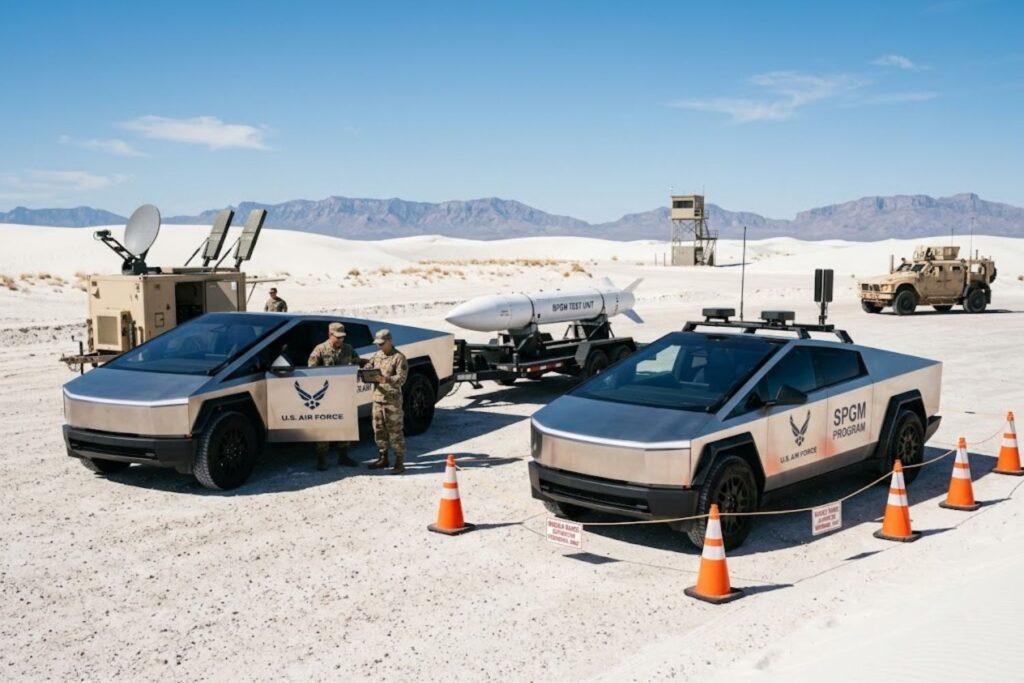
The Air Force didn’t buy the Cybertruck because Elon Musk lobbied Congress. The Air Force’s contract filings explicitly list two Tesla Cybertrucks as part of its Standoff Precision Guided Munitions (SOPGM) target program at White Sands Missile Range.
Two trucks.
The military acquired them as high-fidelity targets for testing advanced missile systems. The Cybertruck’s specifications—its size, materials, electronic systems, and durability—made it useful for simulating modern battlefield vehicles and threats.
Think of it like this: if you’re testing a new missile system, you need a realistic target. The Cybertruck, with its distinctive construction and modern electronics, represents a class of vehicle that U.S. military planners believe adversaries might deploy. By testing missiles against Cybertrucks, the military gathers data on weapon performance against real-world commercial technology.
This is actually a sign of strategic thinking, not waste.
Why the Pentagon Suddenly Needs Consumer Tech Companies
The deeper question: why is the Pentagon turning to companies like Tesla, SpaceX, and Palantir at all?
The answer reveals a stark reality: traditional defense contractors stopped innovating.
Emerging tech firms like SpaceX, Palantir, and Anduril have been tapped for multi-billion-dollar contract awards from the Pentagon for communications, targeting, unpiloted vehicles, anti-drone defenses, and hypersonic weapons.
Meanwhile, the legacy defense contractors—Lockheed Martin, Boeing, Raytheon, Northrop Grumman—were optimized for building expensive, long-development-cycle programs that rarely faced competition.
The more than 50 major defense contractors that existed in 1993 has narrowed to just a handful today — Lockheed, RTX (formerly Raytheon), Northrop, Boeing, General Dynamics and L3Harris.
This consolidation bred complacency. When the Pentagon needed AI platforms, satellite internet, advanced robotics, and real-time intelligence systems, the big contractors were slow to adapt.
Big Tech companies, built in competitive markets where innovation is survival, weren’t.
The Broader Picture: $445 Billion in Private Sector Defense Spending
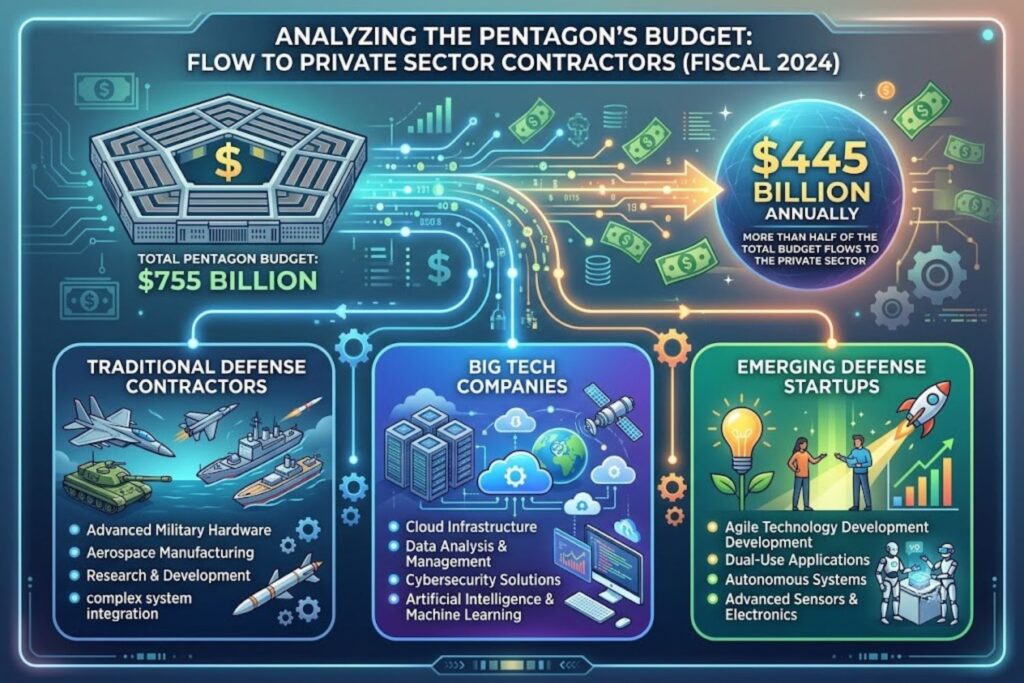
Here’s the stunning number: more than half of the government’s total contract obligations are with the private sector, reaching $445 billion out of $755 billion in fiscal 2024, according to data from the Government Accountability Office.
That’s not a small procurement. That’s a fundamental restructuring of how American military capability is built.
What changed? The Pentagon’s recognition that private technology companies possess capabilities that traditional defense contractors do not, particularly in areas like artificial intelligence, cloud computing.
Tesla’s Role in Pentagon Partnerships (and Why It’s Smaller Than You Think)
Tesla’s Cybertruck: Specifications and Military Applications
The Cybertruck has become famous—or infamous—for its unconventional design. But let’s look at why the Pentagon found it tactically useful.
Tesla unveiled this all-electric pickup in 2019 with a dramatic demo that (literally) broke the internet. Its design is distinctive: an unpainted stainless-steel “exoskeleton” with flat, angular panels gives it a futuristic appearance. Early models deliver over 300 miles of range and can tow more than 14,000 pounds – specs rivaling powerful diesel trucks.
From a military testing perspective:
- Real-world vehicle representation: Demonstrates how modern, armored, electronic-laden civilian vehicles might perform under weapons testing
- Material innovation: Stainless-steel exoskeleton and modern construction provide data on how new materials respond to impact
- Electronic systems: The Cybertruck’s advanced software and electrical systems represent a type of battlefield threat (drone-delivered vehicles, autonomous systems, etc.)
- Long-range capability: 300+ mile range mirrors emerging tactical scenarios
The Air Force isn’t acquiring Cybertrucks because they love Tesla. They’re acquiring them because the truck serves a specific testing purpose that helps validate weapons systems.
The $400 Million “Armored Tesla” Controversy: What Really Happened
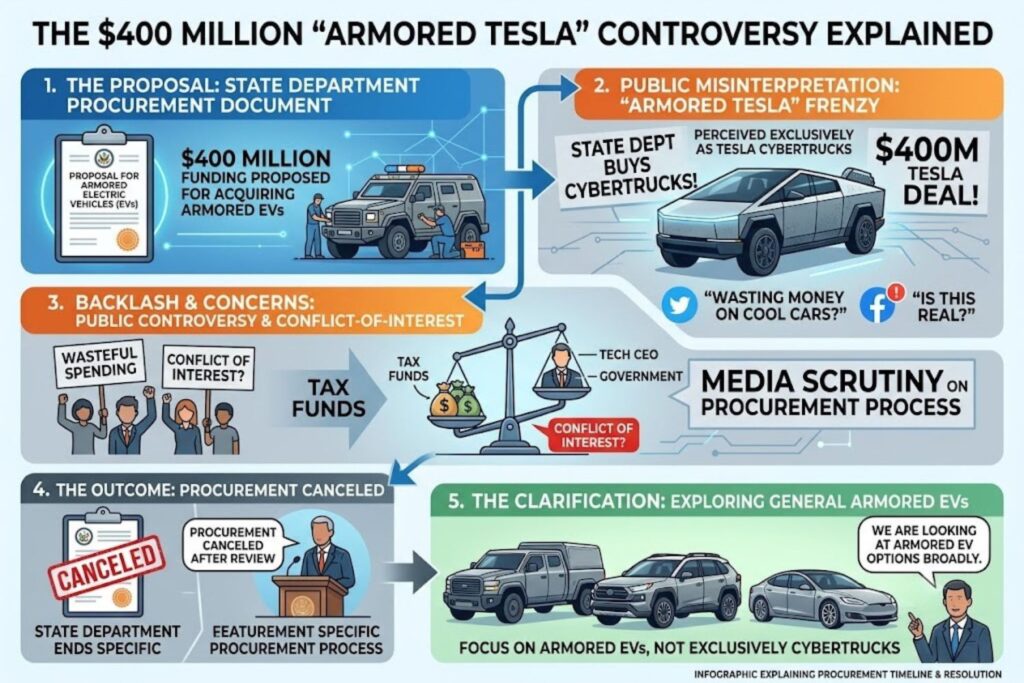
Now let’s address the elephant in the room: the $400 million contract.
In February 2025, the State Department’s procurement forecast for 2025 included a $400 million contract for “Armored Tesla (Production Units)”.
This set off alarms immediately. Elon Musk was serving as the head of the Department of Government Efficiency (DOGE), an advisory role in the Trump administration. Questions exploded: Was this a conflict of interest? Was Musk using his government position to secure contracts?
Musk, a “special government employee,” isn’t “gaining anything” from his White House position, Trump said in an interview with Fox News.
But here’s what actually happened next:
The State Department said Thursday it is abandoning plans of purchasing $400 million worth of armored Tesla vehicles after a public document detailing federal contracts for fiscal year 2025 gained wide attention.
Later clarifications revealed the document originated or was revised around late 2024. The State Department stated the specific “Tesla” reference was an error and emphasized it was exploring armored electric vehicles in general. The plan was placed on hold or canceled amid public scrutiny, with actual prior spending on EV research much smaller (under $500,000 for exploration).
The facts:
- The contract was proposed under the Biden administration
- The State Department claimed naming Tesla specifically was an error
- The procurement was for armored electric vehicles generally, not exclusively Cybertrucks
- The plan was canceled after public controversy
- No $400 million Tesla contract materialized
This illustrates an important point: the political controversy around Musk overshadowed the actual Pentagon-Big Tech story.
How Tesla Compares to Other Pentagon Partners
Here’s the reality check: Tesla’s involvement with the Pentagon is relatively minor compared to other Big Tech companies.
Musk’s companies have gotten $13 billion in federal government contracts over the last five years, according to the New York Times, mostly via his private aerospace and communications firm SpaceX.
The key word: SpaceX. Not Tesla.
Tesla’s defense work consists of:
- Two Cybertrucks for testing
- Exploration of armored EV procurement (canceled)
- Discussions about vehicle supply
SpaceX’s work includes:
- $22 billion+ in launch contracts
- Starlink satellite internet for military operations
- Emerging hypersonic weapons research
The comparison shows where the Pentagon’s actual investment is concentrated: space-based systems and advanced intelligence platforms, not electric vehicles.
The Real Pentagon-Big Tech Players: Who’s Actually Winning
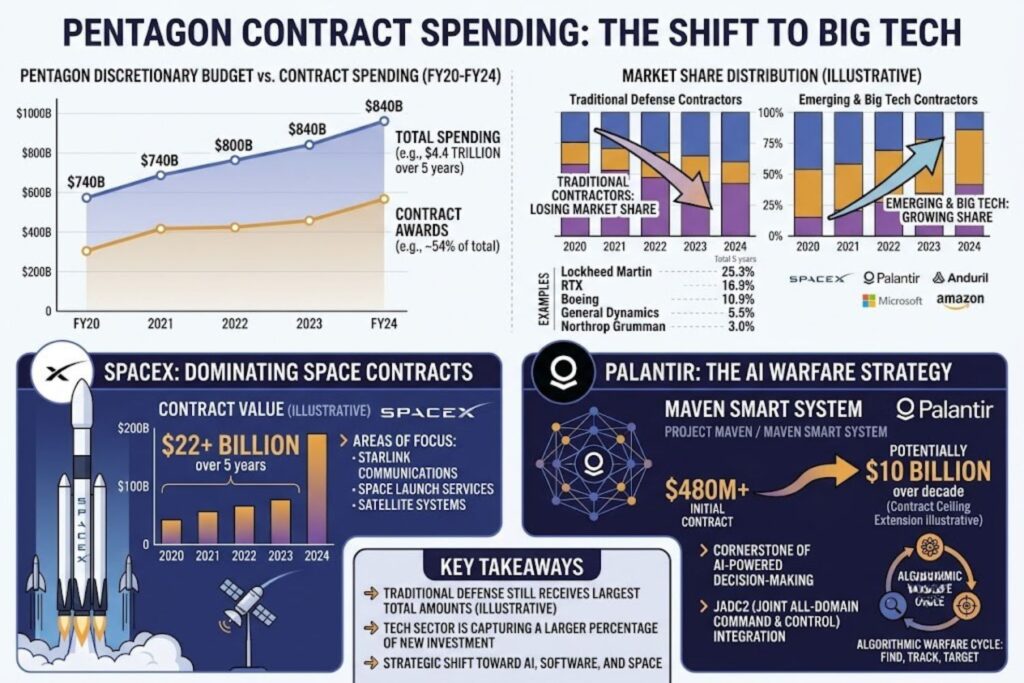
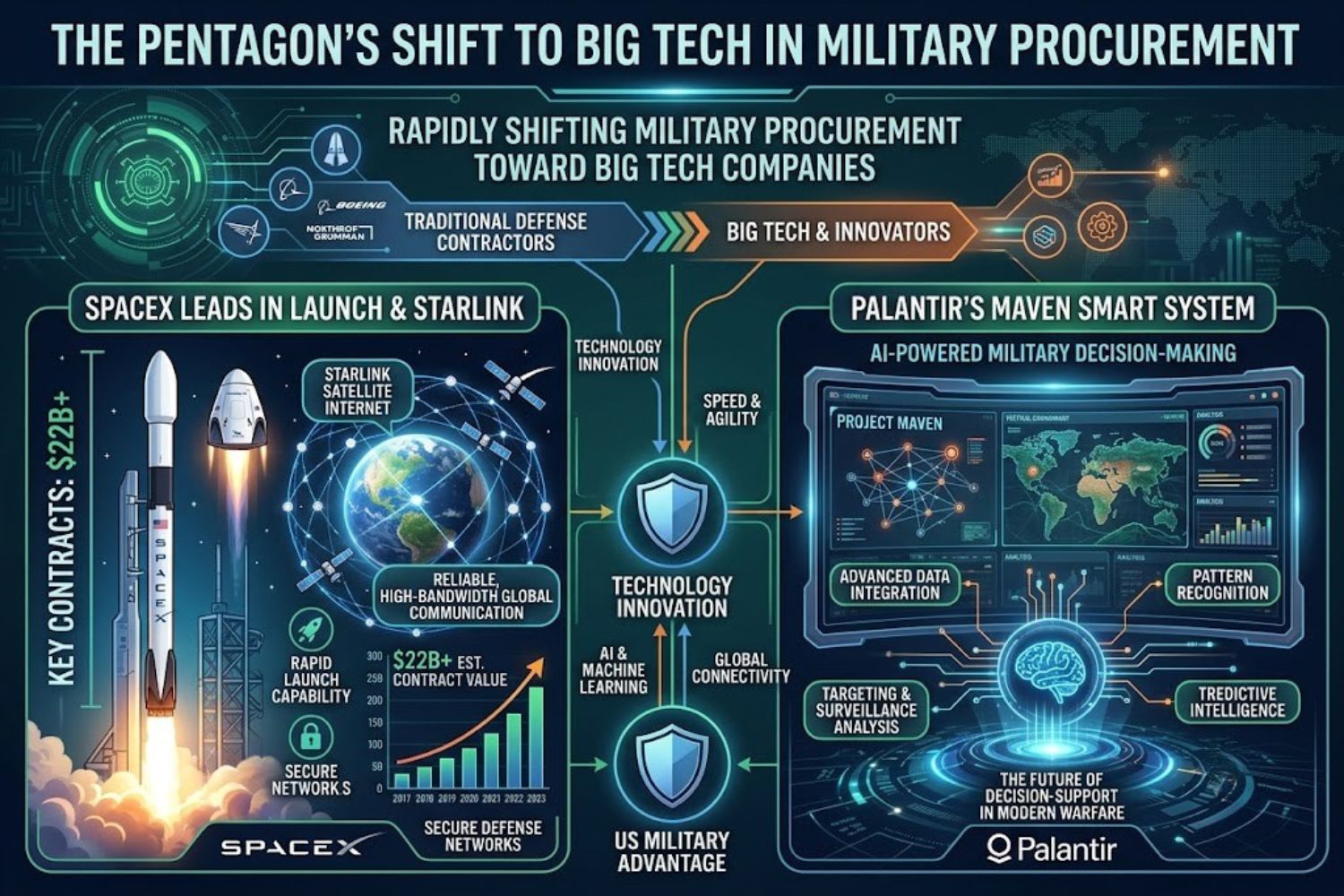
SpaceX & Starlink: The Pentagon’s Most Critical Tech Partner
SpaceX has secured $22 billion in launch deals with the Pentagon, while Starlink has been deployed to provide satellite-based connectivity for military operations in remote areas and in Ukraine.
Why Starlink matters:
During Russia’s 2022 invasion of Ukraine, the Pentagon made an unprecedented decision: they asked Musk to deploy Starlink terminals to provide Ukrainian forces with satellite-based internet connectivity.
This wasn’t theoretical. Starlink became operationally critical in real combat. Ukrainian forces used Starlink for communications, drone operations, and coordination—in environments where traditional military communications infrastructure was destroyed.
The result: the Pentagon learned firsthand that commercial satellite internet could be militarily decisive.
This moved Starlink from “interesting commercial tech” to “critical defense capability.”
Palantir: The Pentagon’s AI Warfare Platform
While SpaceX dominates launch services, Palantir dominates what matters most in modern warfare: intelligence.
Pentagon leaders opted to boost the existing contract ceiling for Palantir Technologies’ Maven Smart System by $795 million to prepare for what they expect will be a significant influx in demand from military users for the AI-powered software.
What is Maven Smart System?
The company won a $480 million U.S. Department of Defense contract in 2024 to develop the Maven Smart System, an AI platform designed to integrate satellite imagery, drone feeds and battlefield intelligence into targeting and decision-making systems.
This is extraordinary. Maven takes:
- Satellite imagery
- Drone video feeds
- Intelligence reports
- Battlefield data
And uses AI to create a unified, real-time intelligence picture that military commanders use for targeting and tactical decisions.
That program has since expanded significantly. The U.S. Army added a $795 million contract modification in 2025, and the broader framework agreement with the Army could be worth up to $10 billion over the next decade.
Palantir’s position is more strategically important than Tesla’s.
OpenAI, Google, Microsoft, AWS: The AI Defense Consortium
The Pentagon recognized it needs AI to compete. In response, it formed a direct partnership with the industry’s leading AI companies.
The Department of Defense announced Friday an agreement with eight major technology companies to use their artificial intelligence tools in its classified networks. The companies involved in the deal: Elon Musk’s SpaceX, ChatGPT-maker OpenAI, Google, Microsoft, Nvidia, Amazon Web Services, Oracle and Reflection.
This is a consortium approach: the Pentagon isn’t betting on one company. It’s integrating multiple AI platforms, cloud providers, and technology companies into its classified defense networks.
The strategic logic: redundancy, capability diversity, and access to cutting-edge AI.
Why These Companies, Not Traditional Defense Contractors?
The traditional defense contractors have struggled with:
Innovation speed: They developed weapons systems over 10-15 year cycles. Modern AI and cloud technology evolve in months.
Talent: The best AI researchers work at OpenAI, Google, and DeepSeek—not Lockheed Martin. Defense contractors couldn’t compete for talent.
Infrastructure: AWS, Azure, and Google Cloud have built world-class cloud infrastructure. Building equivalent systems in-house would take years and billions.
Adaptability: Tech companies are designed for rapid iteration. Defense contractors optimize for stable, long-term programs.
Companies like SpaceX, Palantir, and Anduril have been tapped for multi-billion-dollar contract awards from the Pentagon for communications, targeting, unpiloted vehicles, anti-drone defenses, and hypersonic weapons. Companies like SpaceX, Palantir, and Anduril have been tapped for multi-billion-dollar contract awards from the Pentagon for communications, targeting, unpiloted vehicles.
Why Traditional Defense Contractors Are Being Disrupted
The Innovation Gap: Big Five vs. Big Tech
The simplest explanation: the Big Five defense contractors optimized for the Cold War.
They built:
- Long-development-cycle fighter jets (F-35, 20+ years)
- Aircraft carriers (10+ year programs)
- Missiles (5-10 year development)
- Submarines (15+ year programs)
These take decades because military procurement is risk-averse. You’re committing to a design that might be in service for 40 years.
Big Tech companies optimized for something different: rapid iteration in competitive markets.
When you have 2 billion users and a competitor can ship a new feature in weeks, you learn to move fast.
This speed advantage is now more valuable to the Pentagon than size.
The Real Money: Contract Breakdown
Let’s look at concrete numbers:
SpaceX: $22+ billion in Pentagon contracts
Palantir: $480 million initial Maven contract, potentially $10 billion+ over decade
Microsoft: Billions in cloud and AI contracts with DoD
Amazon AWS: Billions in cloud services for defense
OpenAI: Growing AI contracts with Pentagon
Google: Cloud and AI services to DoD
Traditional Big Five combined: Still have the largest contract base, but losing share to Big Tech
The shift isn’t complete, but the direction is clear: modern warfare requires AI, satellites, and cloud computing more than it requires advanced fighter jets.
The Commercial-to-Military Technology Pipeline
How Consumer Products Become Military Assets
This is perhaps the most important dynamic most people miss.
The Cybertruck didn’t start as a military vehicle. It started as a commercial consumer product.
But once the Pentagon identified a useful military application, it acquired the product.
This pattern is accelerating:
- Starlink: Consumer satellite internet → Military strategic asset
- OpenAI GPT models: Consumer chatbots → Military AI applications
- Drone technology: Commercial drones → Military autonomous systems
- Cloud computing: Commercial AWS/Azure → Classified DoD networks
The logic:
- Big Tech companies develop consumer products in competitive markets
- These products mature and become reliable
- Military planners identify defense applications
- Pentagon contracts for military versions or adaptations
- Originally commercial technology now operates in classified environments
Starlink in Ukraine: The Turning Point
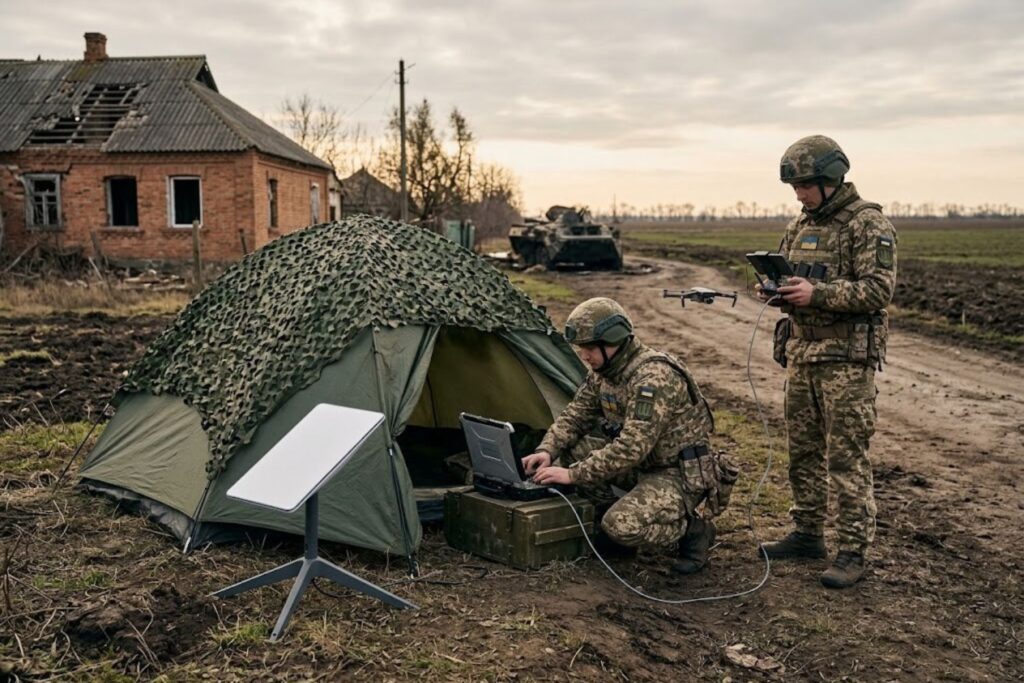
Starlink, SpaceX’s satellite internet constellation, became operationally significant in a way nobody fully anticipated when the US government helped provide Starlink terminals to Ukraine following Russia’s 2022 invasion.
What happened in Ukraine wasn’t theoretical. It was battlefield-tested proof that:
- Commercial satellite internet could survive modern warfare
- It enabled military communications when terrestrial networks were destroyed
- It could be integrated into tactical operations
- It provided genuine operational advantage
This single deployment moved Starlink from “commercial tech with military potential” to “critical defense asset.”
And it opened the Pentagon’s eyes to the broader opportunity: consumer technology can be battlefield-ready.
The Deeper Strategy: Pentagon’s AI and Space Dominance Plan
The Cybertruck procurement, the $400 million contract, the Palantir deals—these aren’t random.
They’re pieces of a larger strategy.
Maven Smart System: AI-Powered Targeting
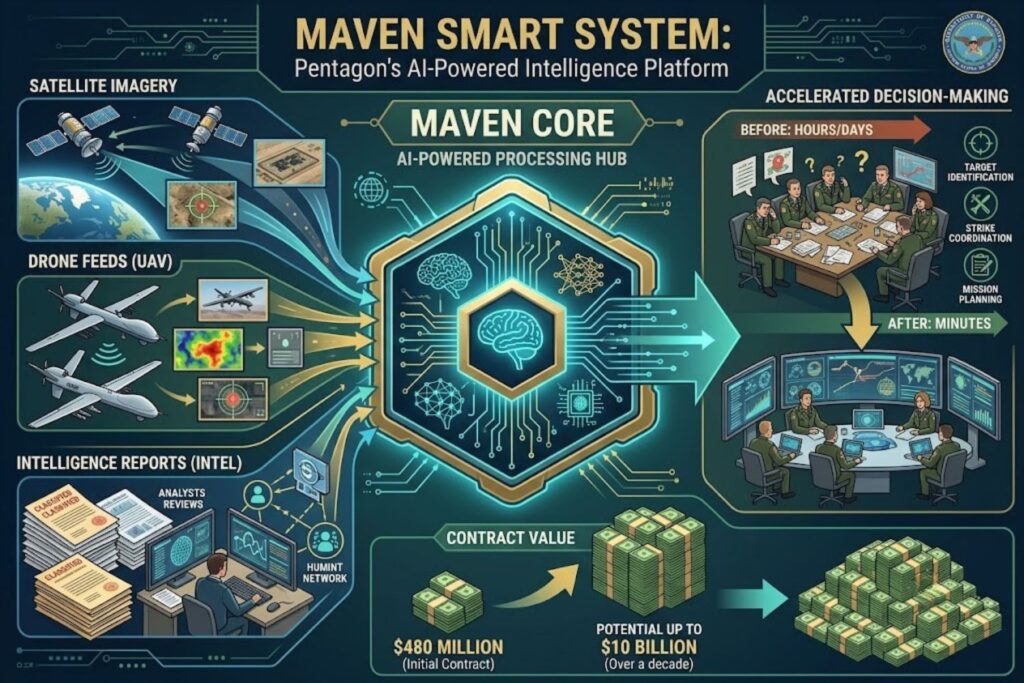
The Pentagon isn’t just buying technology. It’s building an AI-powered decision-making infrastructure.
Maven Smart System integrates:
- Real-time satellite imagery
- Drone feeds
- Intelligence reports
- Historical data
And provides commanders with AI-assisted targeting and tactical recommendations.
This is the future of warfare the Pentagon is building: less human decision-making about where to target, more AI-assisted decision-making with human oversight.
Satellite Internet: Communication Resilience
Starlink isn’t just communications. It’s strategic redundancy.
Adversaries—China, Russia—can target traditional military communications infrastructure. Satellite internet creates a backup: if ground-based systems fail, Starlink maintains connectivity.
This is why the Pentagon is investing billions.
Defense-Tech Consortiums
Most importantly, the Pentagon is forming partnerships between competing Big Tech companies.
Palantir and Anduril are talking to tech companies including SpaceX, OpenAI, Saronic, and Scale AI about forming a consortium to bid on Pentagon contracts.
Why would competitors work together?
Because Pentagon contracts are so large and complex that no single company can deliver.
This consortium approach is reshaping the entire defense industry structure.
Political Connections and the Defense-Silicon Valley Merger
Elon Musk’s Multi-Billion Dollar Empire and Political Influence
Elon Musk isn’t just a tech entrepreneur. He’s an architect of the Pentagon-Big Tech merger.
Tesla and SpaceX have been awarded some $230 million worth in contracts so far in 2025, on top of billions claimed over the past several years.
These aren’t small contracts. SpaceX’s $22 billion in Pentagon deals over five years makes Musk one of the most significant defense contractors in America.
And Musk’s influence extends beyond contracts.
Peter Thiel and the Venture Capital Defense Complex
Beyond Musk, there’s Palantir co-founder Peter Thiel — also a major investor in Anduril and SpaceX. He has long supported the president and backed Vance’s earlier Senate run in Ohio after employing him as a venture capitalist.
Thiel represents a broader pattern: venture capital founders with deep political ties are directly shaping the Pentagon’s technology partnerships.
This isn’t corruption in the traditional sense. It’s the Pentagon’s acknowledged strategy: recruit talented tech entrepreneurs to modernize military capability.
But it does create concentration of power and influence that raises legitimate questions.
The Trump Administration Acceleration
SpaceX’s Elon Musk was one of the biggest donors to the Trump campaign in 2024, donating nearly US$277 million to support Donald Trump’s 2024 presidential campaign and other Republican candidates.
The 2024-2025 transition accelerated Pentagon-Big Tech partnerships.
Not because of corruption, but because the Trump administration explicitly favors Silicon Valley founders over traditional defense establishment.
The Cybertruck Controversy: Separating Fact from Speculation
Timeline: The $400 Million “Armored Tesla” Contract
- Late 2024: State Department begins exploring armored electric vehicle procurement
- February 2025: Procurement documents leak, showing “$400 million Armored Tesla (Production Units)”
- February 13, 2025: News outlets report Pentagon planning massive Cybertruck purchase
- February 13, 2025 (evening): State Department removes “Tesla” reference, replaces with “Armored Electric Vehicles”
- February 14, 2025: Elon Musk denies the deal
- February 14, 2025: State Department confirms the procurement was abandoned
What Actually Happened
The controversy had more to do with optics and conflict of interest concerns than actual Pentagon strategy.
The State Department said in a written statement that the idea originated with the Biden administration and that, when it was active, the contract would have been open to any electric carmaker.
The facts:
- This was not a Pentagon/Air Force initiative (it was State Department)
- The procurement was for general armored EVs, not specifically Cybertrucks
- The plan was relatively modest compared to Pentagon-Big Tech spending elsewhere
- It was canceled due to political controversy, not strategic issues
Why the Confusion?
The confusion arose because:
- Elon Musk had high visibility as Trump administration advisor
- The timing was sensitive (Musk was heading DOGE, an efficiency agency)
- Media coverage sensationalized “$400 million Cybertruck fleet”
- The actual story (modest EV procurement) wasn’t as interesting
Pentagon-Big Tech Impact on the Defense Industry
Consolidation Trends: The Collapse of Competition
The more than 50 major defense contractors that existed in 1993 has narrowed to just a handful today.
This consolidation created stagnation. When you go from 50 competitors to 6, innovation drops.
Now Big Tech companies are entering the market, and the Big Five are scrambling.
Where the Real Money Is
The largest Pentagon contracts in 2025:
- SpaceX: $22+ billion (over 5 years) in launch and satellite services
- Palantir: $480 million (Maven), potentially $10 billion (decade)
- Microsoft/AWS: Billions in cloud services
- Lockheed Martin: Still the largest traditional contractor, but now competing with Big Tech
New Entrants Disrupting the Market
More than $7.1 billion in venture capital has been raised by defense-related US startups since the start of 2023, according to PitchBook, more than the prior nine years combined. DefenseScoop
The Pentagon-Big Tech shift is attracting venture capital into defense. Startups like Anduril, Saronic, and Shield AI are raising billions to develop autonomous systems, AI, and advanced robotics.
This is the new arms race in America’s defense industrial base.
The Military Applications: What Can the Pentagon Actually Do?
AI-Powered Targeting Systems
Maven Smart System represents the future: automated intelligence analysis that accelerates decision-making from hours to minutes.
Global Satellite Connectivity
Starlink provides secure, resilient communications anywhere on Earth. This enables operations in denied environments where traditional military communications can’t operate.
Autonomous Vehicles and Robotics
Big Tech companies are developing autonomous systems. Anduril is building an unmanned fighter jet. These systems require massive AI capabilities.
Cyber Warfare and Intelligence Analysis
Palantir’s platform gives military intelligence agencies capabilities to detect patterns in massive datasets—the essence of modern intelligence.
Real-Time Decision-Making
Instead of human analysts taking hours to identify targets, AI systems identify them in minutes. Humans retain decision authority but operate at accelerated pace.
Controversies, Risks, and Questions
Ethical Concerns: Private Companies and Military Operations
Should private companies build military targeting systems? Intelligence platforms? Autonomous weapons?
These are legitimate questions without easy answers.
Security Vulnerabilities
Relying on commercial cloud infrastructure (AWS, Azure) for classified military operations creates dependency and potential vulnerabilities.
Regulatory Gaps
There’s no clear regulatory framework governing Big Tech’s role in military operations. Guidelines are emerging, but they’re not mature.
Long-Term Risk
What happens if a tech company loses government contracts or decides to stop doing defense work? Alternatively, what happens if a tech company gains too much influence over military decisions?
Future Trajectory: Where Is This Heading?
Expected Growth (2025-2030)
Pentagon-Big Tech spending is expected to accelerate. Estimates suggest AI defense contracts alone could reach $50+ billion annually by 2030.
Emerging Technology Areas
- Hypersonic weapons: Requires advanced computational modeling; Big Tech companies are leading
- Autonomous systems: Self-driving military vehicles, drones, robots
- Quantum computing: Defense agencies are investing in quantum research
- Extended reality: AR/VR for military training and operations
International Competition
China and Russia are pursuing similar Pentagon-Big Tech convergence strategies. China’s AI development is advancing rapidly. This accelerates the U.S. Pentagon’s urgency to partner with American Big Tech.
Key Takeaways
The Pentagon-Big Tech convergence is real and fundamental.
It’s not about the Cybertruck. It’s about how America builds military power in an AI-dominated, satellite-connected world.
The money is substantial: $445 billion annually flowing to private sector contractors.
The shift is accelerating: Big Tech companies are winning larger contracts than traditional defense contractors.
The implications are strategic: This represents a generational shift in how America’s military capability is built.
Controversies are real but often misunderstood: The $400 million Tesla deal was smaller and less significant than coverage suggested.
Palantir and SpaceX matter more than Tesla: The real Pentagon-Big Tech partnerships involve AI and satellite companies, not electric vehicles.
This is just the beginning: Over the next decade, expect Pentagon-Big Tech partnerships to deepen and expand.
FAQ: Pentagon, Big Tech, Tesla & Cybertruck
1. Did the Pentagon actually buy Cybertrucks?
The U.S. Air Force acquired two Cybertrucks for missile-testing purposes at White Sands Missile Range. This was a small procurement for testing, not a fleet purchase.
2. What was the $400 million “Armored Tesla” contract?
A State Department procurement proposal for armored electric vehicles. The contract mentioned “Tesla” specifically but was abandoned after public controversy. The plan was relatively modest compared to other Pentagon-Big Tech spending.
3. How much has SpaceX earned from Pentagon contracts?
SpaceX has secured $22+ billion in Department of Defense contracts over five years, primarily through launch services and Starlink deployments.
4. What is Maven Smart System?
An AI platform developed by Palantir that integrates satellite imagery, drone feeds, and intelligence reports into a unified system for military decision-making. The initial contract was $480 million, with potential expansion to $10 billion over a decade.
5. Why is the Pentagon partnering with Big Tech instead of traditional defense contractors?
Big Tech companies offer capabilities (AI, cloud computing, rapid iteration) that traditional defense contractors developed slowly. Pentagon leadership concluded it needs technology companies’ innovation speed and expertise to remain competitive.
6. Is there a conflict of interest with Elon Musk?
Musk’s role as an advisor to the Trump administration created questions about conflicts of interest. However, SpaceX’s Pentagon contracts originated long before his 2025 advisory role. The $400 million Cybertruck proposal was canceled specifically to address conflict of interest concerns.
7. How much of the Pentagon budget goes to Big Tech companies?
Over $445 billion of the Pentagon’s $755 billion budget (fiscal 2024) goes to private sector contractors. Big Tech’s share is growing but traditional defense contractors still receive the largest portion.
8. Which Big Tech companies have the most Pentagon contracts?
SpaceX leads with $22+ billion over five years. Palantir has $480 million+ in active contracts (Maven). Microsoft, Amazon, Google, and OpenAI have significant AI and cloud contracts.
9. What happened to Starlink after Ukraine?
Starlink’s operational success in Ukraine demonstrated to the Pentagon that commercial satellite internet could be militarily decisive. This elevated Starlink from “commercial tech” to “strategic defense asset” in Pentagon planning.
10. Are there regulations governing Big Tech military partnerships?
There’s no comprehensive regulatory framework. Guidelines are emerging but remain immature. This creates both risk and opportunity for companies entering the defense sector.
11. Could Big Tech companies refuse to work with the Pentagon?
Yes. OpenAI initially refused some defense work. Companies can choose whether to accept Pentagon contracts, but political pressure discourages refusal.
12. What is the Pentagon’s strategy for AI in military operations?
The Pentagon is integrating AI into intelligence analysis, targeting, and real-time decision-making. Maven Smart System exemplifies this. The goal is accelerated decision-making while maintaining human control over targeting decisions.
13. How does this affect traditional defense contractors like Lockheed Martin?
Traditional contractors face pressure to innovate faster and often partner with Big Tech companies. Some are acquiring startups; others are shifting toward system integration rather than manufacturing.
14. What could go wrong with Pentagon-Big Tech partnerships?
Potential risks include over-dependency on commercial infrastructure, security vulnerabilities, regulatory gaps, ethical concerns about private companies in military operations, and concentration of power.
15. Where is this heading in the next decade?
Pentagon-Big Tech spending is expected to accelerate. Estimates suggest AI defense contracts alone could exceed $50 billion annually by 2030. New areas like autonomous systems and hypersonic weapons will drive further Big Tech involvement.