The search results cluster it alongside actual automation software—Zapier, Make, n8n—as if it were just another tool competing for your budget. It shows up in automation platform comparisons. Vendors reference it. Business blogs discuss it. But here’s what most articles get wrong: Droven.io isn’t software at all.
This distinction isn’t pedantic. It’s foundational. And it completely changes how you should think about using it.
Droven.io was built to solve a problem that anyone who has tried to research AI adoption will recognize immediately: the gap between what AI vendors say about their products and what businesses actually need to know before adopting them is enormous. Vendor documentation is promotional. Technical research papers assume computer science expertise. News outlets chase announcements. Droven.io occupies the space between these extremes—reading dense reports and translating findings into plain language without losing the substance that makes information actionable.
This is what separates it from everything else talking about automation.
This comprehensive guide cuts through the noise. You’ll understand exactly what Droven.io is, who should be using it, and how to integrate it into a real business transformation strategy. More importantly, you’ll learn what competitors consistently miss—the implementation frameworks, cost analysis, common failure patterns, and decision-making guidance that separate successful automation deployments from expensive mistakes.
What Droven.io Actually Is (And What It Isn’t)
The Distinction That Matters
Droven.io publishes structured, research-backed educational content on artificial intelligence, automation, machine learning, cloud computing, and cybersecurity—without selling software, offering certifications, or maintaining affiliate relationships with the vendors it covers.
This is the core distinction that everything else depends on.
Droven.io isn’t a SaaS platform you deploy. You don’t install it, configure workflows, or pay per user. Droven.io is a free, editorially independent AI and technology knowledge platform that publishes educational content designed to help professionals, business owners, and learners understand emerging technology before committing to purchases, implementations, or hiring.
Think of it this way: Think of Droven.io as a trusted technology analyst, not a product marketplace. You hire a consultant to understand your market before making decisions. Droven.io serves that same function for AI and automation.
The platform operates from genuine editorial independence. It covers machine learning, workflow automation, RPA, cloud computing, cybersecurity, and digital transformation—without a sales agenda attached to any of it. That independence is rarer than it sounds. Most AI research online is either vendor-funded, affiliate-driven, or sponsored by the companies it claims to review objectively.
Droven.io doesn’t operate that way.
Why This Distinction Matters for Your Decision-Making
The confusion between “knowledge platform” and “automation software” creates a critical problem for businesses considering AI adoption.
When executives search for automation solutions, they’re typically asking: “What software should we buy?” The presence of Droven.io in those results tempts the wrong conclusion—that it’s a tool competing for the same buyer decision.
It’s not.
The real value is different. Droven.io exists to answer the question that comes before the tool selection: “What do we actually need to accomplish, and how do we structure our thinking about this category before we spend money on tools?”
This matters because tool selection without proper foundational understanding drives most automation failures. Organizations jump to implementation without understanding their process requirements, data readiness, team capabilities, or realistic timelines. The software doesn’t fail. The strategy fails. The distinction between a knowledge platform and a software tool reflects the difference between understanding your problem and buying something that claims to solve it.
Why Businesses Are Adopting Droven.io in 2026
The AI Implementation Knowledge Gap
The AI and automation space in 2026 moves fast. Tool capabilities evolve weekly. Market consolidation happens constantly. New approaches emerge regularly. According to recent projections, the global AI automation market is projected to reach $407 billion by 2027, growing at an accelerating pace.
But the knowledge base for actually deploying these technologies at a business level hasn’t kept pace.
Vendors sell. Researchers publish papers for other researchers. News outlets report launches. What’s missing is the middle layer—practical explanations of what different automation categories actually do, where they excel, where they fall short, and what conditions determine success or failure in a specific business context.
This gap creates expensive problems. Companies purchase tools without understanding whether they solve the right problem. Implementation stalls because the foundational architecture was never designed. Teams struggle because they lack the conceptual frameworks for working with AI systems. Projects fail not because the technology is immature, but because the business wasn’t ready.
Droven.io addresses this directly. Droven.io explains AI concepts, tools, adoption paths, and business use cases in language that non-specialists can follow. The platform bridges vendor marketing, technical depth, and business-level decision making.
Cost Savings Before Software Purchases
The most underestimated benefit of platforms like Droven.io isn’t what it explains—it’s what it prevents.
When organizations gain clarity on automation categories, tool capabilities, and integration requirements before buying, they make fundamentally different purchasing decisions. According to Exotica IT Solutions, businesses deploying the right AI automation stack reduce operational costs by 30–60% within the first 90 days of production deployment.
But this only happens when the right tool is selected for the right problem.
Organizations that approach automation without foundational knowledge frequently purchase over-engineered solutions for simple problems. They buy enterprise platforms when lightweight tools would suffice. They invest in automation categories that don’t address their actual bottlenecks. They underestimate the data preparation and integration work required.
The knowledge investment—understanding what you actually need before you buy—typically pays for itself within weeks.
Avoiding the Top 5 AI Automation Failures
Studies consistently show that organizations fail at automation for similar reasons:
- Wrong problem selected – Automating non-critical processes while leaving bottlenecks untouched
- Data unprepared – Assuming clean data exists when significant preparation is needed
- Architecture insufficient – Building point solutions instead of integrated workflows
- Team capability gaps – Lacking the skills to deploy, maintain, or optimize the solution
- Change management neglected – Deploying technology without managing human adaptation
The most common mistake we see from businesses researching droven io ai automation tools is treating tool selection as the primary decision. It isn’t. Integration architecture and process design determine outcomes—the tool is a vehicle, not the driver.
Droven.io’s value is teaching organizations how to avoid these patterns before spending money on tools and implementation.
Core Topics Droven.io Covers
AI & Machine Learning Fundamentals
Droven IO covers machine learning, cybersecurity, cloud computing, AI for business, IT career development, robotics, and quantum computing. The platform breaks down ML concepts in accessible language without oversimplifying the technical realities.
This matters because businesses increasingly face machine learning applications—recommendation systems, predictive analytics, anomaly detection, demand forecasting. Understanding ML basics informs realistic expectations about what these systems can accomplish and what they require.
Workflow Automation & RPA
The platform covers workflow automation, no-code and low-code automation, repetitive task reduction, and operational efficiency. This is the category most organizations immediately connect with automation—connecting systems, triggering actions, eliminating manual handoffs. Tonic Of Tech
Droven.io explains the distinctions between workflow automation platforms (like n8n or Make), traditional RPA tools, and AI-enhanced automation systems. These categories have different strengths, cost profiles, and implementation requirements.
Cloud Computing & Infrastructure
Modern automation doesn’t exist in isolation. It requires cloud infrastructure, data storage, and integration layers. Droven.io covers cloud platforms, infrastructure decisions, and how to design systems that scale.
Cybersecurity & Data Protection
Every automation introduces security considerations. The platform covers security practices, threat awareness, and data protection. As systems become more automated, security architecture becomes more critical.
Digital Transformation Strategies
Automation isn’t just about tools. Droven.io also touches on how modern teams can use it before making technology decisions, covering practical AI skills, automation roles, and technology paths. This broader perspective recognizes that successful automation requires organizational change, not just technical deployment.
Who Should Use Droven.io (And Who Shouldn’t)
Ideal Users & Use Cases
Droven.io is most valuable for:
Business leaders evaluating whether to pursue automation—need to understand categories, realistic ROI, and implementation requirements before committing budget.
Operations managers tasked with identifying automation opportunities—need to understand how different tools address different process types.
Technical teams planning implementations—need architectural guidance and best practices from sources without a product bias.
Developers and engineers building custom solutions—need to understand the landscape of existing tools before building from scratch.
Career-focused professionals entering AI and automation fields—need accessible explanations of foundational concepts and career paths.
Startup founders building products in these spaces—need to understand the market, user needs, and existing solution categories.
Prerequisites for Success
Droven.io creates value when you approach it with clear intention:
- You have specific problems in mind—Not just vague interest in “using AI” or “getting into automation”
- You’re willing to invest time in learning—Value requires engagement, not passive consumption
- You plan to implement based on what you learn—Knowledge without action wastes the investment
- Your organization has implementation capacity—Understanding what to do requires ability to execute
Red Flags That Suggest You’re Not Ready
Some organizations approach automation platforms before they’re ready. Droven.io won’t solve these problems:
- Zero process clarity—If you can’t describe current workflows, automation won’t help yet
- No executive alignment—If leadership doesn’t support change, implementation will fail
- Data disaster—If your data infrastructure is fundamentally broken, fixing that comes before automation
- Budget constraints—Automation requires investment in tools, implementation, and team development
- Resistance to change—If your culture resists new technology, adoption will fail regardless of platform quality
The Complete Implementation Framework
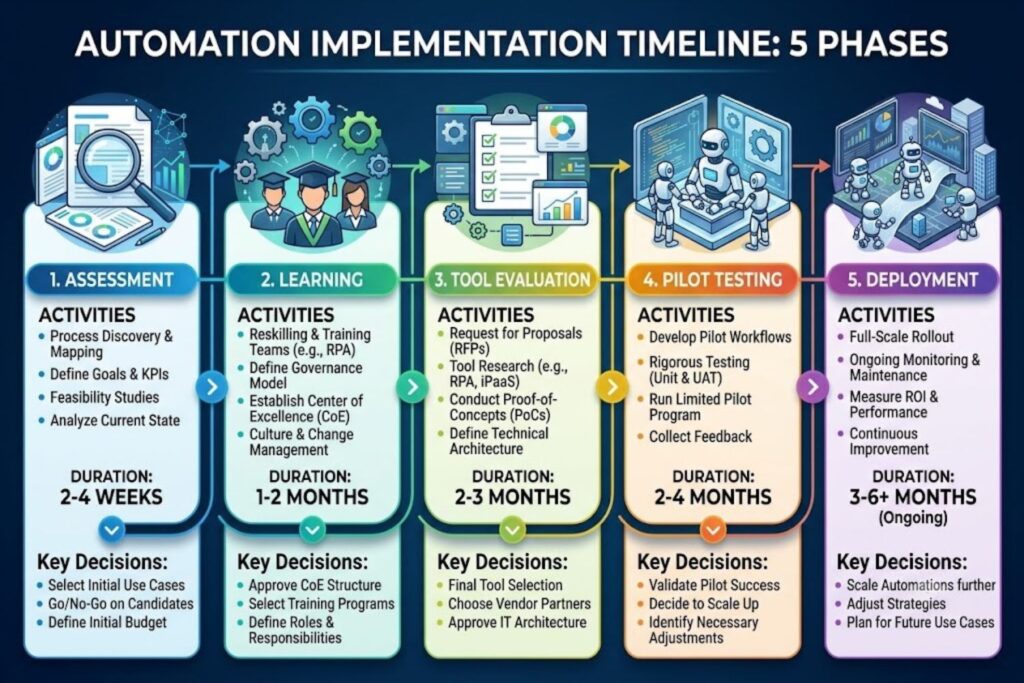
Successful automation deployments follow a structured progression. This framework is derived from analyzing successful and failed implementations across industries.
Phase 1 – Assessment (Weeks 1–2)
Objective: Understand current state, identify automation opportunities, assess organizational readiness.
Activities:
- Document current processes end-to-end
- Identify bottlenecks, manual handoffs, and error points
- Calculate time and cost impact of current inefficiencies
- Assess data availability and quality
- Evaluate team technical capability
- Define realistic success metrics
Key Questions:
- What specific processes cost the most time and money?
- Where do manual handoffs create delays or errors?
- What data do we have access to, and in what condition?
- What technical skills exist on our team currently?
Droven.io Application: Use the platform’s process-mapping resources to standardize how you document current workflows. This creates the baseline against which automation ROI will be measured.
Phase 2 – Learning & Planning (Weeks 3–4)
Objective: Build team knowledge, define automation strategy, establish implementation roadmap.
Activities:
- Conduct team training on automation fundamentals
- Review Droven.io’s coverage of relevant tool categories
- Develop automation strategy aligned to business priorities
- Identify pilot projects (quick wins, lower risk)
- Define team roles and skill requirements
- Create implementation timeline
Key Questions:
- Which processes should we automate first?
- What tools are best suited to our architecture?
- What skills do we need to develop or hire?
- What’s our realistic timeline?
Droven.io Application: Use the platform to educate your team about automation categories, capabilities, and limitations. This knowledge sharing prevents false expectations and accelerates decision-making.
Phase 3 – Tool Evaluation (Weeks 5–8)
Objective: Select specific tools, evaluate vendors, plan integrations.
Activities:
- Create detailed tool selection criteria
- Evaluate tools against your specific requirements
- Request demos and trial access
- Assess integration requirements
- Calculate tool costs and licensing models
- Reference existing implementations at similar organizations
Key Questions:
- Does this tool solve our specific problem?
- What’s the total cost of ownership?
- Can it integrate with our existing systems?
- What support and documentation are available?
- What’s the learning curve for our team?
Droven.io Application: Use vendor-neutral analysis to understand tool categories and their strengths/weaknesses. This prevents being oversold on features you don’t need while identifying gaps in vendor claims.
Phase 4 – Pilot & Testing (Weeks 9–12)
Objective: Prove concept, identify issues, refine approach.
Activities:
- Deploy solution to controlled environment
- Conduct user acceptance testing
- Document issues and required adjustments
- Calculate actual ROI from pilot
- Train pilot users
- Gather feedback for refinement
Key Questions:
- Does the tool work as represented?
- What issues emerged in practice?
- What’s the actual ROI compared to projections?
- What training is required?
- What process adjustments are needed?
Droven.io Application: Reference best practices for pilot design and change management. Understanding common pilot pitfalls prevents expensive mistakes before full deployment.
Phase 5 – Full Deployment (Weeks 13+)
Objective: Scale solution, optimize performance, establish ongoing management.
Activities:
- Deploy to production
- Conduct full team training
- Establish performance monitoring
- Create documentation and runbooks
- Define escalation procedures
- Plan for optimization and iteration
Key Questions:
- Are all systems functioning as designed?
- Is the team comfortable with the solution?
- What ongoing support is required?
- How will we identify optimization opportunities?
Droven.io Application: Use the platform for continued learning and optimization. Automation is not a one-time deployment—it requires ongoing attention and evolution.
Real ROI & Cost-Benefit Analysis
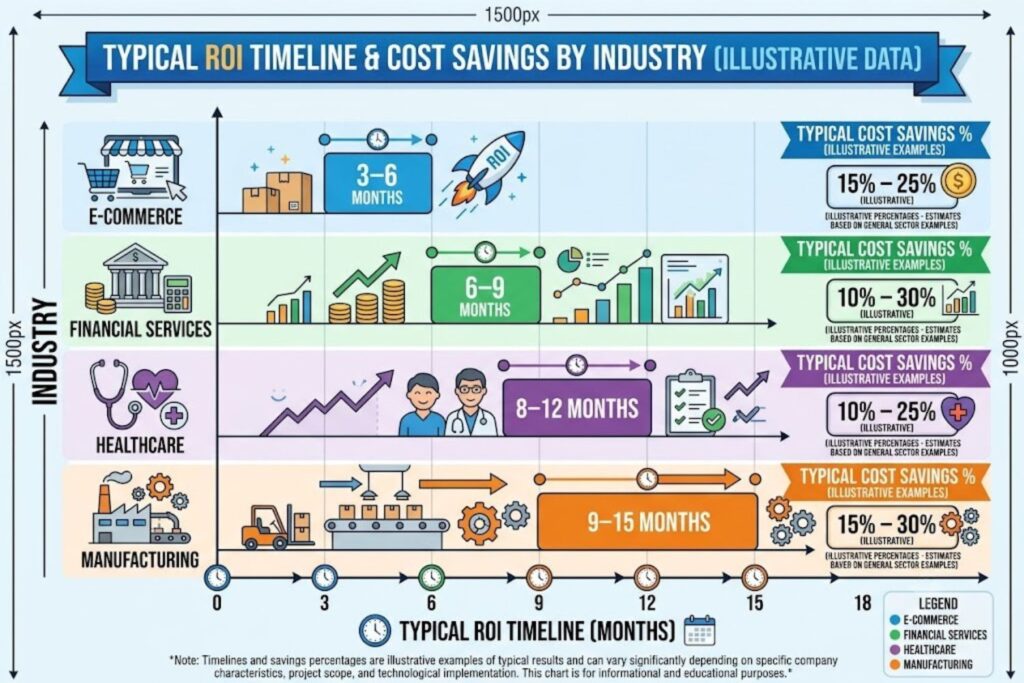
Automation investments must pay for themselves. Here’s how to calculate realistic returns.
Typical Cost Savings by Industry
Financial Services: 35–50% reduction in back-office labor costs. Processing loans, account reconciliation, and fraud detection are prime automation candidates. Timeline to ROI: 6–9 months.
Healthcare Administration: 30–45% reduction in administrative staff time. Claims processing, appointment scheduling, and patient communication are highly automatable. Timeline to ROI: 4–8 months.
E-Commerce & Retail: 40–55% reduction in order processing and customer service labor. Inventory management, order routing, and customer inquiries automate effectively. Timeline to ROI: 3–6 months.
Manufacturing: 25–40% reduction in production planning and administrative overhead. Predictive maintenance and production scheduling improve both efficiency and quality. Timeline to ROI: 8–12 months.
Utilities & Infrastructure: 20–35% reduction in field operations labor. Work order management, customer communication, and billing processes streamline significantly. Timeline to ROI: 9–15 months.
Hidden Costs Most Businesses Overlook
Automation investments involve more than tool licensing:
Implementation labor: Custom configuration, integration building, and testing typically cost 3–5x the software licensing cost.
Team training: Bringing staff up to speed on new systems takes time and potentially requires temporary productivity decreases during transition.
Data preparation: Cleaning and structuring data for automation often represents 20–30% of total project cost.
Integration infrastructure: APIs, middleware, and data pipeline construction may require additional tools and services.
Ongoing maintenance: Updated configurations, troubleshooting, and optimization require ongoing investment.
Change management: Supporting teams through workflow changes and helping them adapt to new processes takes time and resources.
Most organizations underestimate these costs by 40–60%, creating budget surprises and project delays.
ROI Timeline & Realistic Expectations
Quick-win automation (simple, contained processes) typically shows ROI within 2–4 months.
Medium-complexity automation (multi-system integration, moderate data preparation) typically shows ROI within 6–9 months.
Complex enterprise automation (heavy integration, data-intensive, organizational change required) typically shows ROI within 12–18 months.
The most important metric isn’t speed to ROI—it’s accurate projection. Organizations that forecast realistically outperform those that chase quick wins at the expense of strategic thinking.
Common Implementation Mistakes (And How to Avoid Them)
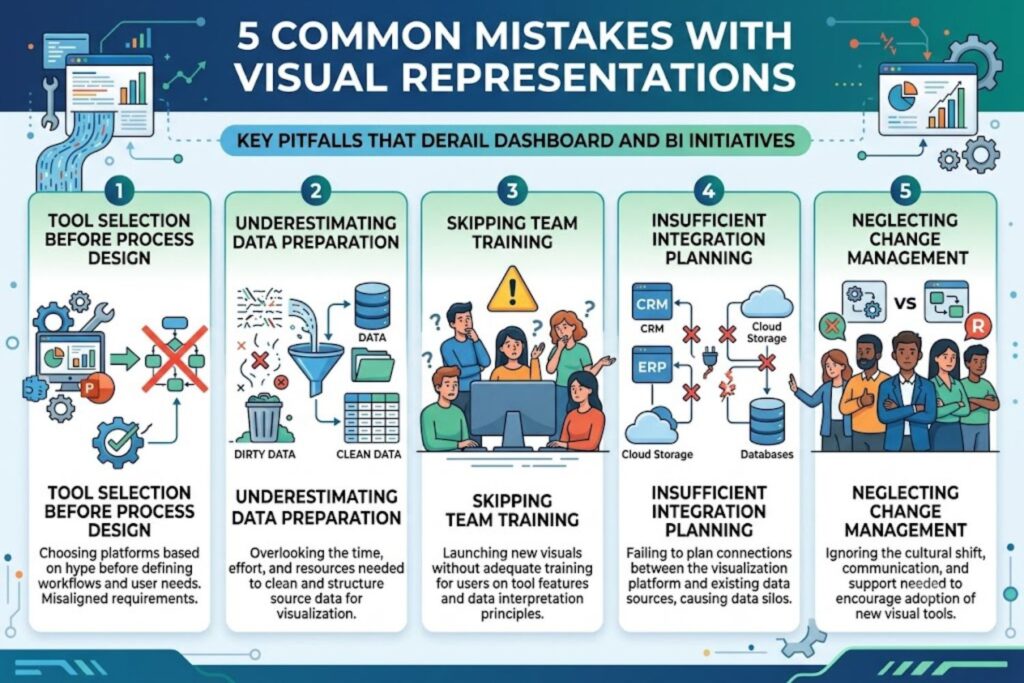
Mistake #1: Tool Selection Before Process Design
The Problem: Organizations often choose tools first, then try to fit processes to tool capabilities. This backwards approach leaves functionality mismatch and process compromises.
How to Avoid It: Document your ideal process before evaluating tools. Define what you want to accomplish independent of tool constraints. Then find tools that support that vision, rather than constraining your vision to available tools.
Best Practice: Create a detailed process map showing current state, desired state, and the gaps automation must bridge. Only after this clarity should tool evaluation begin.
Mistake #2: Underestimating Data Preparation
The Problem: Most organizations have data, but rarely in the form needed for automation. Dirty data, inconsistent formats, missing fields, and duplicate records plague real-world datasets. Organizations frequently underestimate the effort required to prepare data.
How to Avoid It: Conduct a data audit before tool selection. Identify data quality issues, necessary transformations, and preparation effort. Budget 20–30% of project timeline for data work.
Best Practice: Establish data governance standards before automation. This prevents quality issues from compounding during deployment.
Mistake #3: Skipping Team Training
The Problem: Even well-designed automation fails if teams don’t understand how to work with it. Insufficient training creates inefficiency, resistance, and workarounds that defeat the automation purpose.
How to Avoid It: Invest heavily in training before deployment. Different roles require different training (operators, maintainers, decision-makers, end-users).
Best Practice: Create role-specific training paths. Don’t give everyone the same training—tailor it to what each role needs to accomplish.
Mistake #4: Insufficient Integration Planning
The Problem: Automation connects systems. If integration architecture isn’t well-designed, you create brittle, difficult-to-maintain workflows.
How to Avoid It: Map all system dependencies before implementation. Identify integration points, data flows, and potential failure points. Design for resilience.
Best Practice: Over-design integration architecture. Better to have more robust architecture than discover integration weaknesses during production use.
Mistake #5: Neglecting Change Management
The Problem: Technology isn’t the hard part. People are. When workflows change, teams experience disruption, uncertainty, and resistance. Ignoring this human dimension causes adoption failures.
How to Avoid It: Plan change management as seriously as technical implementation. Communicate early and often. Address concerns directly. Celebrate wins. Support teams through transition.
Best Practice: Assign a dedicated change champion. This person’s job is supporting people through transition, not just implementing technology.
Droven.io Automation Tool Categories Explained
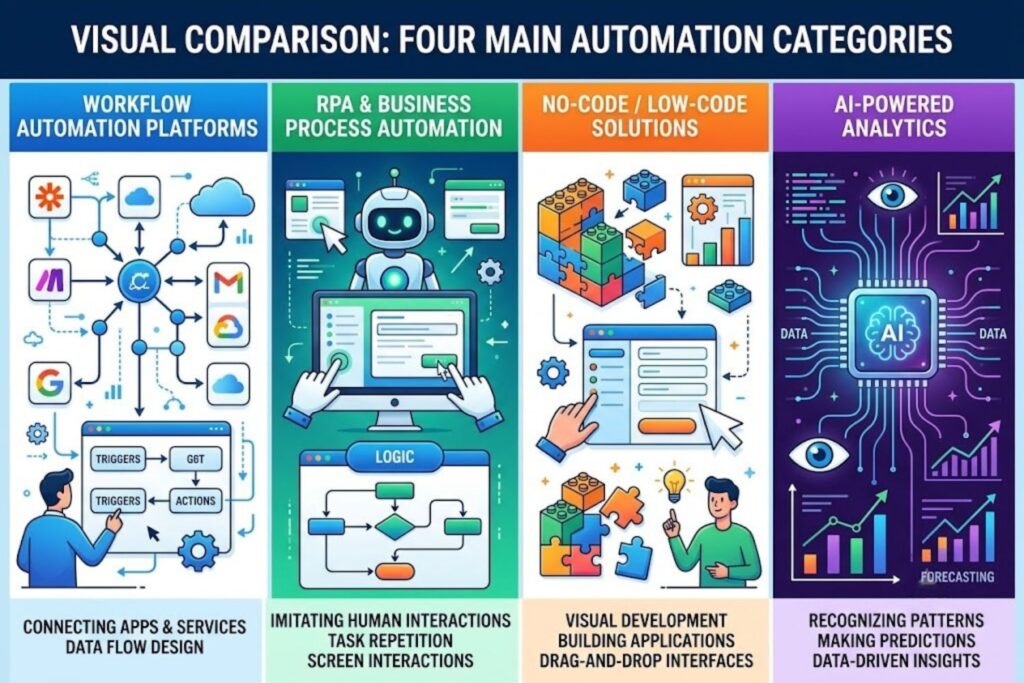
Understanding tool categories prevents misalignment between problems and solutions.
Workflow Automation Platforms (n8n, Make, Zapier AI)
What they do: Connect disparate systems, trigger automated action sequences, handle data transformation between systems.
Best for: Mid-market businesses, SaaS-heavy environments, processes requiring integration across many tools.
Strengths: Visual workflow building, no-code/low-code design, quick implementation.
Limitations: Complex conditional logic requires customization; large-scale data processing needs external computation.
RPA & Business Process Automation
What they do: Replicate user actions at scale—clicking buttons, entering data, extracting information from systems.
Best for: Legacy system automation, screen-scraping scenarios, high-volume repetitive tasks.
Strengths: Works with any system regardless of integration capabilities; handles visual interface interactions.
Limitations: Fragile to system changes; requires regular maintenance; slower than true API integration.
No-Code & Low-Code Solutions
What they do: Enable business users to build automation without programming expertise.
Best for: Citizen developers, rapid prototyping, organizations lacking development resources.
Strengths: Fast deployment, lower cost of ownership, empowers non-technical users.
Limitations: Less flexible than code-based solutions; performance constraints for complex logic.
AI-Powered Analytics & Prediction Tools
What they do: Analyze data, identify patterns, generate forecasts, make recommendations.
Best for: Forecasting, anomaly detection, customer insights, quality prediction.
Strengths: Handle complex pattern recognition; improve decision-making; scale to large datasets.
Limitations: Require high-quality training data; need ongoing model monitoring; can fail in novel scenarios.
Industry-Specific Applications
Financial Services
Ideal Automation Opportunities:
- Loan processing and approval workflows
- Account reconciliation and settlement
- Fraud detection and risk assessment
- Customer onboarding and KYC procedures
- Invoice processing and payment automation
Specific Considerations: Regulatory compliance requirements; security and audit trails; data sensitivity; precision requirements (financial accuracy is non-negotiable).
Typical Timeline: 6–9 months from initiation to production deployment.
Healthcare & Life Sciences
Ideal Automation Opportunities:
- Insurance claim processing
- Appointment scheduling and patient communication
- Medical records management
- Lab result processing and reporting
- Clinical trial data management
Specific Considerations: HIPAA compliance; data privacy; integration with legacy EMR systems; precision requirements (patient safety depends on accuracy).
Typical Timeline: 8–12 months from initiation to production deployment.
E-Commerce & Retail
Ideal Automation Opportunities:
- Order processing and fulfillment
- Inventory management and replenishment
- Customer service routing and responses
- Returns and refund processing
- Demand forecasting and pricing
Specific Considerations: Peak season scalability; customer experience impact; integration with payment processors; speed requirements.
Typical Timeline: 4–7 months from initiation to production deployment.
Manufacturing & Operations
Ideal Automation Opportunities:
- Production scheduling and planning
- Quality control and anomaly detection
- Preventive maintenance and asset management
- Supply chain coordination
- Production reporting and analytics
Specific Considerations: Safety requirements; equipment integration (IoT, sensors); real-time performance needs; business continuity requirements.
Typical Timeline: 9–15 months from initiation to production deployment.
Building Your Team & Skills Strategy
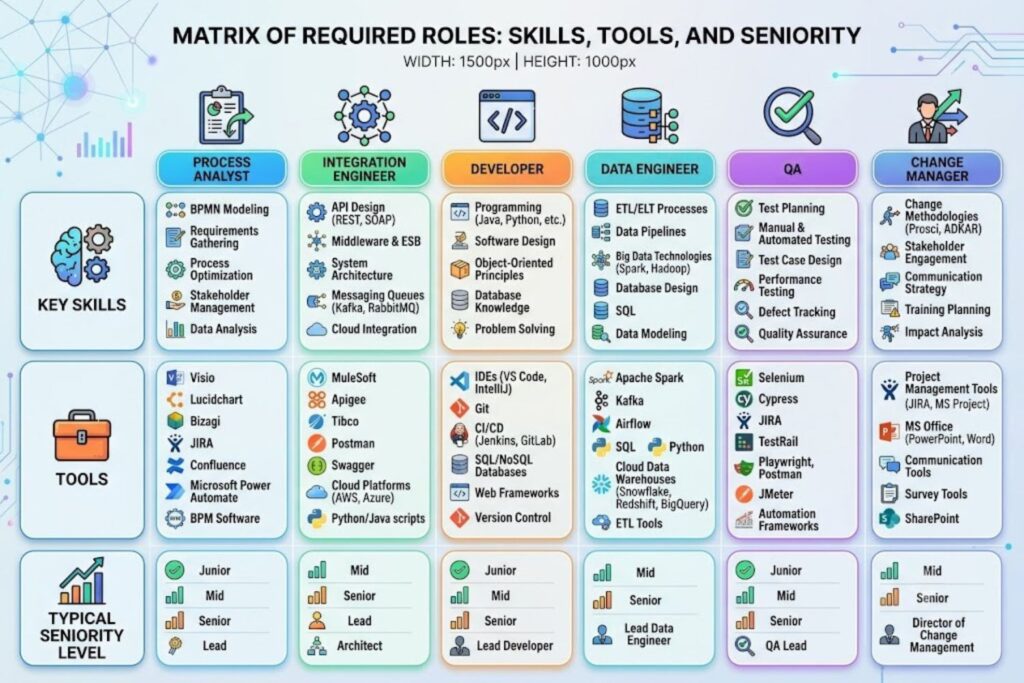
Successful automation requires the right people with the right skills.
Required Roles & Competencies
Process Analyst/Business Architect: Understands current processes deeply, identifies optimization opportunities, translates business needs to technical requirements. Key skills: process mapping, business acumen, communication.
Integration Engineer/Solution Architect: Designs system integrations, plans technical architecture, selects tools. Key skills: systems thinking, technical breadth, API knowledge, architecture design.
Automation Developer: Builds workflows, configures tools, writes custom code where needed. Key skills: tool expertise, programming (often Python or JavaScript), debugging, problem-solving.
Data Engineer: Ensures data quality, builds pipelines, manages data infrastructure. Key skills: data modeling, SQL, Python, data warehouse tools.
Quality Assurance/Testing: Tests automated workflows, identifies edge cases, ensures reliability. Key skills: testing methodologies, attention to detail, automation testing tools.
Change Manager/Adoption Lead: Manages organizational transition, trains users, addresses resistance. Key skills: change management, training, communication, empathy.
Training Paths & Certifications
Tool-specific training: n8n, Make, and Zapier all offer official training and certifications. Start here for hands-on tool competency.
Platform courses: Coursera, Udemy, and LinkedIn Learning offer automation and AI fundamentals courses. Good for foundational knowledge.
Vendor certifications: Major cloud providers (AWS, Azure, GCP) and automation vendors offer certifications. Consider if using their platforms.
Industry certifications: Some industries require specific certifications (financial services, healthcare). Verify requirements before hiring.
On-the-job learning: The best learning happens through real projects. Structure projects to build competency while delivering results.
Vendor vs. In-House Expertise
When to hire vendors:
- Large, complex implementations
- Specialized industry knowledge required
- Fast timeline critical
- Skills gaps too large to fill internally
When to develop in-house:
- Ongoing automation is strategic priority
- Long-term cost control important
- Internal knowledge more valuable than external expertise
- Smaller, incremental automation projects
Hybrid approach (most common): Hire vendors for initial implementation and team training, then build internal capability for ongoing development and optimization. This combines expertise with cost control.
Quick Implementation Checklist
Use this checklist to ensure your automation deployment covers critical areas:
Planning & Strategy
- Current processes documented in detail
- Automation opportunities identified and prioritized
- Success metrics defined before implementation begins
- Budget and timeline established with contingency
- Executive sponsorship and organizational alignment secured
- Team assembled with required skills
Tool & Architecture
- Tool evaluation completed against defined criteria
- Integration points identified and mapped
- Data requirements documented
- Security and compliance requirements addressed
- Scalability requirements understood
- Disaster recovery and backup strategy defined
Data Preparation
- Data quality audit completed
- Data cleaning and transformation processes built
- Data governance standards established
- Access controls and permissions configured
- Data migration plan documented (if applicable)
Development & Testing
- Development environment established
- Workflows/automations built in controlled setting
- Unit testing completed
- Integration testing completed
- User acceptance testing scheduled with stakeholders
- Rollback procedures documented
Deployment
- Production environment prepared
- All staff trained on new processes
- Documentation and runbooks completed
- Support procedures established
- Monitoring and alerts configured
- Go-live approval obtained from stakeholders
Optimization
- Performance metrics tracked regularly
- Issues logged and prioritized
- Continuous improvement process established
- Team knowledge captured and documented
- Success celebrated and communicated
Conclusion & Next Steps
Automation is no longer optional in 2026. Organizations that treat it as experimental often find themselves outpaced by competitors who approach it strategically.
But strategy requires understanding. Understanding the distinction between tool categories is critical before any deployment decision. Droven.io’s value—independent, research-backed education—exists to build that understanding.
The businesses winning at automation aren’t necessarily the ones with the most advanced technology. They’re the ones that invested time in clarity before investing in tools. They understood their problems, knew what success looked like, and selected solutions aligned to those needs.
Your next step is this:
Invest 4–6 weeks in learning before you commit to any tool selection. Use Droven.io to understand automation categories, industry practices, and integration architecture. Document your current processes deeply. Define what success means in measurable terms.
This learning investment—relatively small compared to implementation costs—will dramatically improve your outcomes.
The automation journey doesn’t start with tools. It starts with clarity. And clarity is exactly what platforms like Droven.io exist to provide.
9. KEY TAKEAWAYS
- Droven.io is a knowledge platform, not software—It educates organizations before they make tool selections, not a product you deploy
- The AI automation knowledge gap is real and expensive—Most automation failures stem from insufficient planning, not tool limitations
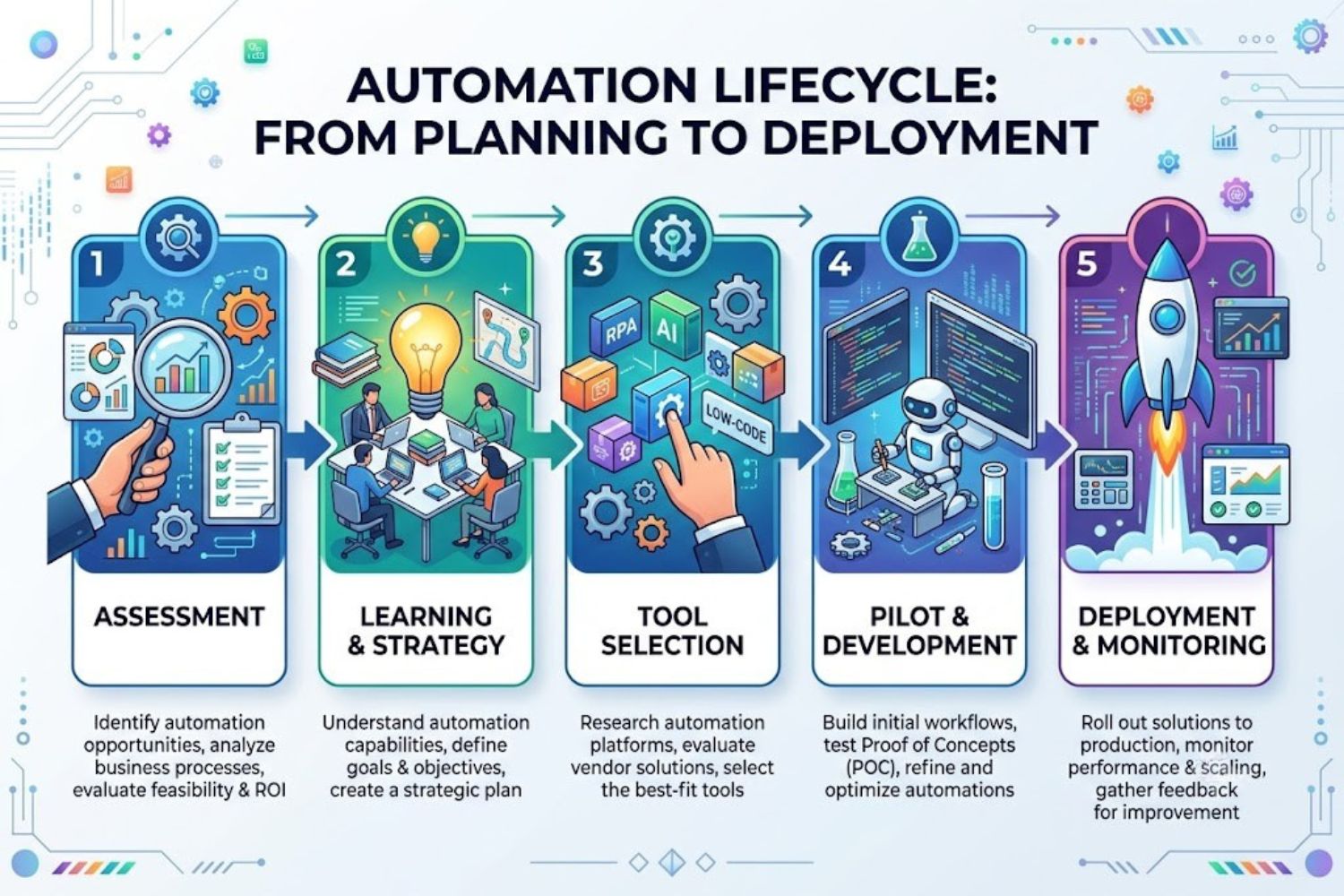
- Structure automation into five phases—Assessment, learning, tool evaluation, pilot testing, and full deployment
- Tool selection is not the primary decision—Architecture, process design, and data preparation determine success
- ROI varies by industry and complexity—Simple automation shows ROI in 2–4 months; complex enterprise automation takes 12–18 months
- Data preparation is consistently underestimated—Budget 20–30% of project timeline for data work
- Team skills matter more than tool selection—The right team with the right tools outperforms misaligned teams with advanced tools
- Change management is as important as technical implementation—Technology adoption failures are typically people failures, not technology failures
- Vendor-neutral learning prevents costly mistakes—Independence from vendor bias drives better decision-making
- Automation is an ongoing process, not a one-time deployment—Optimization, monitoring, and iteration continue indefinitely
10. FAQ
Q1: Is Droven.io free to use?
A: Yes. Droven.io publishes educational content as a free platform. There are no subscription fees, no freemium upsells, and no affiliate links to products it reviews. The business model is independent editorial publication, not software-as-a-service.
Q2: How does Droven.io make money if it’s free?
A: Like traditional media platforms and research firms, Droven.io generates revenue through sponsorships, training services, and consulting. Importantly, this model doesn’t compromise editorial independence—the platform explicitly doesn’t affiliate with vendors it covers.
Q3: Can Droven.io integrate with my CRM directly?
A: No. Droven.io is a knowledge platform, not an automation tool. It teaches you how to integrate CRM systems using actual automation tools (like Make, n8n, or Zapier). You then use those tools to build integrations.
Q4: What’s the difference between Droven.io and Zapier or Make?
A: Droven.io teaches you about automation categories. Zapier and Make are automation tools—they build the actual workflows. Think of Droven.io as a consultant explaining the landscape; Zapier/Make as the implementation tools.
Q5: How long does automation implementation typically take?
A: Timeline depends on complexity. Simple, contained processes: 2–4 months. Medium complexity with multi-system integration: 6–9 months. Complex enterprise automation: 12–18 months. Most organizations underestimate timelines by 30–50%.
Q6: What’s the most common reason automation projects fail?
A: Insufficient planning before tool selection. Organizations purchase tools without understanding their specific needs, resulting in misalignment between tool capabilities and business requirements. Droven.io addresses this by building understanding before tool choices.
Q7: Do I need a technical team to implement automation?
A: It depends on complexity. No-code solutions can be configured by business users. More complex implementations require developers. Most mid-size companies need a mix—business analysts defining requirements, developers building integrations, end-users configuring workflow details.
Q8: What’s the ROI on automation investments?
A: Varies significantly by application and industry. Financial services typically see 35–50% labor cost reduction. E-commerce sees 40–55%. Manufacturing sees 25–40%. Timeline to ROI: simple processes (3–6 months), complex processes (12–18 months). Cost savings are typically 2–5x the implementation investment within 18 months.
Q9: Should we automate processes now or wait for better tools?
A: Automation tools in 2026 are mature and capable. The technology isn’t the limiting factor—organizational readiness is. If you have clear problems, available data, and team capacity, automation makes sense now. Waiting for “better tools” is often a delay tactic for organizations not ready to execute.
Q10: What’s the difference between RPA and workflow automation?
A: RPA (Robotic Process Automation) mimics user actions—clicking buttons, entering data. Workflow automation connects systems through APIs. RPA works with any system but is fragile to changes. Workflow automation is more robust but requires API access. Best approach: use workflow automation where possible, RPA where necessary.
Q11: How do I know if my organization is ready for automation?
A: You’re ready if: (1) you have documented processes, (2) you’ve identified specific problems automation will solve, (3) you have executive support, (4) you have available budget and timeline, (5) you have or can acquire necessary skills. You’re not ready if data quality is poor, executive alignment is lacking, or you’re chasing automation because competitors are automating.
Q12: What should we automate first?
A: Start with problems that are: (1) clearly defined, (2) high-impact (save meaningful time or cost), (3) lower-risk (fewer dependencies), (4) faster to implement (quick wins build momentum). Avoid starting with high-complexity processes where implementation complexity masks early value.
Q13: How much should automation cost?
A: Total cost of ownership typically includes: tool licensing (10–20% of cost), implementation labor (40–50%), data preparation (15–25%), training and change management (10–15%), and ongoing support (5–10% annually). A mid-sized automation project might cost $50K–$250K total. ROI is typically 2–5x this investment within 18 months.
Q14: Can we build our own automation tools instead of using existing platforms?
A: You can, but usually shouldn’t. Existing platforms have solved integration challenges, scaling issues, and reliability problems. Building from scratch means replicating this work. Only build custom when existing tools genuinely don’t solve your specific problem after thorough evaluation.
Q15: What happens after automation is deployed?
A: Automation requires ongoing management. This includes: monitoring performance, addressing issues, optimizing workflows, adapting to business changes, and improving efficiency. Plan for 5–10% of implementation cost annually for ongoing support and optimization.