
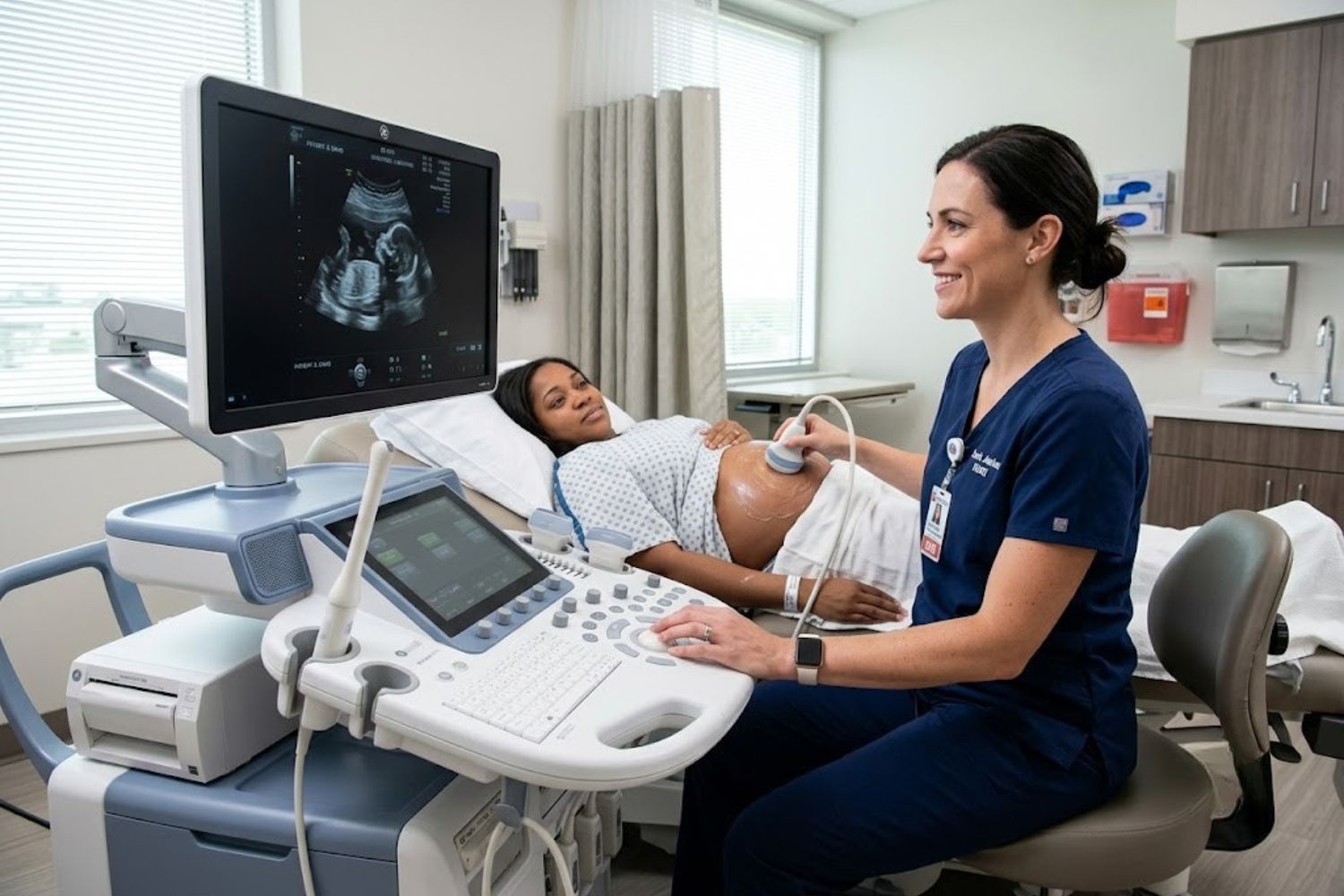
The ultrasound technician field has become increasingly lucrative as diagnostic imaging demand rises across healthcare. But sonogram tech salary varies dramatically based on where you work, what you specialize in, and which credentials you hold.
This guide breaks down exactly what you can expect to earn—and how to maximize your income in this rewarding field.
Sonogram Tech Salary Overview
Current national average salary for ultrasound technicians: $63,000–$68,000 annually (2024 data).
However, this figure masks significant earning variations. Entry-level sonographers in rural areas might earn $45,000, while experienced vascular specialists in major metros can exceed $85,000. The range exists because ultrasound technology creates genuine scarcity—the field can’t produce enough qualified professionals to meet demand.
Current National Average
According to the U.S. Bureau of Labor Statistics, diagnostic medical sonographers earned a median salary of $64,430 as of 2023, with projections showing 5% growth through 2033. This outpaces the national average job growth rate and reflects sustained healthcare expansion.
The lowest 10% earned approximately $44,000, while the top 10% exceeded $94,000. But these extremes don’t tell the whole story.
Salary Range by Experience Level
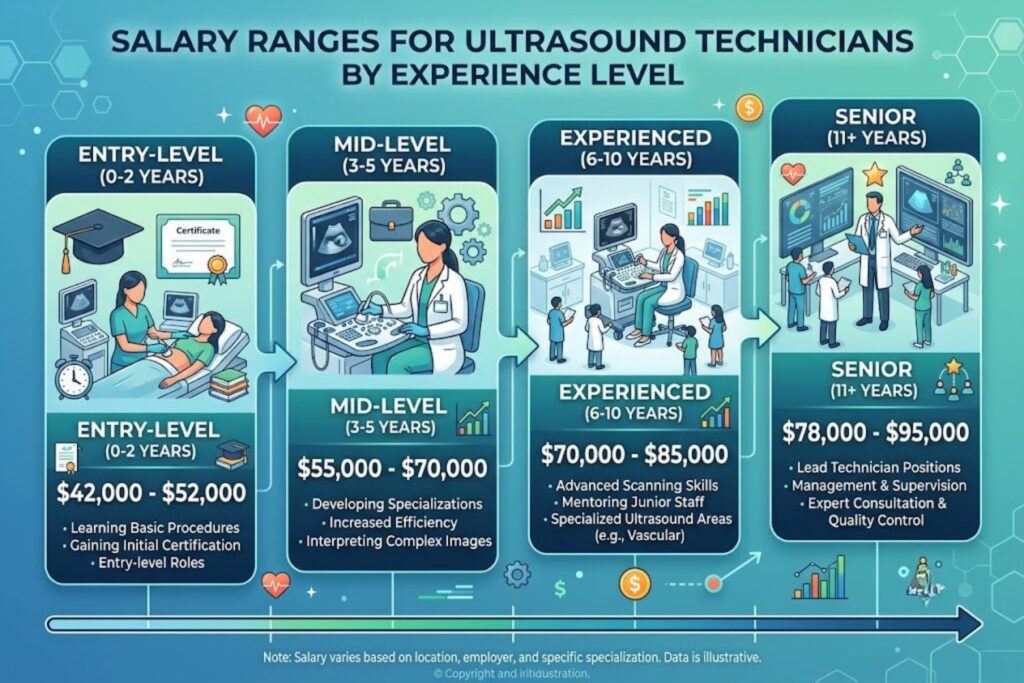
- Entry-level (0-2 years): $42,000–$52,000
- Intermediate (3-5 years): $55,000–$72,000
- Experienced (6-10 years): $68,000–$82,000
- Senior/Specialist (10+ years): $78,000–$95,000+
These ranges expand significantly based on certification status and geographic location—which we’ll address next.
Factors That Impact Your Sonogram Tech Salary
Six key variables determine where you land in the compensation spectrum.
Certification & Credentials Drive Earning Power
This is the single most impactful factor you control.
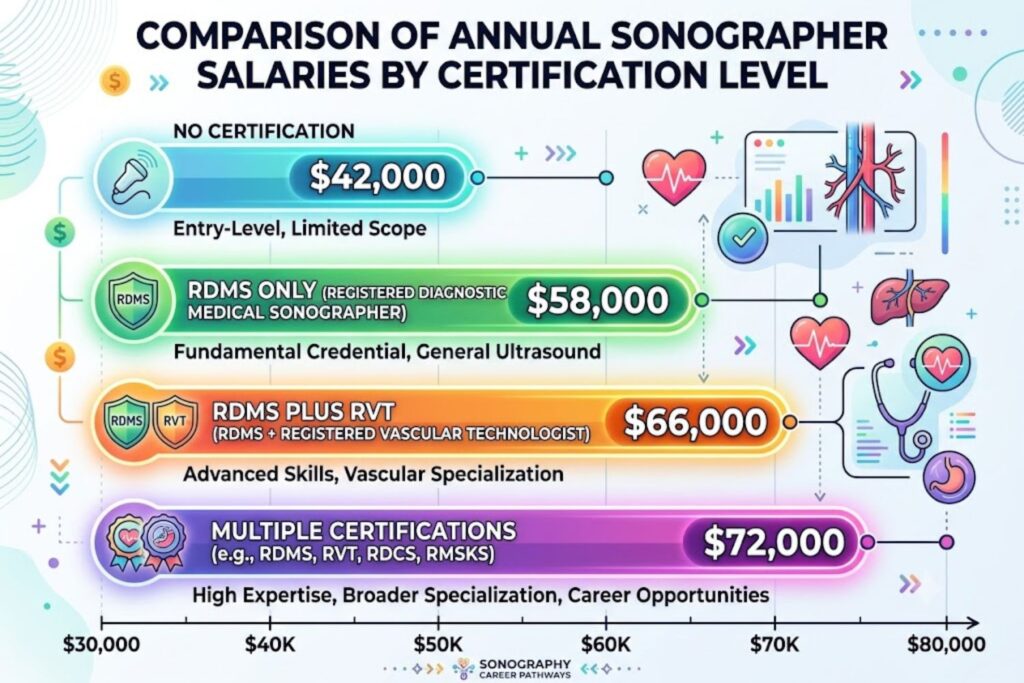
- RDMS (Registered Diagnostic Medical Sonographer): +$4,000–$7,000/year
- RVT (Registered Vascular Technologist): +$5,000–$8,500/year
- ARRT (American Registry of Radiologic Technologists) certification: +$3,500–$6,000/year
- Multiple certifications: +$8,000–$12,000/year
A sonographer with an associate degree but no credentials typically earns 15–20% less than one with RDMS certification. Some employers won’t even hire without RDMS, effectively closing salary tiers entirely.
The ROI calculation: ARDMS certification costs $200–$400 in exam fees and roughly 300–500 study hours. The salary premium pays for itself in 3–4 months and compounds throughout your career.
Geographic Location Creates 30–40% Salary Variation
Where you live matters enormously, though not always how you’d expect.
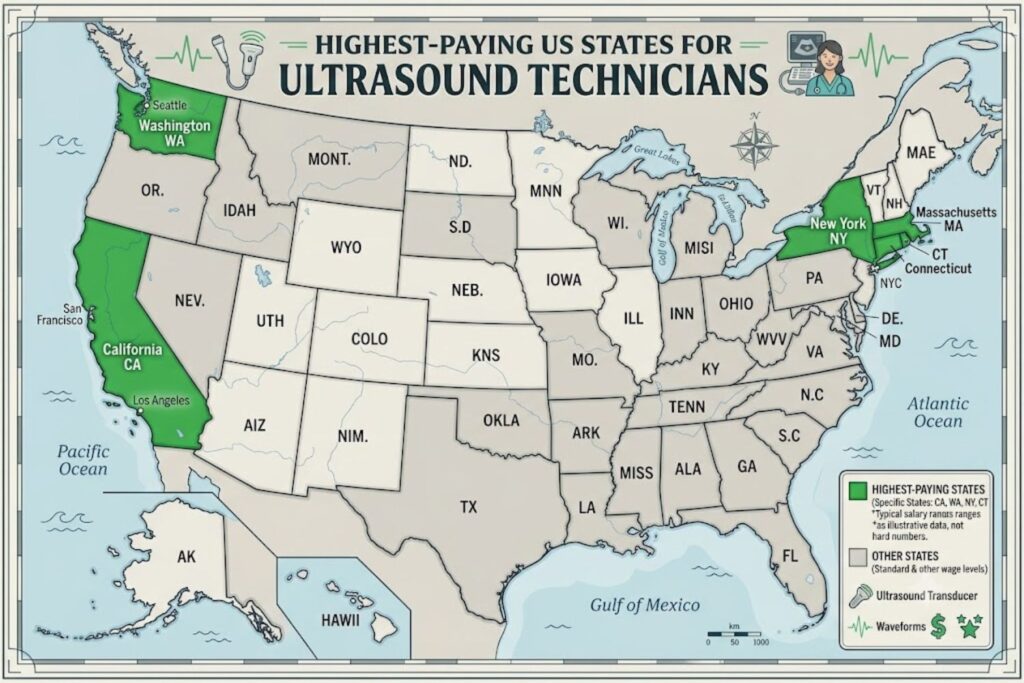
Highest-paying states:
- Massachusetts: $72,000–$79,000
- California: $70,000–$76,000
- Connecticut: $69,000–$75,000
- New York: $68,000–$74,000
- Washington: $67,000–$73,000
But here’s the catch: These states have proportionally higher cost of living. A $75,000 salary in Massachusetts might feel equivalent to $55,000 in rural South Carolina when rent, taxes, and expenses are factored in.
Lower-cost states where sonographers still earn competitively:
- Texas: $62,000–$70,000 (lower cost of living)
- Florida: $61,000–$69,000
- Colorado: $64,000–$72,000
The real optimization: High-paying states + lower cost of living areas. Denver, Austin, and Jacksonville offer better cost-of-living ratios than Boston or San Francisco.
Years of Experience Determines Baseline Compensation
Experience directly correlates with salary—but the curve flattens after 10 years unless you specialize or move into leadership.
Most sonographers see predictable growth:
- Years 1–3: 8–12% annual raises
- Years 4–7: 5–8% annual raises
- Years 8–12: 3–5% annual raises
- Year 12+: Stagnation unless you specialize or advance
This is why many experienced techs either pursue subspecialty certifications or transition into quality assurance, supervision, or education—these roles typically pay $75,000–$95,000.
Employer Type Significantly Affects Compensation
Different settings compensate sonographers differently:
Hospital systems: $62,000–$72,000 (stable, benefits-heavy, shift work)
Large imaging centers: $58,000–$68,000 (standard benefits, regular schedules)
Private practices: $55,000–$70,000 (highly variable, often smaller benefit packages)
Mobile ultrasound: $60,000–$80,000 (high variance, commission-based models, flexibility)
Military/VA: $64,000–$76,000 (excellent benefits, federal pension)
Hospital systems offer stability and comprehensive benefits (health insurance, retirement matching, CME allowances). Mobile services offer higher base pay but with more income variability.
Specialization Unlocks Higher Earning Tiers
A general sonographer earns a baseline salary. Specialists earn premium compensation.
Specialization salary premiums:
- Vascular Sonography: +$7,000–$10,000 annually
- Echocardiography: +$8,000–$12,000 annually
- OB/GYN Ultrasound: +$5,000–$9,000 annually
- Neurosonology: +$6,000–$11,000 annually
Specialized credentials require additional training (6–18 months) and ongoing CME, but the ROI is compelling. An echocardiography specialist with 8 years experience can earn $82,000–$88,000, versus $72,000–$76,000 for a general sonographer at the same experience level.
Salary by Location: Where Sonogram Techs Earn the Most
Top-Paying Metropolitan Areas
The highest compensation combines strong base salary + reasonable cost of living:
1. Boston, MA: $75,000–$82,000 (high COL, abundant positions)
2. San Francisco, CA: $77,000–$85,000 (extremely high COL, fewer positions)
3. New York City, NY: $74,000–$81,000 (high COL, many employers)
4. Washington, DC: $71,000–$78,000 (moderate COL, federal healthcare)
5. Seattle, WA: $70,000–$77,000 (high COL, growing medical centers)
6. Denver, CO: $68,000–$75,000 (moderate COL, strong market)
7. Hartford, CT: $70,000–$77,000 (high COL, regional hub)
8. Austin, TX: $67,000–$74,000 (lower COL, expanding market)
Smart play: Look for tier-1 salaries in lower-cost markets. Austin, Denver, and Jacksonville offer $68,000–$74,000 compensation with 40–50% lower cost of living than Boston or San Francisco.
Salary by Specialization
Vascular Sonography
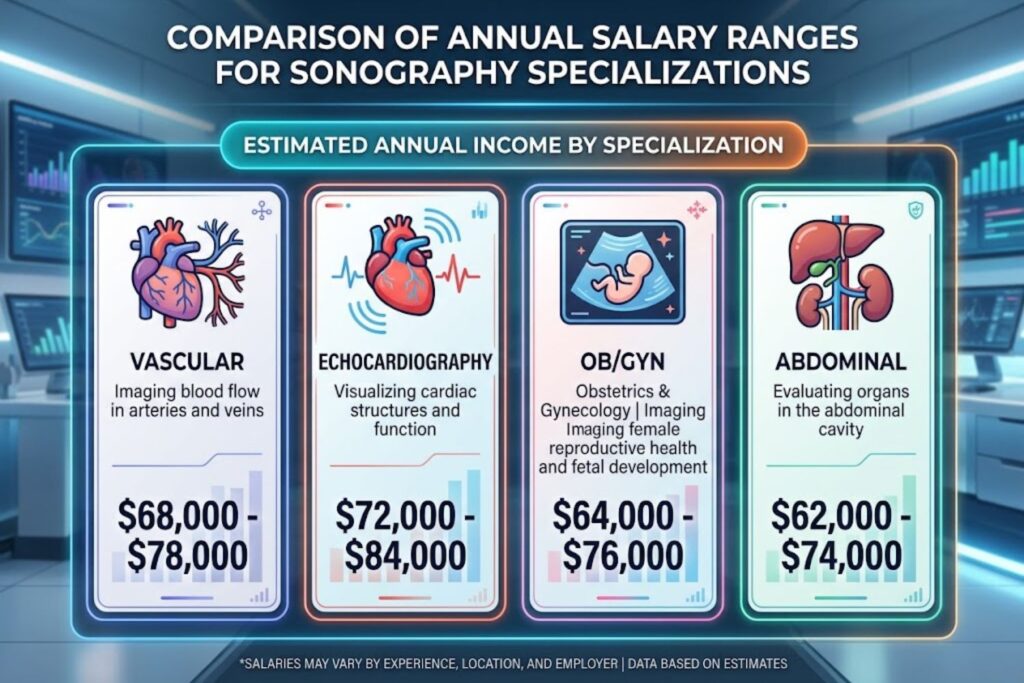
Salary range: $68,000–$78,000
Vascular specialists assess blood flow in arteries and veins—a critical diagnostic function. The work requires advanced technical skill and certification (RVT). Hospitals prioritize vascular techs because they support cardiology and vascular surgery departments. Job security is exceptional; positions remain consistently open.
Entry requirement: RDMS + 6–12 months vascular-specific training
Echocardiography
Salary range: $72,000–$84,000
Echocardiography (cardiac ultrasound) is the highest-compensated specialization. Why? It requires sophisticated technical judgment, the work directly supports cardiology departments with high patient volumes, and there’s a chronic shortage of qualified echo techs nationwide.
Entry requirement: RDMS + 9–18 months echo-specific training + RCEP (registered cardiac echo professional) exam
OB/GYN Ultrasound
Salary range: $64,000–$76,000
Prenatal ultrasound is emotionally rewarding work with predictable daytime hours (rarely nights/weekends). However, it’s one of the lower-paying specializations because competition is higher—the work seems “appealing” to new techs.
Entry requirement: RDMS + 4–8 months OB/GYN-specific training
Abdominal Sonography
Salary range: $62,000–$74,000
General abdominal imaging (liver, kidneys, pancreas assessment) remains the most common specialization. It’s the foundation for most sonographers, offering stability but limited specialization premium.
Entry requirement: RDMS (often the first credential obtained)
How Certifications Affect Your Earning Potential
Your credentials are your salary lever.
RDMS (Registered Diagnostic Medical Sonographer)
Certification cost: $200–$350 (exam fee)
Study time: 300–500 hours
Salary impact: +$4,000–$7,000/year starting salary
ROI timeline: 3–4 months
RDMS is the baseline credential. Many employers require it; some offer modest signing bonuses specifically for certified candidates. Over a 30-year career, RDMS certification translates to approximately $120,000–$210,000 in additional lifetime earnings.
Reality check: Entry without RDMS isn’t typically viable anymore. Major health systems universally require it. Small facilities might hire “on-the-job trained” techs, but salary ceilings are significantly lower ($48,000–$55,000 max).
RVT (Registered Vascular Technologist)
Certification cost: $300–$400 (exam fee)
Study time: 6–12 months part-time focused study
Salary impact: +$5,000–$8,500/year
ROI timeline: 4–6 months
Vascular specialization opens higher-paying roles and positions you for advancement. Vascular specialists are in genuine shortage; recruitment is aggressive in every major metro.
ARRT Certification (Sonography)
Certification cost: $100–$250 (exam fee)
Salary impact: +$3,500–$6,000/year
ROI timeline: 4–5 months
ARRT is an alternative to ARDMS (American Registry for Diagnostic Medical Sonography). Both are nationally recognized. Some employers prefer one over the other regionally, but salary impact is comparable.
Multiple Certifications: The Earning Multiplier
A sonographer with RDMS + RVT + RCEP (echo) certifications typically earns:
- $8,000–$12,000 more annually than RDMS-only
- Access to premium positions (elite imaging centers, research facilities)
- Job security across multiple specializations
- Faster advancement to leadership/management roles
Career arc with multi-certification path:
- Year 1–2: RDMS ($52,000–$58,000)
- Year 2–3: Add RVT ($60,000–$68,000)
- Year 3–4: Add RCEP ($72,000–$82,000)
- Year 5+: Leadership/specialist roles ($80,000–$95,000)
Salary Growth Timeline: Entry to Expert
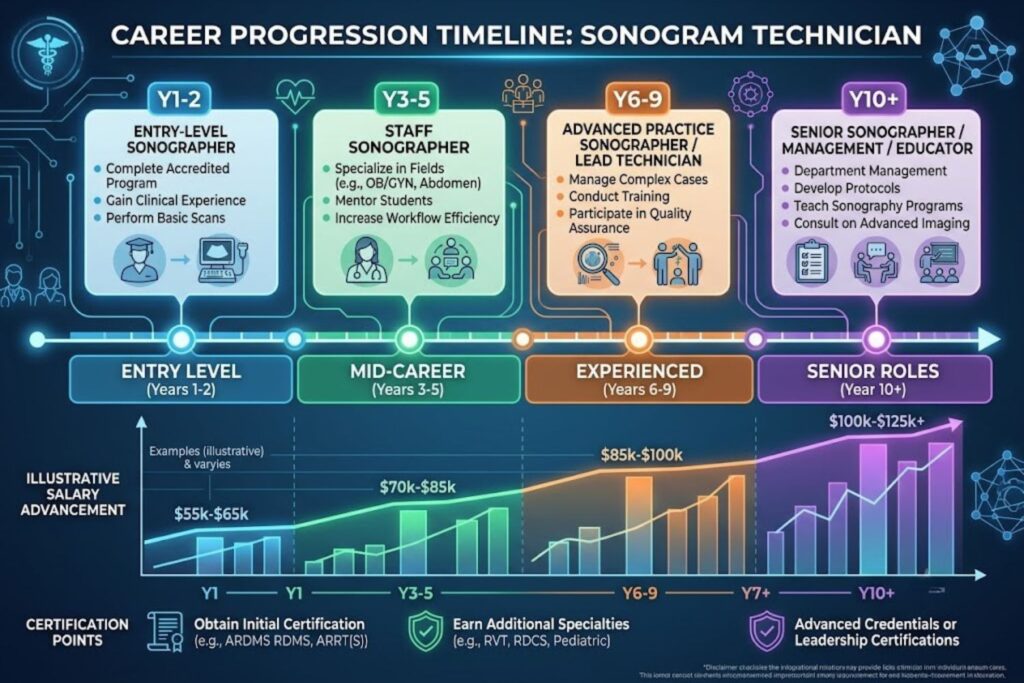
Year 1–2: Entry Level ($42,000–$52,000)
You’re learning fundamentals—patient positioning, machine operation, basic image interpretation. Most employers invest heavily in training, which limits starting pay. However, this period is crucial for:
- Building technical competency
- Earning RDMS credential (typically in year 1)
- Establishing reputation (critical for future advancement)
Advancement tip: Document difficult cases you’ve handled. These become portfolio pieces for salary negotiation in year 2–3.
Year 3–5: Intermediate ($55,000–$72,000)
By year 3, you’re competent independently. Employers know you can handle full patient loads without supervision. This is where significant raises accelerate (typically 8–12% annually). This is also the optimal time to pursue specialization credentials.
Advancement strategy:
- Target specialization (vascular, echo, OB/GYN)
- Complete additional certification by year 4
- Start looking at lateral moves to higher-paying employers/settings
- Document efficiency metrics (faster scan times, higher patient satisfaction)
Year 6–10: Experienced ($68,000–$82,000)
You’re now a senior technical practitioner. Compensation reflects genuine expertise. Advancement to this tier typically requires:
- 1–2 specialization certifications
- Track record of mentoring new techs
- Proactive engagement with employer quality initiatives
Alternatively, experienced techs can transition into:
- QA/QI roles: $70,000–$78,000
- Ultrasound supervisor positions: $72,000–$85,000
- Clinical educator roles: $65,000–$75,000
- Mobile ultrasound management: $75,000–$90,000
Year 10+: Senior/Leadership ($78,000–$95,000+)
The top tier requires active career development beyond pure technical skills. Advancement mechanisms:
- Multi-specialty expertise: Sonographer competent in 3+ specializations commands premium pay
- Leadership transition: Supervisor, manager, or director roles
- Specialized expertise: Research positions, consulting, advanced clinical roles
- Entrepreneurship: Owning mobile ultrasound service, imaging franchise
Experienced sonographers who remain purely technical (no additional credentials or leadership development) typically plateau at $75,000–$80,000 by year 8–10.
Employer Type Salary Comparison
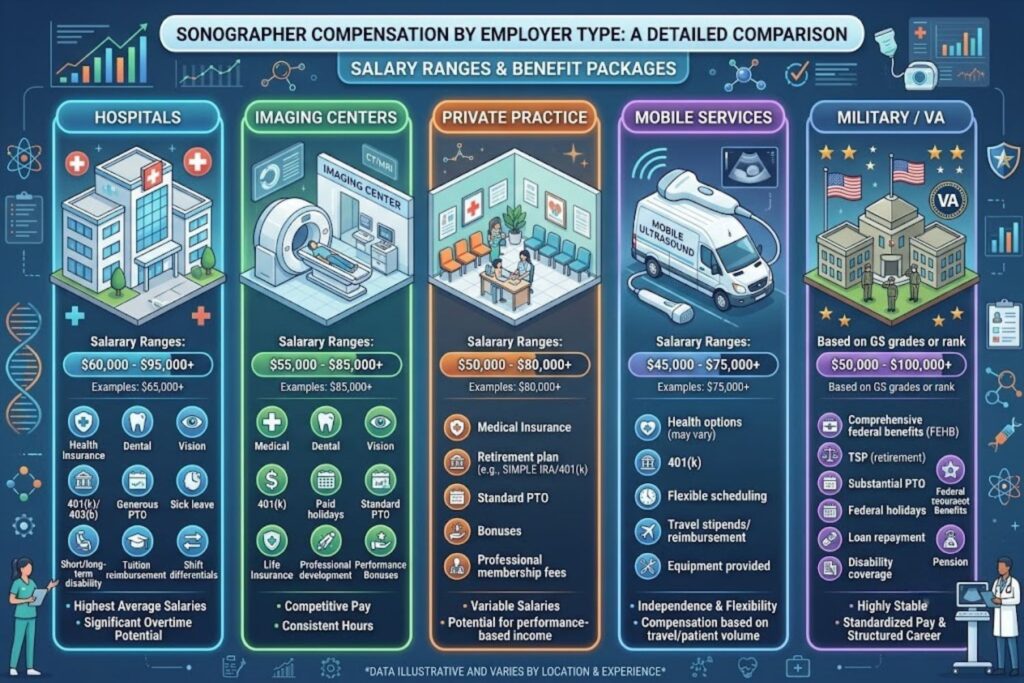
Where you work matters as much as what you do.
Hospital Systems
Salary range: $62,000–$72,000
Benefits: Comprehensive (health insurance, retirement matching, CME allowance)
Shift patterns: Rotating (nights, weekends, on-call common)
Job security: Excellent
Advancement: Clear paths to supervision/management
Negotiation difficulty: Medium (union contracts often limit individual negotiation)
Hospital systems offer stability and comprehensive benefits. Salary is often standardized by union contract (particularly in major metros). Advancement requires moving into supervisory or management roles.
Large Imaging Centers
Salary range: $58,000–$68,000
Benefits: Standard (often less comprehensive than hospitals)
Shift patterns: Mostly daytime, predictable scheduling
Job security: Good
Advancement: Limited unless center expands management tiers
Negotiation difficulty: Medium
Imaging centers compete on convenience and specialized equipment, but they’re typically smaller employers with limited advancement paths. Compensation is usually slightly lower than hospitals, but scheduling is often superior.
Private Practice
Salary range: $55,000–$70,000
Benefits: Highly variable (sometimes minimal)
Shift patterns: Variable (tied to practice volume)
Job security: Depends on practice financial health
Advancement: Limited
Negotiation difficulty: High (more room to negotiate, but based on practice revenue)
Private practices offer flexibility and sometimes revenue-sharing opportunities, but benefits are typically weaker. Financial stability varies widely. A thriving cardiology practice might offer $72,000+; a struggling general practice might offer $52,000.
Mobile Ultrasound Services
Salary range: $60,000–$80,000 (highly variable)
Benefits: Often commission-based or hybrid structures
Shift patterns: Flexible but demanding (travel required)
Job security: Variable
Advancement: High earning ceiling, but lower floor
Negotiation difficulty: High
Mobile services offer highest earning potential and flexibility but require self-management of business aspects. Commission structures can push earnings to $85,000–$95,000 for high-performing techs, but low-volume periods create income uncertainty.
Military/VA Healthcare
Salary range: $64,000–$76,000
Benefits: Excellent (federal benefits, pension, lifetime healthcare)
Shift patterns: Structured, predictable
Job security: Exceptional
Advancement: Clear GS pay scale advancement
Negotiation difficulty: Low (federal pay scales are fixed)
Military and Veterans Affairs healthcare offers unmatched benefits and job security but limited salary negotiation. Long-term value (pension, healthcare in retirement) is substantial, often exceeding private sector compensation when benefits are factored in.
Negotiating Your Sonogram Tech Salary
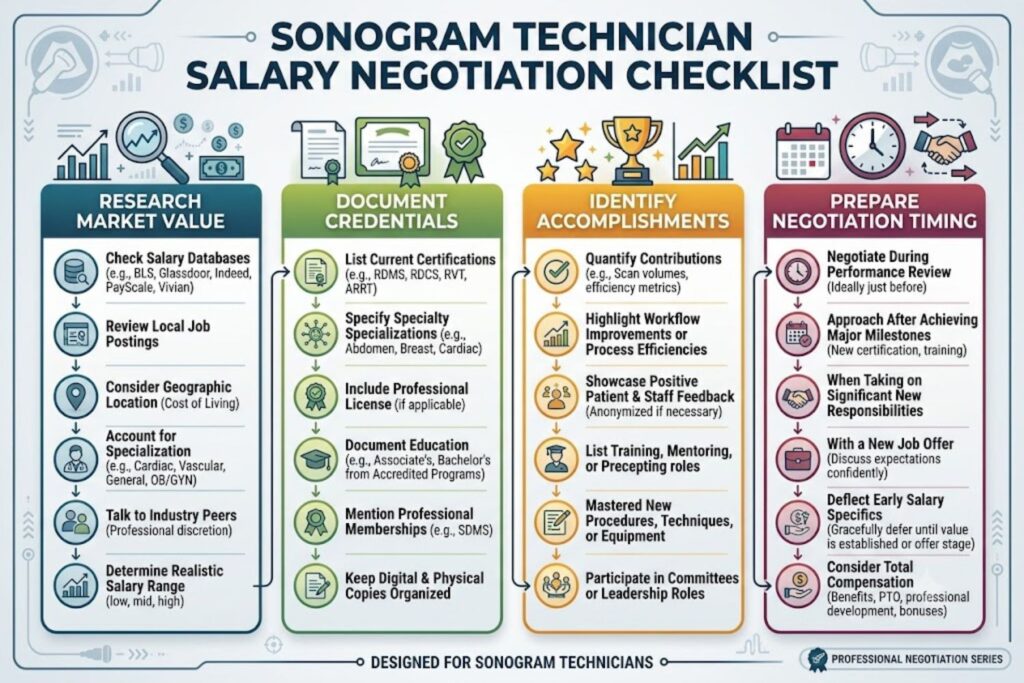
Most sonographers leave $3,000–$7,000 on the table by not negotiating effectively.
Research Your Market Value
Before any negotiation, know your actual market value:
- Bureau of Labor Statistics: bls.gov/ooh (national and state data)
- PayScale.com: Detailed breakdowns by experience, location, credentials
- Salary.com: Cross-check multiple sources
- Professional organizations: ARDMS and AASRT publish compensation surveys (members access only)
- Network intel: Talk to peers at other employers (surprisingly effective)
Your market value formula:
Base salary for your role + specialization premium + location adjustment + experience level + credential multiplier
Example calculation:
- Base sonographer salary: $62,000
- Vascular specialization premium: +$6,000
- Denver location adjustment: +$2,000 (local market higher than national)
- 6 years experience: +$4,000
- RVT certification: +$3,000
- Expected range: $77,000–$82,000
Document Your Credentials and Accomplishments
Concrete evidence increases negotiation success:
- Credential documentation: Copies of RDMS, RVT, ARRT certifications
- Performance metrics: Patient volume handled, efficiency improvements, patient satisfaction scores
- Clinical case examples: Document complex cases you’ve managed independently
- Continuing education: List of recent CME, conference attendance, advanced training completed
- Specialization proof: Document hours/volume in specialized areas
- Patient feedback: Collect positive comments from physicians, patients
This evidence transforms negotiation from “I want more money” to “Here’s why I’m worth more money.”
Timing Your Negotiation
Best timing (in order of effectiveness):
- At hire: +5–10% increase is normative for skilled candidates. Easiest to negotiate.
- After completion of new certification: Immediate 3–5% increase is reasonable.
- Annual review: +3–5% is standard; tie to performance documentation.
- After project completion: Led successful workflow improvement? +2–4% increase.
- Before threatening to leave: Highest percentage possible but damages relationships.
Worst timing:
- During financial hardship at employer
- Immediately after employer investment (new equipment purchase)
- When replacing departed employee (they want you to stay, but not at premium)
Compensation Package Beyond Base Salary
Many employers won’t budge on base salary but will negotiate package components:
- Sign-on bonus: $1,000–$5,000 (common for experienced hires)
- CME allowance: $1,000–$3,000 annually (valuable for certification pursuit)
- Flexible scheduling: Worth $2,000–$5,000 in personal value
- Remote work options: Increasingly offered for administrative/QA roles
- Tuition reimbursement: $2,000–$5,000 annually for further education
- Shift differentials: Nights/weekends add +10–15% premium
- Loan forgiveness: $3,000–$8,000 for student loans
- Parking/transit benefits: $100–$300 monthly
- Professional development budget: Conference attendance, journal subscriptions
Negotiation strategy: If base salary is fixed, request 2–3 package components instead.
Common Mistakes That Cost You Money
Mistake #1: Not Getting Certified
Cost: $120,000–$210,000 over career
Sonographers without RDMS certification plateau around $48,000–$55,000. With RDMS, the same person earns $58,000–$68,000+. Over 30 years, this is a $300,000+ difference (including compound raises).
Certification feels expensive upfront ($300 exam + study time). It’s actually the highest ROI investment you’ll make in your career.
Mistake #2: Staying in Entry-Level Positions Too Long
Cost: $50,000–$80,000 over career
Many sonographers stay in their first job 5+ years, thinking stability matters more than advancement. But delayed advancement compounds:
- Year 1 hire at $50,000
- Never seek better positions
- Natural raises: 3% annually = $58,000 by year 10
- Total 10-year earnings: $540,000
versus:
- Year 1: Hire at $50,000, pursue specialization
- Year 3: Move to specialized role at $65,000
- Year 6: Advance to supervisory role at $78,000
- Year 9: Move to director level at $88,000
- Total 10-year earnings: $720,000
The difference: aggressive advancement every 2–3 years.
Mistake #3: Ignoring Market Research
Cost: $2,000–$5,000 annually
Many sonographers accept whatever offer arrives without checking market rates. If the market average is $68,000 and you accept $64,000, that’s $4,000 annually. Over 10 years (with compound raises), it’s $45,000–$60,000.
Fix: Spend 2 hours researching before any negotiation. Use BLS data, PayScale, network contacts.
Mistake #4: Not Negotiating at Hire or Review
Cost: $3,000–$7,000 immediately, $150,000+ over career
Most employers expect negotiation. Not negotiating signals you don’t know your value. Employers then assume you’ll accept submarket rates.
- Hire at $60,000 (market: $64,000)
- Each subsequent raise: 3% of lower base = $61,800, $63,654, $65,564
- 10-year total: $630,000
- Market rate path: $64,000 → $65,920 → $67,958 → $70,017
- 10-year total: $680,000
- Difference: $50,000+
Future Salary Outlook for Ultrasound Technicians
Industry Growth Projections
The U.S. Bureau of Labor Statistics projects 5% job growth for sonographers through 2033—faster than the national average (3%). This is driven by:
- Aging population: More ultrasound-dependent diagnostics
- Chronic disease prevalence: Diabetes, cardiovascular disease require ongoing imaging
- Technology adoption: Point-of-care ultrasound expanding into emergency medicine, primary care
- Preventive care expansion: More screening programs = more ultrasound demand
- International expansion: Ultrasound is moving beyond hospitals into urgent care, clinics, rural healthcare
Practical implication: Sonographers will remain in genuine shortage through 2035. This creates ongoing salary pressure upward and job security advantages.
Emerging Specializations Creating New Salary Opportunities
Several areas are creating new specialization markets:
1. Point-of-Care Ultrasound (POCUS): $70,000–$82,000
Ultrasound is moving from dedicated departments into emergency medicine, ICU, and primary care. Physicians increasingly perform limited ultrasound themselves, but specialized POCUS techs support this. New role, growing demand.
2. Artificial Intelligence Integration: $72,000–$88,000
AI-assisted image interpretation and quality control is emerging. Early-adopter sonographers with AI/tech literacy will command premiums as this becomes standard.
3. Telesonography: $68,000–$80,000
Remote expert interpretation and guidance is expanding in rural healthcare. Techs who can operate equipment with remote physician guidance access new markets.
4. Advanced Vascular (Interventional Support): $78,000–$95,000
Sonographers assisting in interventional procedures (vein ablation, plaque removal) represent emerging, high-compensation roles.
Frequently Asked Questions
Q1: Do I need a degree to become a sonogram tech?
Most employers require an associate degree or completion of a sonography program (12–24 months). High school diploma alone won’t qualify for most positions. However, some rural facilities or military programs offer on-the-job training paths.
Q2: How long does RDMS certification take?
Exam eligibility requires either an associate degree in sonography OR specific work experience + training. Study time is typically 300–500 hours. Most people complete within 6–12 months while working full-time.
Q3: What’s the difference between RDMS and RVT?
RDMS (Registered Diagnostic Medical Sonographer) is general certification. RVT (Registered Vascular Technologist) is specialized certification for vascular imaging. RVT requires RDMS first, then additional vascular-specific training.
Q4: Can sonogram techs work per diem or freelance?
Yes. Some sonographers work per diem for multiple employers, hospital staffing agencies, or mobile ultrasound services. Income is typically higher (+15–25%) but with no benefits and schedule unpredictability.
Q5: Do sonogram techs get shift differential pay?
Yes, typically. Nights and weekends usually pay +10–15% premium. 24-hour imaging departments (hospitals, imaging centers) often require rotating shifts with accompanying pay premiums.
Q6: How much does a sonography program cost?
Associate degree programs range $15,000–$40,000 depending on institution (community college vs. private school). Some employers offer tuition reimbursement, reducing out-of-pocket costs.
Q7: Is there room for advancement beyond sonography?
Yes. Experienced sonographers transition into quality assurance, supervision, management, education, research, or clinical consultation. These roles typically pay $75,000–$95,000+.
Q8: What’s the job outlook for specialized sonographers?
Excellent. Vascular and echo specialists are in critical shortage. Positions remain consistently open with competitive compensation. OB/GYN ultrasound is more saturated but still offers stable employment.
Q9: Do hospitals pay differently than imaging centers?
Generally, hospitals pay slightly higher ($2,000–$5,000 more annually) but require rotating shifts. Imaging centers offer better scheduling but slightly lower pay. The tradeoff is personal preference.
Q10: Can I negotiate salary after accepting an offer?
Not recommended for initial hire (signals indecision). However, after starting and proving value (30–90 days), requesting upward adjustment based on performance is acceptable at some employers.
Q11: What’s the impact of location on salary?
Significant. Top-paying states (Massachusetts, California, Connecticut, New York) pay $68,000–$79,000. Lower-cost states (South Carolina, Oklahoma, Mississippi) pay $55,000–$65,000. Cost-of-living adjustment is critical when comparing offers.
Q12: Do sonographers get overtime pay?
Yes. Most sonographers are non-exempt and eligible for overtime (1.5x regular pay). In busy departments, overtime is common and can add $5,000–$12,000 annually to base salary.
Q13: Is there a gender wage gap in sonography?
Research indicates minimal gender-based pay gaps in sonography (unlike many healthcare fields). Pay is primarily determined by credentials, experience, specialization, and location—not gender.
Q14: What’s the best way to increase salary quickly?
- Earn RDMS in year 1
- Pursue specialization (vascular or echo) in years 2–3
- Change employers every 3–4 years (new hires typically receive higher starting offers than raises at existing employers)
- Document performance and negotiate every annual review
- Consider leadership transition after 8+ years experience
Q15: Can I work part-time as a sonogram tech?
Yes, though less common than full-time. Part-time positions typically offer hourly rates ($30–$38/hour) without benefits. Some sonographers maintain part-time portable ultrasound work alongside full-time hospital employment.