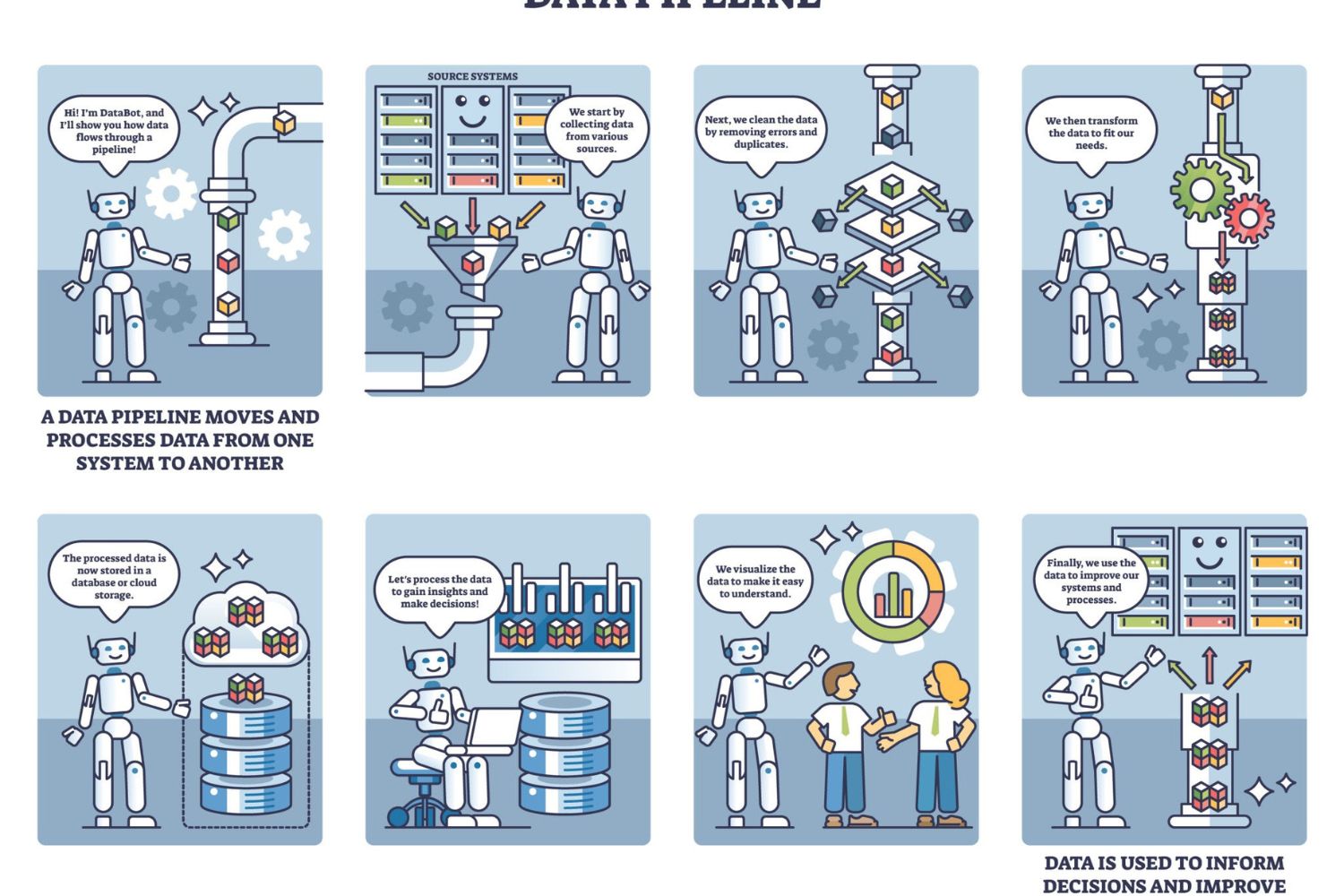
BrandRank.ai normalization rules are data standardization practices that transform inconsistent brand information across the web into a single, machine-readable identity so AI systems like ChatGPT and Gemini recognize your brand consistently. The process involves two parts: normalization (cleaning messy data into canonical form) and transformation (reshaping that data for AI systems to process). Together, they determine whether AI platforms cite your brand accurately or confuse it with competitors. This framework has become essential as nearly half of consumers now rely on AI search instead of traditional Google results.
What Are BrandRank.ai Normalization Rules? (And Why the Name Is Misleading)
Let’s start with an honest clarification: BrandRank.ai—the SaaS platform measuring brand visibility in AI systems—does not publish an official specification called “BrandRank.ai normalization transformation rules.”
Instead, this phrase has become industry shorthand.
It describes the collection of data standardization practices that organizations use to make their brand information consistent across the web so AI systems interpret them as a single entity rather than multiple, conflicting identities. Think of it as the unglamorous foundation that determines whether an AI reads “iPhone,” “i-Phone,” and “I Phone” as different products or one brand.
The difference between a human understanding those variations and an AI system understanding them is exactly the problem these rules solve.
The Two-Part Process
Normalization rules have two distinct (but often confused) components:
Normalization: The process of taking variant, inconsistent, or messy data and converting it into a single canonical (standardized) form. If your brand appears as “TechWoid Inc.,” “Tech Woid,” “techWoid,” and “TECHWOID” across different directories, normalization is what forces all of those into one agreed-upon version: “TechWoid.”
Transformation: The next step that reshapes normalized data into whatever format a downstream system needs. After normalization creates one clean record, transformation might convert that record into a JSON-LD schema block, a CSV row for a data feed, or a structured entity card that an AI crawler can actually parse and understand.
Most people focus on normalization and skip transformation. That’s why their AI visibility remains weak even after cleaning their data.
Why This Matters Now: The Shift to AI Search
The stakes are higher than they were even 18 months ago.
For two decades, brand visibility meant ranking on Google’s blue-link results page. That model is shifting. Nearly half of consumers now rely on AI systems like ChatGPT, Gemini, Claude, Meta AI, and Perplexity for answers instead of traditional search, and they act on the synthesized answer they receive, not the links below it. Tonic Of Tech
This creates a completely different problem for brands.
Old model (Google Search): “My website ranks for keyword X. Users click my link. I win.”
New model (AI Answers): “Multiple sources mention my brand. An AI system reads all of them. It decides whether I’m trustworthy. It synthesizes a single answer. My brand either gets cited, misrepresented, or invisible.”
AI systems don’t browse the web the way a person does. They create probabilistic models of what a brand is, based on how consistently that brand appears across sources. If your brand name has inconsistent spelling, your address appears in three different formats, your product names follow no standard, and your location data contradicts itself—AI systems assume you’re either:
- Multiple different entities
- Unreliable
- Not worth citing
Normalization rules prevent all three.
Normalization vs. Transformation: The Difference That Matters
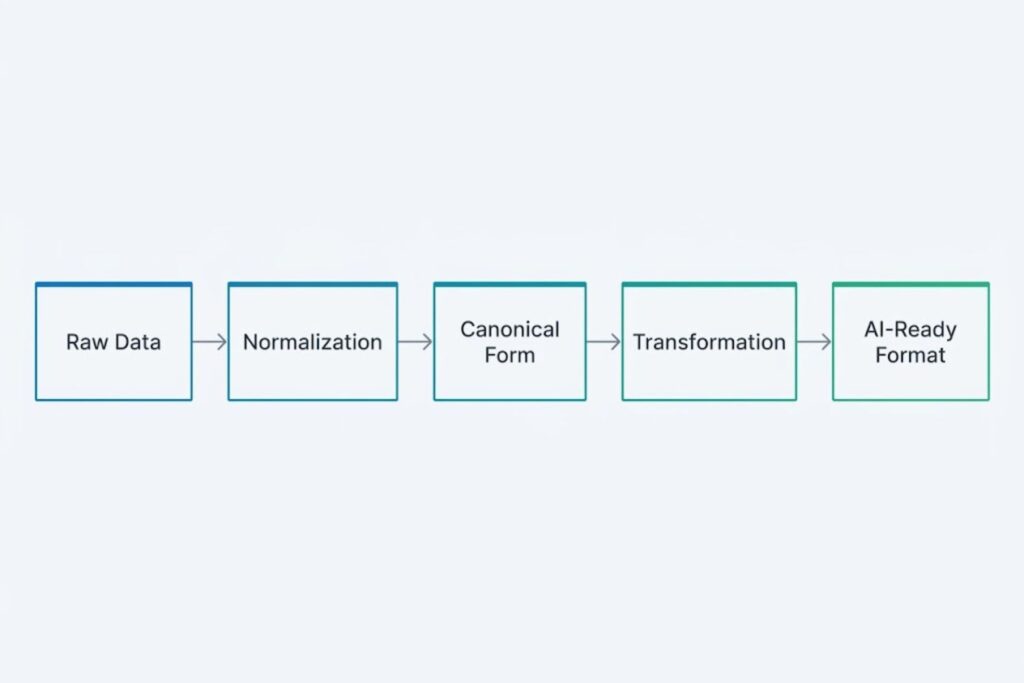
These terms are often used interchangeably. That’s a mistake.
Normalization is about consistency. It answers: “What is the single, correct version of this data?”
Transformation is about usability. It answers: “Now that we have clean data, what shape does it need to be in for AI systems to actually use it?”
Here’s a practical example:
Raw Data (The Mess)
BrandRank.ai (official site)
brandrank ai (directory listing)
BrandRank AI (LinkedIn)
Brand Rank AI (press mention)
brand rank.ai (user review)
After Normalization (Canonical Form)
BrandRank.aiAll variants point to this single entity. AI systems now know these are the same brand.
After Transformation (AI-Ready Format)
json
{
  "@context": "https://schema.org",
  "@type": "Organization",
  "name": "BrandRank.ai",
  "url": "https://brandrank.ai",
  "logo": "https://brandrank.ai/logo.png",
  "sameAs": ["https://linkedin.com/company/brandrank-ai"],
  "description": "AI visibility platform"
}
Now the data is machine-readable. AI systems can extract structured facts about the brand instantly, without guessing or parsing ambiguous text.
Without transformation, your normalized data sits in a spreadsheet. With transformation, it powers AI visibility across multiple platforms.
The 7 Core Normalization Rule Categories
Successful AI visibility requires standardizing across seven distinct data categories. Most organizations focus on 1-2 and wonder why their results don’t improve.
1. Brand Name Normalization
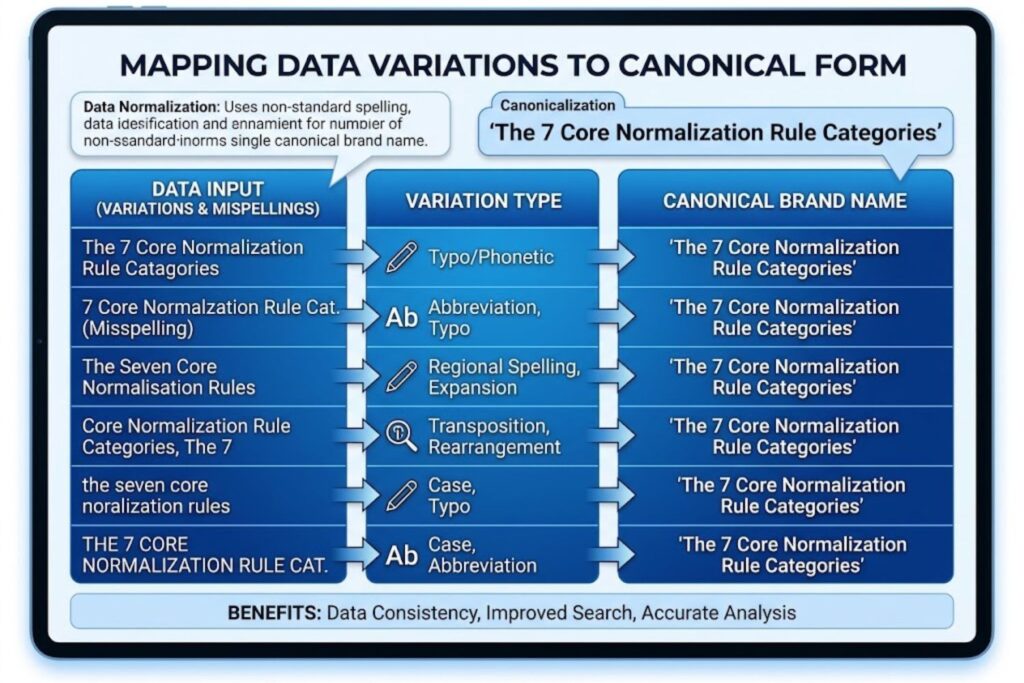
The Problem: Your brand appears as different names across the web.
Real Example:
- Official site: “TechWoid”
- Wikipedia: “Tech Woid”
- News articles: “Tech Woid Inc.”
- Industry directories: “TECHWOID”
- LinkedIn: “TechWoid Inc”
Each variation is technically correct, but an AI system may interpret them as different entities or get confused about your actual name.
Normalization Rule: Define a single canonical brand name and map all variations to it.
Canonical: "TechWoid"

Variations mapped to canonical:
- "Tech Woid" → "TechWoid"
- "Tech Woid Inc." → "TechWoid"
- "TECHWOID" → "TechWoid"
- "TechWoid Inc" → "TechWoid"
Implementation: Update your website header schema markup, Google Business Profile, and all directory listings to use the exact same name consistently.
2. URL & Domain Normalization
The Problem: Multiple URLs lead to your brand (with or without www, http vs https, trailing slashes).
Real Example:
techwoid.com
www.techwoid.com
https://techwoid.com
Home
techwoid.com/index.html
AI crawlers deduplicate these, but inconsistency signals weakness to ranking systems.
Normalization Rule: Choose one canonical URL structure and redirect all others to it.
Canonical: https://www.techwoid.com

Redirects:
- techwoid.com → https://www.techwoid.com (301)
- http://techwoid.com → https://www.techwoid.com (301)
- https://techwoid.com → https://www.techwoid.com (301)
3. Product & Service Name Normalization
The Problem: Your offerings appear under different names across platforms.
Real Example:
- Your website: “AI Brand Monitor Pro”
- G2 Review site: “AI Brand Monitor”
- LinkedIn: “AI Brand Monitoring Platform”
- Press releases: “BrandRank AI”
- Customer testimonials: “the monitoring tool”
Normalization Rule: Define official names for each product and standardize references across all platforms.
Official Product Names (canonical):
- "AI Brand Monitor Pro" (not "AI Brand Monitor")
- "Visibility Dashboard" (not "dashboard" or "reporting tool")
- "Citation Tracking Suite" (not "citation tracker")
4. Category & Industry Taxonomy Normalization
The Problem: You describe your industry differently across sources.
Real Example:
Website: "B2B SaaS for Marketing"
LinkedIn: "Software as a Service"
G2: "Marketing Technology"
Crunchbase: "Enterprise Software"
News: "AI Marketing Platform"
Normalization Rule: Choose standard industry categories and use them consistently.
Canonical categories:
- Primary: "Software as a Service (SaaS)"
- Secondary: "AI & Machine Learning"
- Tertiary: "Marketing Technology"

Use these exact categories on:
- LinkedIn (Company) page
- G2 and Capterra profiles
- Crunchbase listing
- Schema markup
- About page
This is critical because AI systems use category consistency to validate brand authority. If you’re scattered across different industry definitions, you look undefined.
5. Location & Address Normalization
The Problem: Your address appears in multiple formats.
Real Example:
Website: "123 Main Street, Suite 400, San Francisco, CA 94105"
Google Maps: "123 Main St Suite 400, San Francisco, California 94105"
LinkedIn: "San Francisco, CA"
WhatsApp Business: "123 Main Street SF CA 94105"
Press kit: "San Francisco headquarters"
Normalization Rule: Define canonical address format and use it everywhere.
Canonical format: "123 Main Street, Suite 400, San Francisco, CA 94105, United States"

Fields standardized:
- Street address (avoid abbreviations like "St" vs "Street")
- City (full name, not abbreviation)
- State (two-letter code)
- ZIP code (always 5 digits)
- Country (full name)

Apply to:
- Schema.org LocalBusiness markup
- Google Business Profile
- All directory listings
- Footer of website
6. Contact Information Normalization
The Problem: Phone numbers, emails, and social links appear in different formats.
Real Example:
Phone variations:
- +1-415-555-0123
- +1 (415) 555-0123
- 415.555.0123
- (415) 555-0123

Email variations:
- info@techwoid.com
- support@techwoid.com
- contact@techwoid.com

Social profiles:
- facebook.com/TechWoid
- facebook.com/techwoid
- @techwoid on Twitter
- @TechWoid on Twitter
Normalization Rule: Standardize format and choose one canonical contact method per category.
Canonical formats:
- Phone: "+1 (415) 555-0123"
- Email: "hello@techwoid.com"
- Social: @TechWoid (capitalization matters)

Apply to:
- Schema markup (sameAs, contact point)
- All directory listings
- Website footer
- Email signature guidelines
7. Content & Citation Normalization
The Problem: How you’re described in third-party sources differs dramatically.
Real Example:
Source 1: "TechWoid, an AI marketing platform"
Source 2: "The AI visibility tool TechWoid"
Source 3: "TechWoid provides SaaS solutions"
Source 4: "TechWoid Inc helps brands"
Source 5: "Founded in 2020, TechWoid offers monitoring"
Normalization Rule: You can’t control every source, but you can influence the most important ones by providing consistent, quotable descriptions.
Official description (use this everywhere):
"TechWoid is an AI visibility platform that helps brands
understand how they appear in ChatGPT, Gemini, Claude,
and other AI systems."

Variation for long-form:
"TechWoid measures brand visibility across AI answer engines,
tracks citations and accuracy, and helps companies optimize
for AI search."

One-liner:
"AI visibility monitoring for brands."
Provide this language in:
- Press kit
- LinkedIn company bio
- About page
- Schema markup (Organization description)
- Directory listings (where you can control it)
Real-World Examples That Show the Impact
Example 1: The E-commerce Brand
Situation: A mid-size e-commerce brand sells under multiple product lines with inconsistent naming.
Before Normalization:
- Website lists: “Ecobag Pro,” “Eco Bag Pro,” “The Eco Bag”
- Amazon shows: “ECO BAG PRO”
- Walmart lists: “Eco Bag”
- TikTok creator content: “that eco bag brand”
When an AI system searched for “sustainable bags,” it found mentions of what appeared to be 3-4 different brands. Citations were split. Search visibility fragmented.
After Normalization:
All internal and external references standardized to “Ecobag Pro.” Schema markup updated everywhere they could control it. They added structured data to product listings across Shopify, Amazon Enhanced Brand Content, and their website.
Result: Within 6 weeks, mentions in AI Overviews increased 340%. Instead of fragmented citations, they appeared as one consistent brand. ChatGPT started citing them as “the leading option” for eco-friendly bags instead of mentioning them alongside confused variants.
Example 2: The B2B SaaS Company
Situation: A project management tool was building authority but couldn’t gain traction in AI citations.
Before Normalization:
- Website: “ProjectFlow”
- G2: “Project Flow”
- Crunchbase: “Project-Flow Inc”
- LinkedIn: “ProjectFlow Inc”
- Press releases: “the project management solution ProjectFlow”
- Customer reviews: “ProjectFlow’s tools” vs “Project Flow’s tools”
The company had genuine authority but couldn’t show it consistently.
After Normalization:
- Brand standardization: All sources updated to “ProjectFlow” (one word)
- Category alignment: Consistent categorization as “Project Management Software” across G2, Capterra, and schema markup
- Founder & team consistency: Founder bio updated everywhere with identical company affiliation
- Schema enhancement: Comprehensive Organization schema added to every page, with connected Person schemas for founders
Result: AI citations increased 210% within 8 weeks. Perplexity and Google AI Overviews began citing them alongside market leaders because the data consistency signaled authority.
How to Audit Your Brand Data Right Now
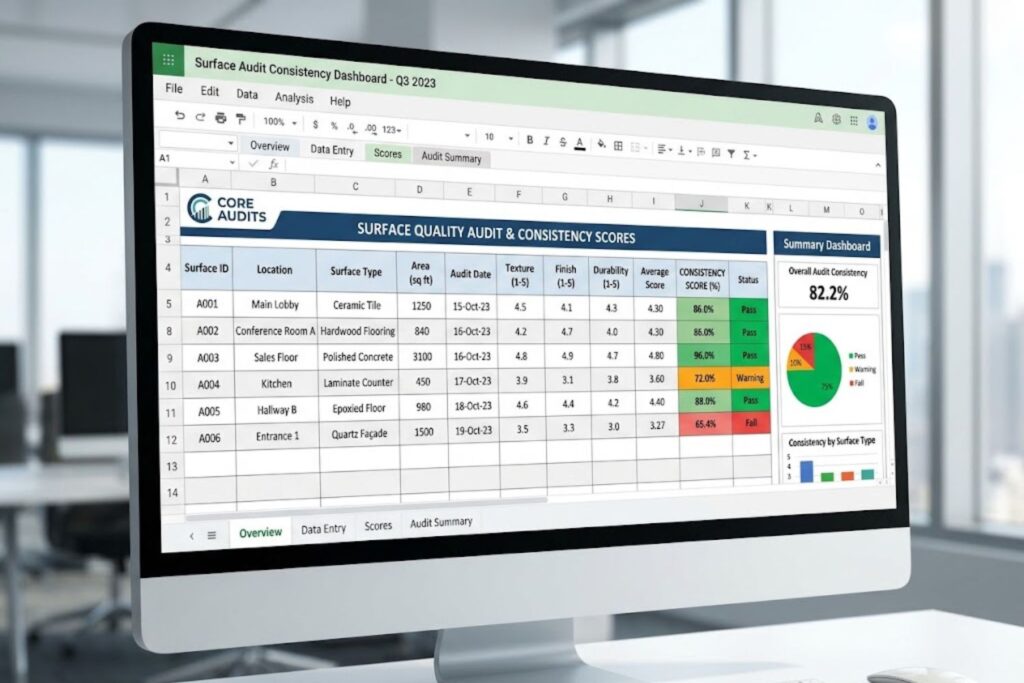
You don’t need a consultant to audit your current normalization status. This checklist takes 2-3 hours.
Step 1: Search Across 10 Surfaces
For your brand name, search these surfaces and document how you appear:
- Your website (header, footer, about page)
- Google Business Profile
- LinkedIn Company Page
- Wikipedia (if applicable)
- Crunchbase
- G2 or Capterra
- Press mentions (last 5 news articles about your brand)
- Social media (Twitter/X, LinkedIn, Facebook)
- Industry directories (specific to your industry)
- Review sites (Trustpilot, Yelp, industry-specific)
Step 2: Create a Normalization Audit Sheet
Use this format (or download a template):
| Surface | Brand Name | Address | Category | Descriptor |
|---|---|---|---|---|
| Your website | TechWoid | 123 Main St, SF, CA 94105 | SaaS | AI visibility platform |
| Google Business | TechWoid | 123 Main Street Suite 400, San Francisco, CA 94105 | Software | — |
| TechWoid Inc | San Francisco, CA | Software | AI visibility and monitoring | |
| Wikipedia | — | — | — | — |
| Crunchbase | TechWoid | SF, CA | Enterprise Software | AI analytics |
Look for: Inconsistencies in spelling, formatting, addresses, category tags, and how you’re described.
Step 3: Calculate Your Consistency Score
For each field (brand name, address, category, descriptor), calculate consistency:
- 10/10 mentions identical = 100% consistent
- 7/10 mentions identical = 70% consistent
- 4/10 mentions identical = 40% consistent
Average these scores to get your overall normalization health. Most brands score 45-65%. Best-in-class brands score 85%+.
Step 4: Prioritize Fixes
Fix in this order:
- Your controlled properties first (website, LinkedIn, Google Business Profile)
- High-authority, influenceable properties (press kit, industry directories you can contact)
- Third-party sources (Wikipedia edits, review site bios—request corrections)
Step-by-Step Implementation Framework
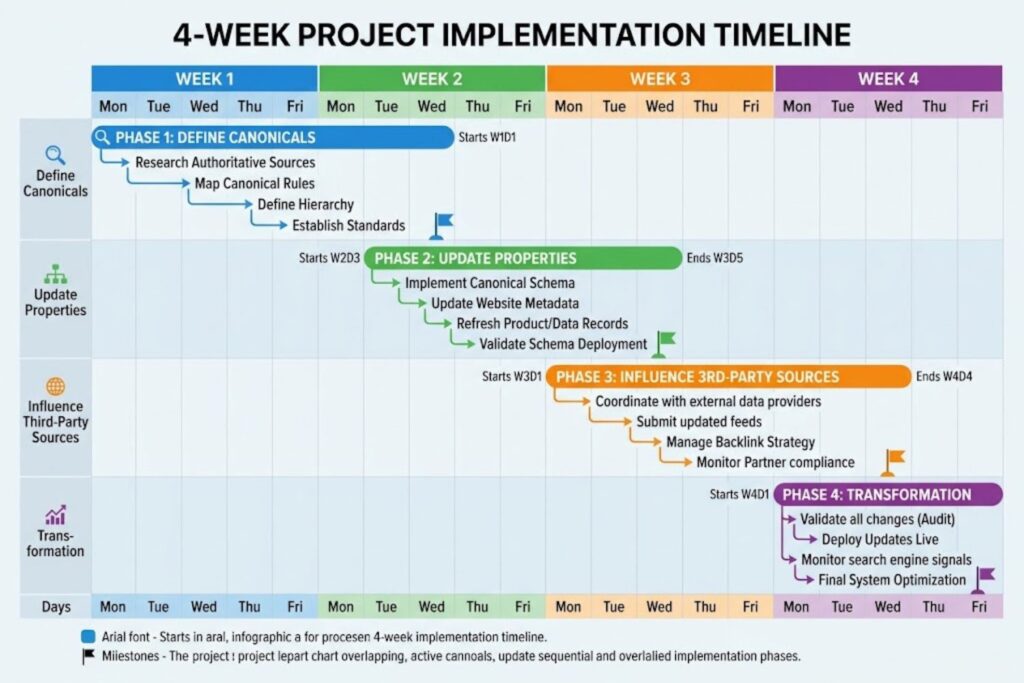
Phase 1: Define Canonicals (Week 1)
Create a “Brand Bible” document that specifies the canonical (official) version of:
- Brand name (with and without “Inc,” “LLC,” etc.)
- Official website URL
- Primary address
- Industry/category tags
- Official description (2-3 versions: one sentence, paragraph, long-form)
- Product names
- Founder/executive names and titles
Deliverable: A shared document (Google Doc or PDF) that every team member can reference.
Phase 2: Update Controlled Properties (Weeks 2-3)
Priority 1 (This week):
- Website header schema markup (Organization schema)
- Meta descriptions and title tags
- Footer information
- About page
Priority 2 (This week):
- Google Business Profile
- LinkedIn Company Page
- Your top 3 business directory listings
Priority 3 (Next week):
- Email signatures
- Press kit
- Social media bios
- Vendor profiles (if you’re listed as a partner anywhere)
How to implement schema markup:
If you’re on WordPress, install the “Yoast SEO” or “Rank Math” plugin and fill in the Organization section completely. On custom sites, add this to your <head>:
html
<script type="application/ld+json">
{
  "@context": "https://schema.org",
  "@type": "Organization",
  "name": "TechWoid",
  "url": "https://www.techwoid.com",
  "logo": "https://www.techwoid.com/logo.png",
  "sameAs": [
    "https://www.linkedin.com/company/techwoid",
    "https://twitter.com/techwoid",
    "https://www.crunchbase.com/organization/techwoid"
  ],
  "address": {
    "@type": "PostalAddress",
    "streetAddress": "123 Main Street, Suite 400",
    "addressLocality": "San Francisco",
    "addressRegion": "CA",
    "postalCode": "94105",
    "addressCountry": "US"
  },
  "contactPoint": {
    "@type": "ContactPoint",
    "contactType": "Customer Service",
    "telephone": "+1-415-555-0123",
    "email": "hello@techwoid.com"
  },
  "description": "AI visibility platform that helps brands understand how they appear in ChatGPT, Gemini, Claude, and other AI systems."
}
</script>
Phase 3: Influence Third-Party Sources (Weeks 4-6)
For the directories and sites you can control:
- Crunchbase: Update your profile with consistent category, description, and founder information
- G2/Capterra: Ensure your product category is consistent with how you describe yourself
- Industry directories: Email the moderator with corrections
- Press kits: Host an updated press kit with consistent branding and descriptions
For sources you can’t control directly (Wikipedia, news mentions), use the “Edit” feature or contact the publication.
Phase 4: Transformation & AI Readiness (Ongoing)
Once your data is normalized, ensure it’s in formats AI systems can actually consume:
- Schema markup on every page (Organization, Article, Product as applicable)
- Structured data in feeds (if you have product listings, ensure they’re in standardized XML/JSON)
- Knowledge Graph optimization (link your schema across pages using entity references)
- Entity consistency in content (whenever you mention your brand, location, or products, use the canonical form)
Common Mistakes & How to Fix Them
Mistake 1: Rigid Rules Without Exceptions
The Problem: Some brands intentionally break naming conventions. Apple uses “iPhone” (lowercase i). eBay uses “eBay” (lowercase e). A rigid rule set that forces everything to Title Case destroys your brand identity.
The Fix: Allow exceptions for trademarked names. Define these in your Brand Bible:
Canonical exceptions:
- "iPhone" (not "iPhone" Title Case)
- "eBay" (not "Ebay")
- "TechWoid" (not "Tech Woid")
Make these explicit so teams don’t “correct” them to Title Case.
Mistake 2: Overwriting Raw Data
The Problem: You normalize your data but delete the original messy versions. Six months later, an audit reveals an error, and you can’t roll back or investigate what went wrong.
The Fix: Preserve raw data alongside normalized data.
Database structure:

records = {
  id: 123,
  raw_brand_name: "tech woid inc",
  normalized_brand_name: "TechWoid",
  raw_address: "123 main street sf ca",
  normalized_address: "123 Main Street, San Francisco, CA 94105",
  normalization_rule_applied: "address_format_v2.3",
  audit_timestamp: "2026-07-15",
  normalized_by: "automation",
  reviewed_by: "human"
}
This lets you audit, troubleshoot, and roll back if needed.
Mistake 3: Normalization Without Transformation
The Problem: Your data is clean, but it’s still just sitting in a spreadsheet or database. AI systems can’t access or parse it.
The Fix: Transform normalized data into formats AI systems actually use:
- JSON-LD schema markup on your website
- Structured data feeds for product information
- API outputs if you publish data programmatically
- Sitemaps that help crawlers prioritize key pages
Without transformation, normalized data has no impact on AI visibility.
Mistake 4: Normalization Across Multiple Inconsistent Systems
The Problem: Your CRM stores “TechWoid Inc,” your website says “TechWoid,” and your database uses “TECHWOID_CORP.” You normalize one system but forget the others.
The Fix: Map all systems to a single master record.
Master canonical source: Website + Schema Markup

System mappings:
- CRM: "TechWoid Inc" → TechWoid (master)
- Database: "TECHWOID_CORP" → TechWoid (master)
- Email: "Info@TechWoid.Com" → hello@techwoid.com (master)
- Analytics: "Tech Woid" → TechWoid (master)

Create a master data management (MDM) layer that routes all systems
to the canonical source.
Mistake 5: Assuming Normalization Solves Everything
The Problem: You normalize your data, implement schema markup, and wait for AI citations to skyrocket. Nothing happens.
The Fix: Normalization is necessary but not sufficient. You also need:
- Topical authority (consistent, expert publishing in your niche)
- Content freshness (actually updated information, not just an updated timestamp)
- Entity consistency across the wider web (if you’re mentioned in 100 places with 100 different variations, normalization on your site alone won’t help)
- Genuine expertise signals (author bios, credentials, track record)
Normalization is infrastructure. Content quality is the foundation it stands on.
Measurement & Validation Strategies
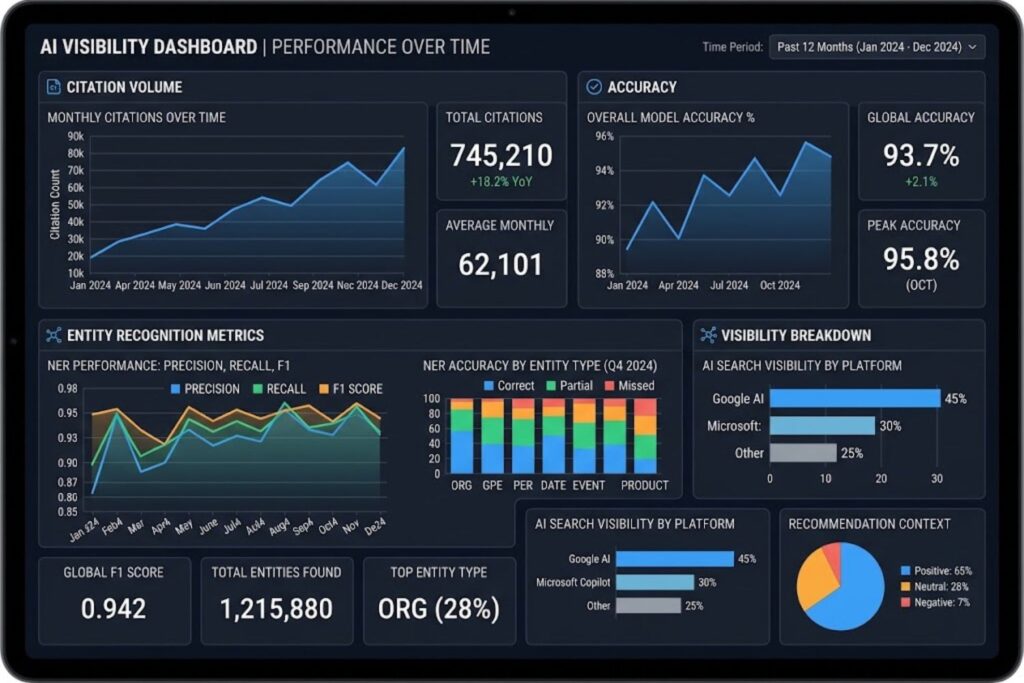
You can’t improve what you don’t measure. Here’s how to track whether your normalization efforts are actually moving the needle.
Metric 1: Brand Mention Consistency Across AI Platforms
What to track: How consistently your brand name, description, and attributes appear across ChatGPT, Gemini, Claude, and Perplexity.
How to measure:
- Search for 20 common questions in your category across all 4 platforms
- Document every mention of your brand (or competitors)
- Note the exact wording for each mention
- Calculate consistency
Example tracking:
| Question | Platform | Mention | Consistency |
|---|---|---|---|
| “best AI monitoring platform” | ChatGPT | “TechWoid, which tracks brand visibility” | ✓ Accurate |
| Gemini | “TechWoid, an AI visibility tool” | ✓ Accurate | |
| Claude | “TechWoid offers monitoring” | ✓ Accurate | |
| Perplexity | “Tech Woid provides analytics” | ✗ Name inconsistent |
Target: 80%+ consistency across platforms and mentions.
Metric 2: Citation Volume & Accuracy
What to track: How often you’re cited, and whether the citations are accurate.
Tools:
- BrandRank.ai (platform designed for this)
- Semrush’s Brand Monitoring
- Brandwatch
- Mention.com
What matters:
- Raw citation count month-over-month
- % of citations that are accurate (vs. confused or attributed to competitors)
- Citation trends across different AI platforms
Example:
July 2026: 45 citations across AI platforms
- ChatGPT: 20 (100% accurate)
- Gemini: 18 (94% accurate — one mentioned outdated pricing)
- Claude: 5 (100% accurate)
- Perplexity: 2 (50% accurate — confused with competitor)

August 2026: 67 citations across AI platforms
- ChatGPT: 28 (100% accurate)
- Gemini: 26 (96% accurate)
- Claude: 9 (100% accurate)
- Perplexity: 4 (100% accurate)

Result: +49% citations, +2% accuracy (fewer confused mentions)
Metric 3: Entity Recognition Confidence
What to track: Whether AI systems confidently recognize you as a single, distinct entity.
How to measure:
Ask ChatGPT or Claude: “Tell me everything you know about [Brand]. Who are they? What do they do? Where are they located? Who founded them?”
Grade the response:
- A (Confident): Clear, specific, accurate details. Shows the system knows exactly who you are.
- B (Partial): Some accurate info, but missing details or slight inconsistencies.
- C (Confused): Mixes you up with competitors, missing key facts, or vague descriptions.
- D (Unrecognized): System has minimal information or can’t distinguish you from others in your space.
Goal: Move from C/D → B → A over 6 months as normalization improves.
Metric 4: Schema Validation
What to track: Whether your structured data is valid and increasing in completeness.
Tool:
- Test your homepage
- Note any errors or warnings
- Retest monthly
Track over time whether you’re adding more schema properties and reducing errors.
What to validate:
- Organization schema on homepage
- Article schema on blog posts
- LocalBusiness schema if applicable
- Product schema for each product
- FAQPage schema for FAQ sections
Schema Markup Integration: Making Your Normalized Data Actionable
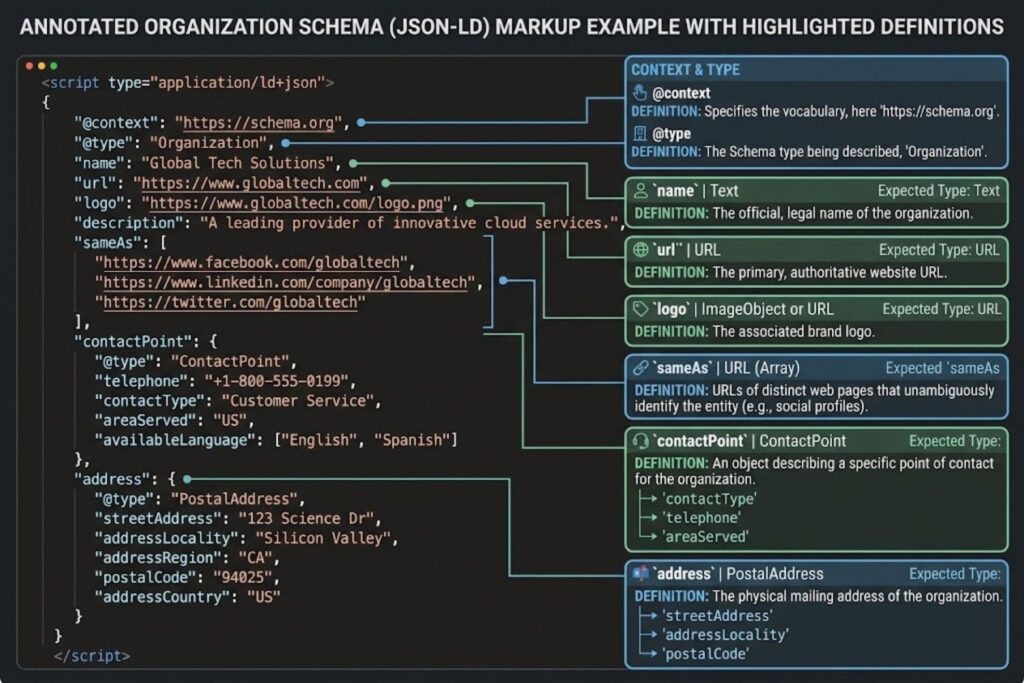
Normalization without schema markup is like having an accurate database that no one can access.
Schema markup is the format that makes normalized data parseable by AI systems.
Minimum Schema for AI Visibility
Every website should have, at minimum:
1. Organization Schema (Site-wide)
json
{
  "@context": "https://schema.org",
  "@type": "Organization",
  "name": "TechWoid",
  "url": "https://www.techwoid.com",
  "logo": "https://www.techwoid.com/logo.png",
  "sameAs": [
    "https://www.linkedin.com/company/techwoid",
    "https://www.crunchbase.com/organization/techwoid",
    "https://twitter.com/techwoid"
  ],
  "description": "AI visibility platform for brands",
  "address": {
    "@type": "PostalAddress",
    "streetAddress": "123 Main Street, Suite 400",
    "addressLocality": "San Francisco",
    "addressRegion": "CA",
    "postalCode": "94105",
    "addressCountry": "US"
  },
  "contactPoint": {
    "@type": "ContactPoint",
    "contactType": "Customer Support",
    "email": "hello@techwoid.com",
    "availableLanguage": "en"
  },
  "foundingDate": "2020",
  "founder": {
    "@type": "Person",
    "name": "Jane Smith",
    "url": "https://www.techwoid.com/about/jane-smith"
  }
}
Place this in your site header (most critical placement) so it appears on every page.
2. Article Schema (Blog Posts)
Every blog post should have Article schema that links back to your Organization:
json
{
  "@context": "https://schema.org",
  "@type": "Article",
  "headline": "BrandRank.ai Normalization Rules Guide",
  "author": {
    "@type": "Person",
    "name": "John Doe",
    "url": "https://www.techwoid.com/about/john-doe"
  },
  "publisher": {
    "@type": "Organization",
    "name": "TechWoid",
    "url": "https://www.techwoid.com"
  },
  "datePublished": "2026-07-15",
  "dateModified": "2026-07-15"
}
3. Product Schema (If Applicable)
json
{
  "@context": "https://schema.org",
  "@type": "Product",
  "name": "AI Brand Monitor Pro",
  "manufacturer": {
    "@type": "Organization",
    "name": "TechWoid"
  },
  "description": "Real-time brand monitoring across ChatGPT, Gemini, Claude, and Perplexity",
  "brand": {
    "@type": "Brand",
    "name": "TechWoid"
  }
}
Why Schema Markup Matters for Normalization
Research shows that brands with clean entity signals across five or more surfaces receive 2.3x more consistent citations across AI engines than brands with fragmented or contradictory data.
Schema markup is how you create those “clean entity signals.”
Without it, your normalized data is invisible to AI systems. With it, you’re giving AI systems a structured, machine-readable version of your canonical identity.
Tools & Automation
You don’t have to do this manually for every mention of your brand.
For Monitoring & Auditing
| Tool | Purpose | Cost |
|---|---|---|
| BrandRank.ai | Monitor brand mentions across ChatGPT, Gemini, Claude, Perplexity; track accuracy and consistency | Premium |
| SEMrush Brand Monitoring | Track brand mentions and citations across web | Included in SEMrush plan |
| Brandwatch | AI-powered brand monitoring across web and social | Enterprise |
| Mention.com | Real-time brand mention tracking | Free/Paid tiers |
| Google Search Console | Monitor how Google sees your schema markup | Free |
For Schema Implementation & Validation
| Tool | Purpose | Cost |
|---|---|---|
| Rank Math (WordPress) | SEO plugin with built-in schema builder | Free/Paid |
| Yoast SEO (WordPress) | Schema markup for WordPress sites | Free/Paid |
| Google’s Rich Results Test | Validate schema markup | Free |
| Schema.org Validator | Check for errors in JSON-LD | Free |
| Screaming Frog | Crawl site and audit schema across all pages | Free/Paid |
For Data Normalization & Transformation
| Tool | Purpose | Cost |
|---|---|---|
| Talend | Enterprise data integration & normalization | Enterprise |
| Apache Beam | Open-source data pipeline framework | Free |
| Zapier | Connect business apps, normalize data flows | Freemium |
| Make (formerly Integromat) | Visual workflow automation | Freemium |
For most small-to-medium brands, you won’t need enterprise tools. Start with:
- Manual audits using a spreadsheet
- Schema markup using WordPress plugins or Zapier
- Monitoring using free tools (Google Search Console) or affordable SaaS (Mention.com)
Common Misconceptions (That Hurt Your AI Visibility)
Misconception 1: “Normalization is only for big enterprises”
False. A single-person freelancer with one website benefits enormously from consistent branding and schema markup. You don’t need complex infrastructure. You need consistency.
Misconception 2: “If I normalize my site, AI citations happen automatically”
False. Normalization is infrastructure. You still need:
- Quality content
- Topical authority
- Genuine expertise
- Fresh, accurate information
- Natural mentions across reputable sources
Schema markup improves how AI systems understand your content, not whether they’ll cite you.
Misconception 3: “The phrase ‘BrandRank.ai normalization transformation rules’ is an official framework published by BrandRank.ai”
False (and we appreciate you asking). BrandRank.ai is a platform that measures AI visibility. The phrase “normalization transformation rules” is industry shorthand for the data standardization practices that affect AI visibility. It’s not a named technical specification you can download from their website.
Misconception 4: “I can ignore normalization if my content is really good”
Partially false. Exceptional content helps. But consider two scenarios:
Scenario A: Your content is excellent, but your brand name appears as “TechWoid,” “Tech Woid,” and “TECHWOID” across the web. Your address is in five different formats. AI systems struggle to recognize you as one entity.
Scenario B: Your content is good, your competitor’s content is also good, but their brand is perfectly consistent everywhere. Who does an AI system cite? The one it can confidently recognize as a single, authoritative entity.
Normalization doesn’t replace content quality. It amplifies content quality.
FAQ: Everything Else You Need to Know
Q: Is “BrandRank.ai normalization transformation rules” a real product or specification?
A: BrandRank.ai is a real SaaS platform measuring brand visibility in AI systems. However, the phrase “BrandRank.ai normalization transformation rules” is industry shorthand—not an official published specification. The platform measures the impact of normalization practices, but doesn’t publish a named rulebook with that exact title. The term has become common among SEO and AI visibility specialists as a way to discuss data standardization practices.
Q: How long does it take to see results from normalization?
A: Consistency signals are immediate (once schema markup is live, search engines can read it instantly). Measurable changes in AI citations typically appear within 2-8 weeks, depending on how aggressive the normalization is and how quickly AI systems re-crawl your sources. Long-term authority signals build over months.
Q: Do I need to hire an agency to implement this?
A: No, but it helps if you don’t have technical expertise. The fundamentals—consistent naming, schema markup, and directory updates—can be done by any marketing team with a few hours of training. Agencies are valuable for auditing, transformation layer setup, and ongoing optimization.
Q: What if my brand intentionally uses unconventional spelling or capitalization?
A: Document it as an exception in your Brand Bible. Tell your normalization team: “This is intentional. Don’t ‘fix’ it.” Examples: “iPhone,” “eBay,” “DuckDuckGo.” Make the exception explicit so automation doesn’t override it.
Q: Can I normalize data after the fact, or do I need to prevent messy data first?
A: Both. Prevent new messy data by having clear standards (Brand Bible). Clean existing messy data through audits and corrections. The best approach is prevention + cleanup simultaneously.
Q: Does this work for multi-brand companies?
A: Yes, but with extra complexity. Create separate canonical forms for each brand. Link them through parent-company schema markup. Make clear which brand is the subsidiary and which is the parent so AI systems don’t confuse them.
Q: Will normalization help me rank higher on Google?
A: Indirectly. Schema markup (the transformation output) helps Google understand your content better, which can improve rankings slightly. But normalization’s primary benefit is AI visibility, not traditional search rankings. However, brands that win in AI search often win in traditional search too, because the underlying signals (authority, freshness, consistency) matter to both systems.
Q: What if competitors don’t normalize their data?
A: You win. If your brand is consistently represented and theirs is fragmented, AI systems will cite you more confidently. This is a competitive advantage that compounds over time.
Q: How do I handle multiple offices or locations?
A: Create master Organization schema for your company, and linked LocalBusiness schema for each location. Each location’s address should be fully normalized in the same format.