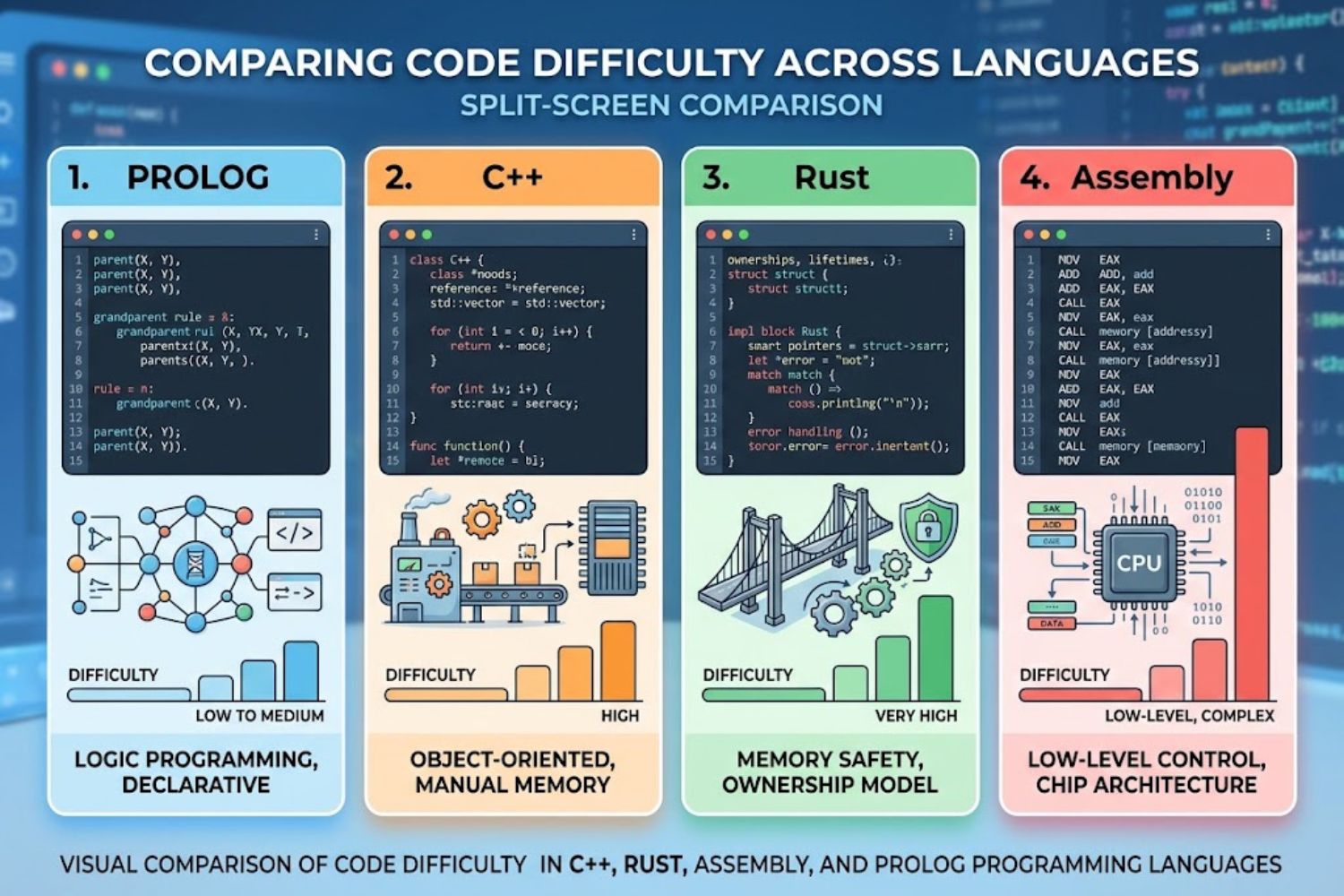
When developers ask “what’s the hardest programming language,” they’re usually looking for one of two things: either they want to challenge themselves or they’re about to make a career decision and want to know what they’re getting into.
The honest answer? It depends.
Language difficulty isn’t one-dimensional. A language might be hard to learn but easy to work with once you understand it. Another might have simple syntax but impossible-to-debug runtime behavior. And some languages are only hard because the ecosystem is small and learning resources are sparse.
Let’s cut through the mythology and look at what actually makes programming languages difficult—and whether learning them is worth your time.
Why Language Difficulty Is More Complex Than You Think
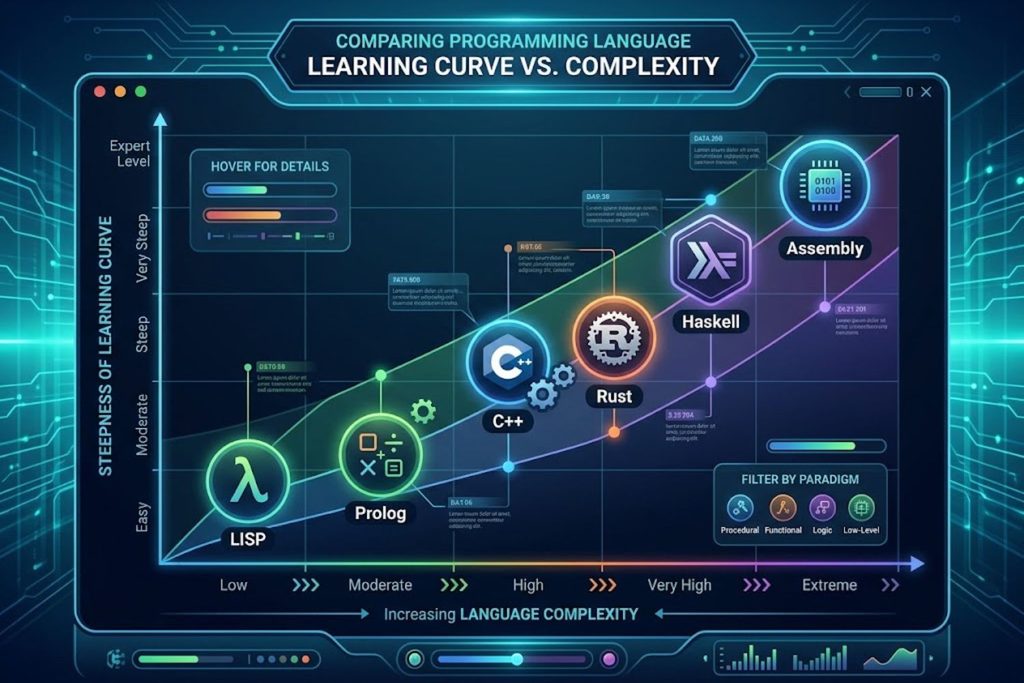
Learning Difficulty vs. Language Complexity
Here’s the critical distinction most articles miss: learning a language is different from mastering a language’s complexity.
Learning difficulty is about the initial barrier to entry. How long before you can write something that works? JavaScript has a low learning barrier. You can write functional code in days. But mastering JavaScript’s asynchronous patterns, prototypal inheritance, and event loop takes months.
Language complexity refers to the depth of concepts you must understand to use the language effectively. Assembly has a brutal learning curve because there’s no hand-holding—you’re managing memory registers directly. But once you understand a few core concepts, you can read and write Assembly. The learning doesn’t get progressively harder; it’s just hard from the start.
C++ is brutal on both dimensions. The learning curve is steep, and the complexity never stops increasing. That’s what makes it genuinely difficult.
Context Matters: Different Challenges for Different Goals
Someone learning Rust for systems programming faces different challenges than someone learning Prolog for artificial intelligence research.
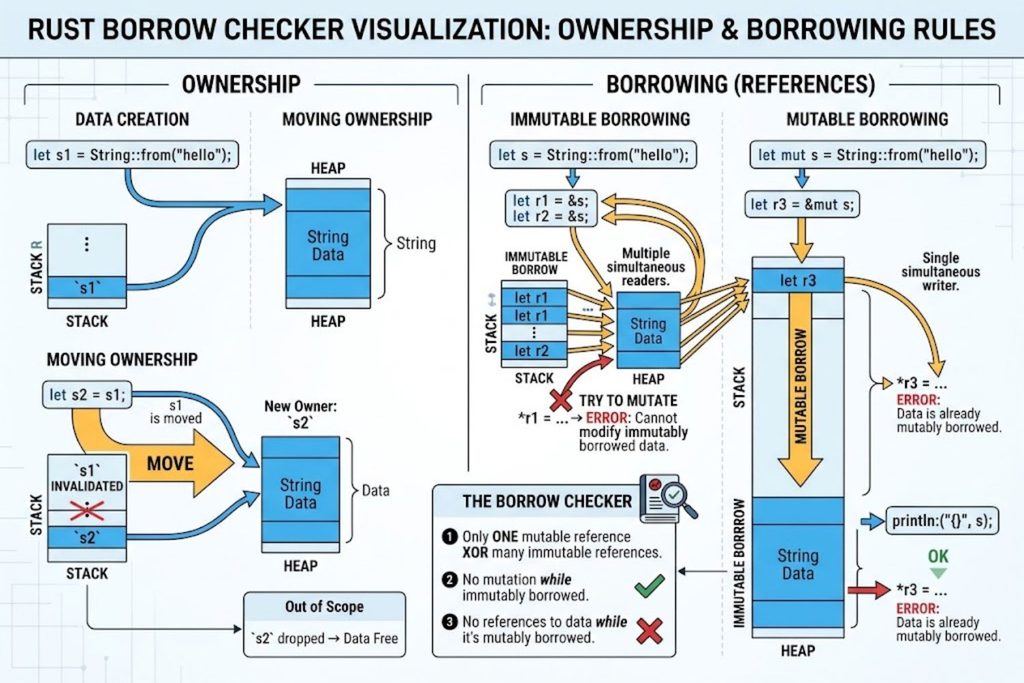
Rust’s difficulty stems from the borrow checker—a feature designed to prevent memory safety bugs. It forces you to think differently about data ownership. That’s a paradigm shift, not just syntax.
Prolog’s difficulty comes from an entirely different computational model. You’re not telling the computer how to solve a problem; you’re telling it what the solution looks like and letting it figure out the steps. This requires retraining your problem-solving approach.
Context shapes difficulty. A C programmer picking up C++ might find it manageable. A Python developer picking up C++ without systems programming experience? That’s a much steeper climb.
The 6 Genuinely Hardest Programming Languages
1. C++ (The Swiss Army Knife of Complexity)
C++ is hard because it tries to do everything. It gives you high-level abstractions and low-level memory control. That flexibility comes at a cost: incredible complexity.
Why beginners struggle: You must understand pointers, memory allocation, object-oriented design, template metaprogramming, and modern C++ features (which keep evolving). You can write terrible C++ code that compiles and runs but crashes unexpectedly. The language doesn’t protect you from yourself.
Experienced developers often say C++ is the language that teaches you how computers actually work. But that education comes through frustration and debugging hell.
When it’s worth learning: If you’re building performance-critical systems, game engines, embedded systems, or trading platforms, C++ is industry standard. The difficulty investment has real career payoff.
2. Rust (Memory Safety Without Garbage Collection)
Rust is a modern systems language designed to prevent entire classes of bugs that plague C and C++. It accomplishes this through compile-time checks that are strict, unforgiving, and initially confusing.
The borrow checker problem: Rust’s most controversial feature is its ownership system and borrow checker. When you pass data around, the compiler needs to verify that you’re not accidentally creating multiple mutable references to the same data. This prevents data races and memory safety issues at compile time.
For developers accustomed to garbage collectors handling memory, or manual memory management, Rust’s approach feels alien. You’re constantly fighting the compiler because you’re trying to write code that violates Rust’s safety guarantees. The error messages are actually helpful (Rust’s greatest achievement), but there are a lot of them.
Why companies are adopting it anyway: Rust eliminates entire categories of production bugs. Once your Rust code compiles, it’s remarkably stable. The upfront difficulty pays dividends in reliability.
3. Assembly Language (Hardware-Level Programming)
Assembly is fundamentally different from higher-level languages. There’s almost no abstraction between your code and the CPU.
You’re working with registers, memory addresses, CPU instructions, and stack manipulation directly. You must understand how the computer actually executes your code—something most languages hide from you.
Zero abstraction = maximum difficulty: There’s no “easy mode” for Assembly. Every line of code is explicit. Debugging requires understanding CPU behavior and memory layout. There’s minimal standard library; you’re writing low-level routines for everything.
Niche but essential: Assembly is rarely used for application development anymore. But it’s essential for kernel development, firmware, embedded systems, and performance-critical sections of high-level code. If your career involves any of these areas, Assembly is non-negotiable.
4. Prolog (Logic Programming Paradigm)
Prolog isn’t hard because of syntax; it’s hard because it requires completely different thinking.
Most programming languages are imperative: you tell the computer what to do, step by step. Prolog is declarative: you describe the problem’s constraints and relationships, and Prolog figures out the solution.
Completely different thinking model: In Prolog, you don’t write loops or conditional statements in the traditional sense. You write facts, rules, and queries. You’re specifying what you know and asking the engine to find solutions that match. This requires retraining how you approach problem-solving entirely.
Who actually uses it: Prolog is relatively niche, used in AI research, expert systems, and logic puzzles. The small community means fewer tutorials, fewer Stack Overflow answers, and fewer job opportunities. That isolation makes it harder to learn.
5. Haskell (Pure Functional Programming)
Haskell enforces functional programming paradigms rigorously. Everything is immutable. Side effects are isolated. Functions are first-class citizens.
Immutability and type systems: If you’ve worked with imperative languages, you’re accustomed to changing variable values. In Haskell, that’s not possible. Instead of mutation, you work with transformations that return new values. This requires a fundamentally different approach to solving problems.
Haskell’s type system is powerful but advanced. Understanding type classes, monads, and higher-order functions takes time. The payoff is compile-time guarantees about your code’s correctness, but the learning curve is steep.
Learning resources are scarce: Haskell has a dedicated community, but fewer learning resources exist compared to mainstream languages. Academic papers often explain concepts better than tutorials, which shifts the difficulty.
6. LISP/Clojure (Unconventional Syntax)
LISP and its modern dialect Clojure use prefix notation and heavy parentheses. This looks alien to programmers trained on languages like Python, Java, or JavaScript.
The parentheses problem: In LISP, you write (+ 1 2) instead of 1 + 2. This extends to everything: (if condition true-branch false-branch) instead of if (condition) {...}. Initially, this feels backward.
But LISP’s real power is code-as-data and powerful macros. You can write programs that generate programs. This is extraordinarily powerful for certain problems but incredibly intimidating when you’re learning.
Powerful but intimidating: The syntax is just the beginning. Understanding how to leverage metaprogramming and functional paradigms takes time. But Clojure specifically has found success in data processing and web development communities.
What Makes a Language Genuinely Hard?
Memory Management Complexity
Languages that expose memory management (C, C++, Rust) are inherently more difficult than languages with garbage collection. You must understand how memory allocation, deallocation, and access patterns affect your program.
Unfamiliar Programming Paradigms
Object-oriented, functional, logic-based, and imperative programming require different mental models. Switching paradigms is harder than learning a new syntax.
Steep Learning Curve Relative to Payoff
Assembly is brutal but valuable for systems programming. Prolog is difficult with limited job opportunities. The effort-to-reward ratio matters when deciding whether difficulty is worth it.
Limited Learning Resources
A language might be genuinely complex, but a strong community with good tutorials makes it more approachable. Prolog’s difficulty is compounded by fewer resources. Rust’s learning curve is steep, but excellent documentation and community support help.
Ecosystem Maturity and Community Size
Mature ecosystems provide libraries, tools, and collective knowledge. Immature or niche ecosystems mean you’re often solving problems that have been solved before, but documentation doesn’t exist in your language.
Hardest Languages by Use Case
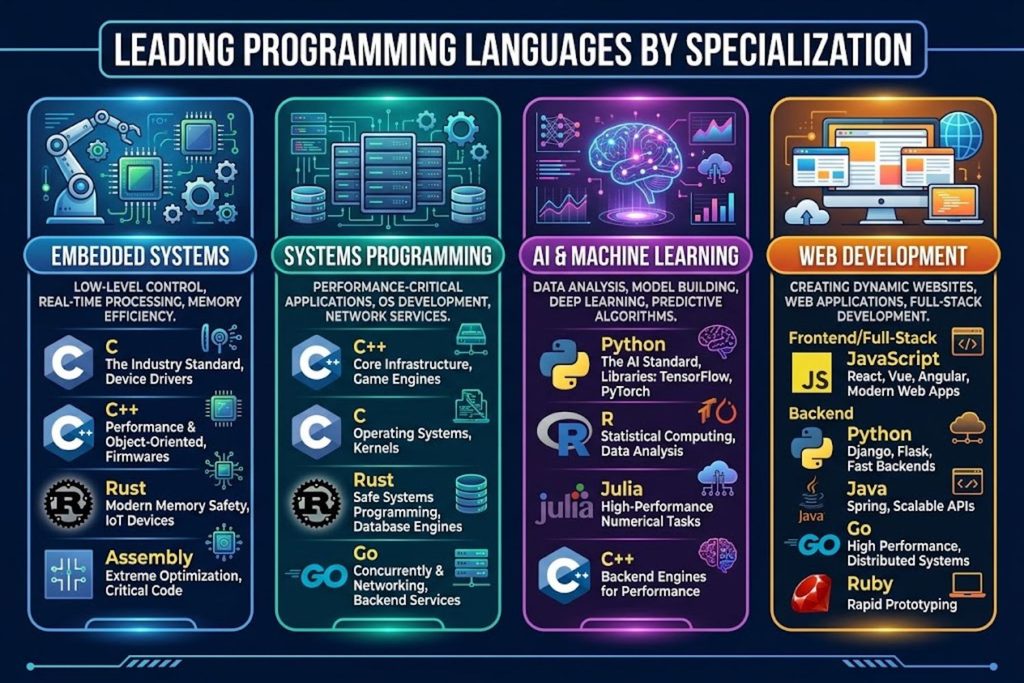
Embedded Systems: Assembly & C
For firmware and embedded development, Assembly and C dominate. C requires memory management knowledge but provides enough abstraction to be productive. Assembly is harder but sometimes necessary for performance-critical sections.
Systems Programming: Rust & C++
Rust is the modern choice for new systems programming projects, but C++ dominates existing codebases. Both demand deep understanding of memory management and performance implications.
Artificial Intelligence: Haskell & Prolog
Haskell’s functional paradigm and strong type system are valuable for AI research. Prolog’s logic programming is historically relevant, though Python now dominates practical AI development.
Web Development: Advanced JavaScript Patterns
JavaScript itself isn’t hard, but advanced patterns—asynchronous programming, state management, metaprogramming—create genuine complexity.
Common Mistakes When Learning Difficult Languages
Skipping the Fundamentals
Developers often jump into advanced features before understanding the core language. With difficult languages, this guarantees frustration. Spend time mastering basic concepts before exploring advanced patterns.
Wrong Learning Resources
Some languages have poor tutorials. For Haskell and Prolog, textbooks and academic papers often explain concepts better than online tutorials. Choosing the right resource accelerates learning dramatically.
Comparing to Your First Language
Your first language shaped how you think about programming. Learning a language with a different paradigm requires unlearning old patterns. That’s not failure; it’s necessary.
Underestimating Mindset Shift Required
Switching from imperative to functional programming, or from mutable to immutable data structures, requires more than syntax adjustment. Give yourself permission to think differently.
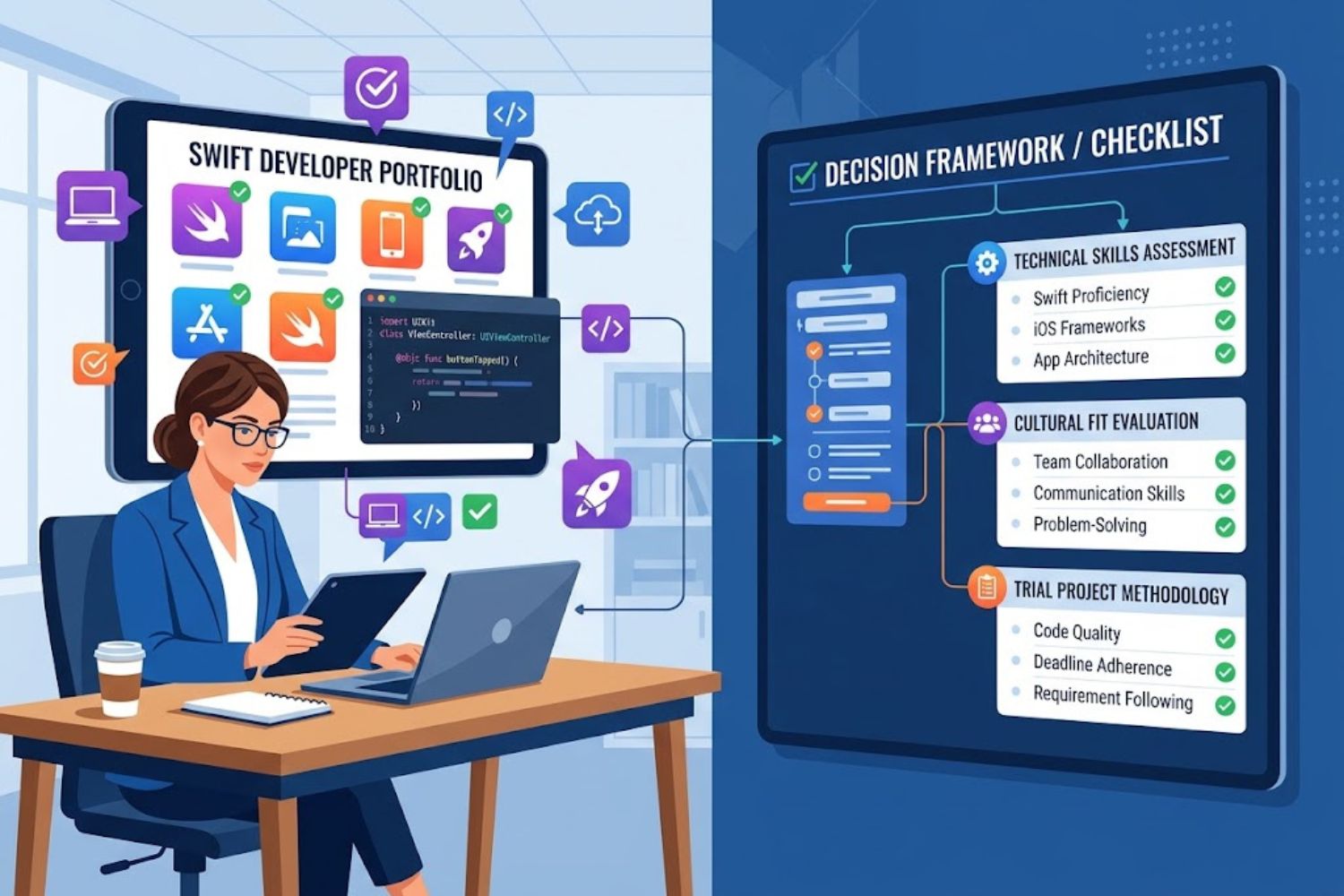
Should You Learn a Hard Language? Decision Framework
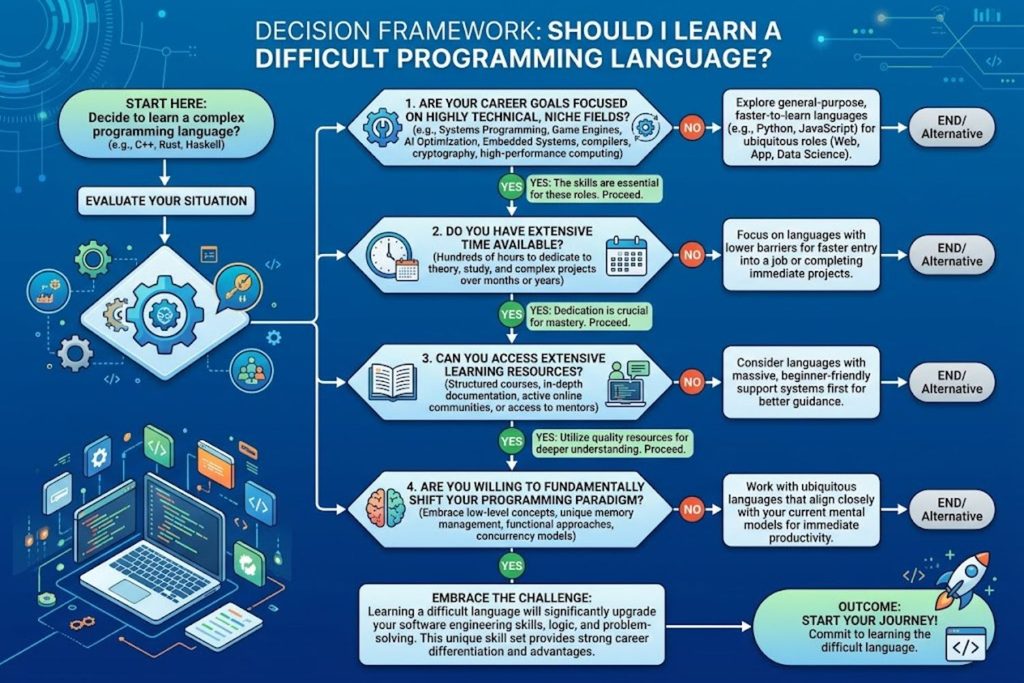
Career Goals Assessment
Will this language advance your career? C++ developers are in demand for systems programming. Rust is gaining adoption. Prolog is niche. Match language difficulty to job market opportunities.
Time Investment Reality
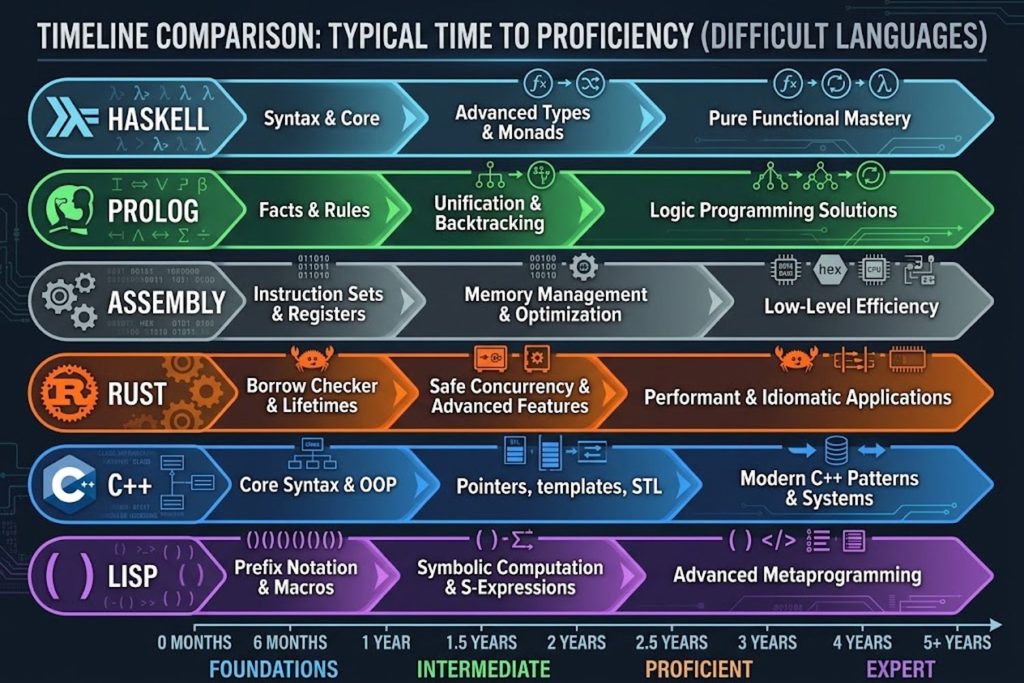
Be honest about time commitment. Becoming proficient in a difficult language typically takes 6–12 months of regular practice. Do you have that bandwidth?
Job Market Considerations
Research whether your target market values the language. Learning Haskell might be intellectually satisfying but limited in job opportunities. C++ has endless demand.
Key Takeaways
The hardest programming languages—C++, Rust, Assembly, Prolog, Haskell, and LISP—are difficult for different reasons. Some demand deep memory management knowledge. Others require paradigm shifts. Some have small communities and sparse resources.
Before committing to learning a difficult language, assess whether the difficulty-to-reward ratio makes sense for your goals. Sometimes the challenge is worth it. Sometimes a more practical language serves you better.
The best language to learn is one that solves problems you care about and opens career opportunities you value. Difficulty is just one factor in that equation.
Frequently Asked Questions: The Hardest Programming Languages
1. Is C++ harder than Python?
Yes, significantly. Python prioritizes readability and has automatic memory management. C++ requires managing memory manually, understanding pointers, and navigating complex syntax. However, Python can have difficult advanced patterns. For most beginners, C++ is much harder.
2. What’s the hardest programming language for a beginner?
Assembly is the hardest for most beginners—zero abstraction between code and hardware is overwhelming. C++ is a close second because it combines complexity with steep learning curves. For someone transitioning from Python or JavaScript, Rust’s borrow checker is surprisingly difficult despite Rust’s modern design.
3. Can I learn a hard language without a computer science degree?
Absolutely. You don’t need formal education to learn difficult languages. What you need is time, quality resources, and persistence. Self-taught developers regularly master C++, Rust, and systems programming. A CS degree helps with theoretical foundations but isn’t required.
4. How long does it take to become proficient in a difficult language?
Expect 6–12 months of consistent practice to write production-ready code in C++, Rust, or Haskell. “Proficient” means understanding idioms, avoiding common mistakes, and writing performant code. Mastery takes years. Assembly and Prolog might take 3–6 months for basics if you’re dedicated.
5. Is Rust harder than C++?
Differently difficult. C++ has more features and higher complexity ceiling, but Rust’s learning curve is actually steeper initially (the borrow checker). Once you understand Rust’s ownership model, it becomes more approachable than C++. Both are genuinely hard.
6. Why is Prolog so different from other languages?
Prolog uses logic programming, a different computational model entirely. Instead of giving the computer steps to follow, you describe the problem’s constraints. Most programmers train their minds imperatively (do this, then that), so logic programming requires retraining how you approach problem-solving.
7. Will learning a hard language make other languages easier?
Yes. Learning C++ teaches you memory management, which makes systems-level concepts clearer. Learning functional languages like Haskell teaches paradigms that apply even in JavaScript or Python. Difficult languages expand your mental toolkit.
8. Should I learn Assembly in 2024?
It depends on your goals. For most application developers, Assembly isn’t necessary. But if you’re doing embedded systems, kernel development, firmware, or reverse engineering, Assembly is essential. It’s also valuable for understanding how computers execute code fundamentally.
9. Is LISP worth learning despite the small job market?
Learning LISP/Scheme/Clojure teaches powerful metaprogramming concepts. It’s worth learning for intellectual growth and understanding functional programming. For career advancement, there are better options unless you specifically want to work with Clojure in data processing.
10. What’s the hardest part about learning Rust?
The borrow checker—Rust’s memory safety system. It prevents you from writing code that violates safety guarantees, which is excellent for preventing bugs but frustrating when learning. The error messages are helpful, but there’s a period of constant compiler disagreement. Once you internalize the ownership model, things click.
11. Can I learn a difficult language part-time?
Yes, but it’s slower. Part-time learning (5–10 hours/week) might take 18–24 months to reach proficiency instead of 6–12 months with full-time focus. Consistency matters more than intensity. Daily practice is better than weekly marathons.
12. Which hard language has the best job market?
C++ has the strongest demand across systems programming, game development, finance, and automotive. Rust is rapidly growing in systems programming and blockchain. Assembly is niche but essential for specific roles. For balancing difficulty with opportunity, C++ offers the best return.
13. Is the borrow checker the main reason Rust is hard?
It’s the primary difficulty for most learners because it’s a paradigm shift, but Rust has other complex features: traits, lifetimes, pattern matching, and functional idioms. The borrow checker is the most frustrating initially, but complexity extends throughout the language.
14. Should I learn Haskell if I only do web development?
Probably not prioritize it immediately. Haskell teaches functional programming concepts that apply to JavaScript, Python, and other languages. If you want to understand functional paradigms deeply, Haskell is exceptional. But for web development career advancement, JavaScript/React expertise is more valuable.
15. What’s the biggest mistake people make when learning difficult languages?
Comparing their progress to easier languages. Learning C++ after Python feels impossibly slow because the complexity gap is huge. Adjust your expectations. Give yourself permission to spend months on fundamentals. That’s normal, not a sign of lacking ability.