
Tech websites are digital platforms that cover technology news, trends, products, reviews, and education. They range from major media outlets like TechCrunch and Wired to specialized niche publications and community-driven forums. Today, tech websites aren’t just news repositories—they’re influential platforms that shape how millions of people understand innovation, make purchasing decisions, and engage with emerging technologies.
In this guide, we explore what tech websites are, how they function, what makes them successful, and how you can build or improve one.
What Are Tech Websites? Definition & Context
A tech website is any online platform dedicated to technology-related content. The definition sounds simple, but the reality is far more nuanced.
Tech websites serve multiple purposes simultaneously. They inform readers about industry developments, establish thought leadership, generate revenue through various channels, build communities, and drive business outcomes for their owners. The most successful ones do all of this without sacrificing credibility.
The Core Elements of a Tech Website:
Tech websites typically include:
- Original reporting and breaking news
- Product reviews and comparisons
- How-to guides and tutorials
- Industry analysis and trend pieces
- Expert commentary and opinions
- Community engagement mechanisms
What differentiates a tech website from a general news site is focus. A tech website’s entire editorial lens is calibrated toward technology—whether that’s hardware, software, AI, cybersecurity, or emerging innovations.
Evolution From Blogs to Media Empires
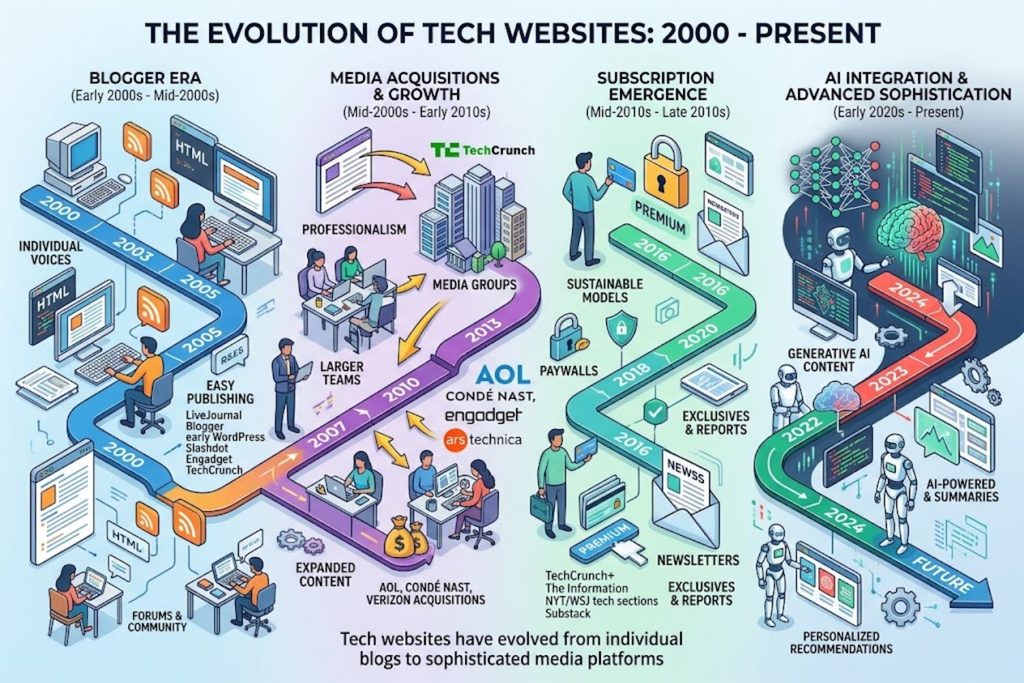
Twenty years ago, tech websites looked nothing like they do today. In the early 2000s, tech coverage came from individual blogger enthusiasts writing about gadgets from basement setups. Sites like Engadget and Gizmodo started this way—passionate founders with minimal budgets.
The transformation was gradual but dramatic:
Phase 1 (2000-2007): Passionate bloggers gain credibility. Digg and Slashdot become community hubs. Advertising (Google AdSense) becomes viable.
Phase 2 (2008-2014): Media companies acquire successful tech blogs. HuffPost acquires AOL. Verizon acquires Yahoo. Major media conglomerates realize tech coverage matters.
Phase 3 (2015-2020): Subscriptions emerge. The Verge thrives without paywalls but experiments with newsletters. Stratechery builds a paid subscriber model from zero. Mobile-first design becomes non-negotiable.
Phase 4 (2021-Present): AI integration, personalization, community platforms, and direct-to-audience revenue become central. Tech websites experiment with podcasts, video, events, and proprietary research.
This evolution matters because it shows tech website success isn’t just about writing good reviews. It’s about building sustainable business models while maintaining editorial independence and audience trust.
Tech Websites vs. Traditional Tech Journalism
Traditional tech journalism—found in publications like Wired or Forbes’ Tech section—operates under institutional editorial standards. These outlets have fact-checkers, legal teams, and established correction policies.
Independent or niche tech websites often move faster but must work harder to establish credibility. They have lower overhead but less institutional backup.
The best modern tech websites blend both approaches: they move with startup speed while maintaining institutional rigor.
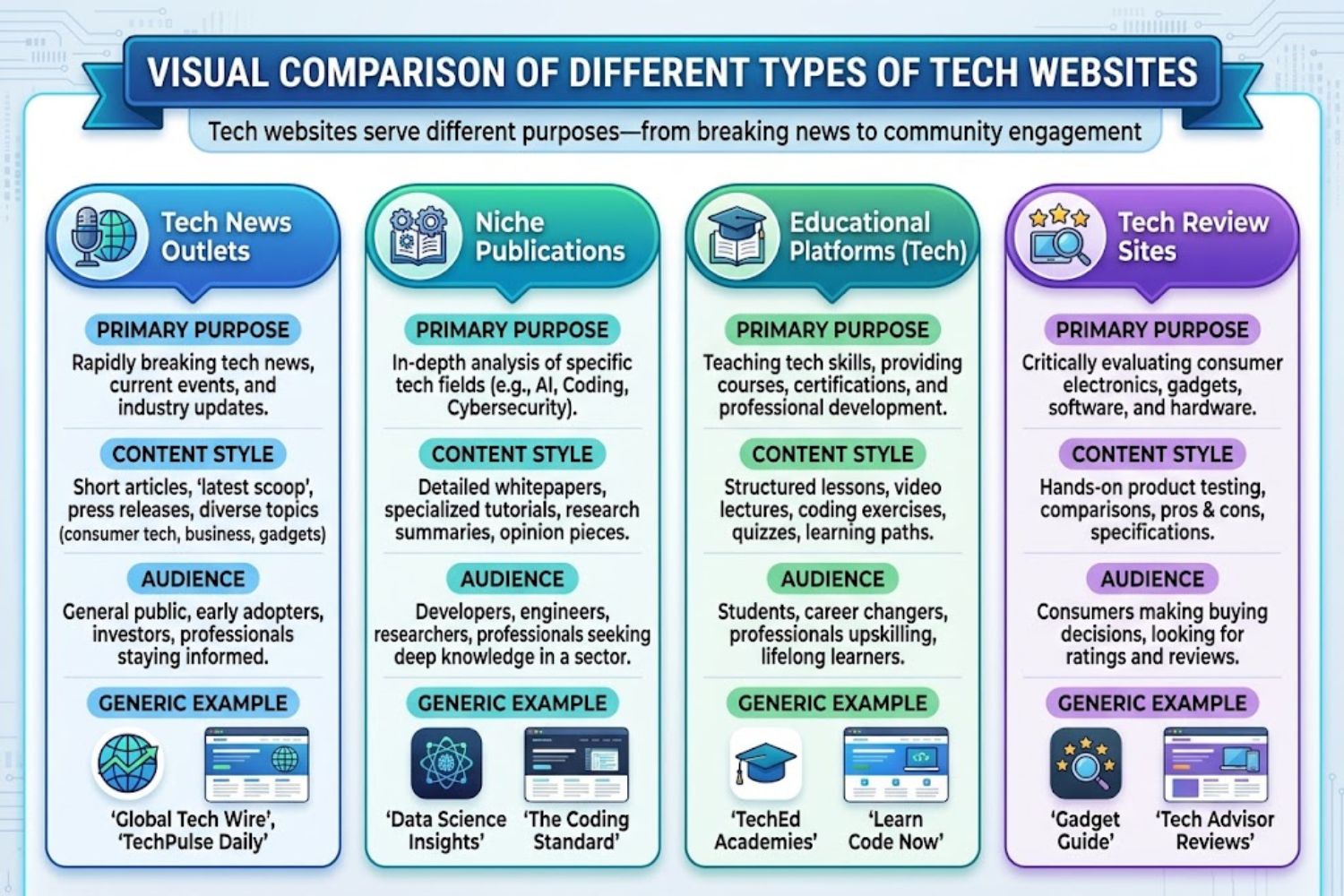
Types of Tech Websites
Not all tech websites serve the same purpose. Understanding the different types helps you identify where opportunities exist and which model might work for your goals.
News & Media Outlets
These are the flagship tech websites most people recognize:
Major Category Examples:
- TechCrunch – Covers startups, funding, and tech industry news
- The Verge – Focuses on consumer tech, gadgets, and cultural impact
- Ars Technica – Deep technical analysis and long-form features
- Wired – Tech culture, innovation, and business intersection
These outlets employ dozens of journalists, run breaking news desks, and compete for scoops. They generate revenue primarily through advertising but increasingly through sponsorships and affiliate content.
Revenue Reality: High traffic but increasingly challenged by ad blockers and declining CPM rates. Most major tech news outlets now rely on venture funding or corporate ownership to subsidize operations.
Niche Specialist Publications
Not every tech website needs massive scale. Some of the most profitable tech websites focus on narrow audiences:
- Protocol – Enterprise technology and digital transformation
- Mobile Dev Memo – Focused exclusively on mobile app development
- Cybersecurity Magazine – Deep-dives into security topics
- AI Journal – Artificial intelligence research and applications
These sites thrive because they own specific keywords and serve underserved audiences. They charge higher advertising rates because ads are highly targeted. Niche publications have lower traffic but higher profit margins.
Community & Forum Platforms
Reddit’s r/technology and Stack Overflow are technically tech websites. So are Discord communities and Slack groups focused on programming or tech.
These platforms succeed through user-generated content and community moderation. Revenue comes from premium features, sponsorships, or venture funding rather than advertising.
Educational & Tutorial Sites
Platforms like freeCodeCamp, Codecademy, and Udemy teach technology skills. These are tech websites with a different primary goal: education rather than news.
Educational tech websites often generate revenue through:
- Course sales
- Certifications
- Enterprise training contracts
- Advertising
Review & Comparison Sites
Tech review sites like RTINGS.com and TopTenReviews exist primarily to help consumers make purchase decisions. These sites generate revenue almost entirely through affiliate commissions.
What makes these successful: exhaustive testing, transparent methodology, and user trust. RTINGS invests heavily in testing equipment and methodology because credibility is their only asset.
What Makes a Successful Tech Website
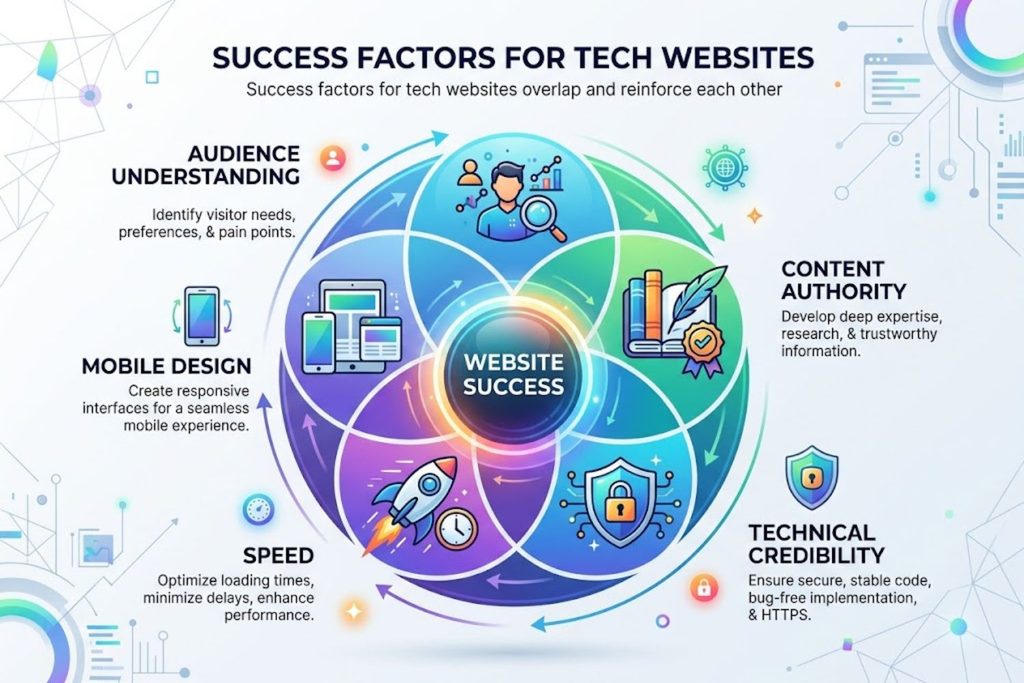
Understanding the types is important, but understanding success factors is crucial. Why do some tech websites become industry-defining while others fade?
Understanding Your Audience
Every successful tech website clearly understands who they’re writing for. TechCrunch targets startup founders and investors. The Verge targets tech-savvy early adopters. Ars Technica targets engineers and technical professionals.
Without clear audience definition, you end up writing for everyone, which means you write for no one.
Practical insight: Define your audience in specific terms. Not “people interested in tech,” but “CTOs evaluating cloud infrastructure,” or “indie game developers,” or “cybersecurity researchers.” The more specific, the better your content serves them.
Content Authority & Expertise
Google’s E-E-A-T framework (Experience, Expertise, Authoritativeness, Trustworthiness) applies heavily to tech websites. Readers need to trust that you know what you’re talking about.
This means:
- Experience: You’ve actually used the products you review
- Expertise: You understand the technical fundamentals
- Authoritativeness: You’re recognized as a leader in your niche
- Trustworthiness: You disclose conflicts, correct errors, cite sources
The fastest way to build authority is to produce original research or investigations that other publications cite. When competitors link to your work, you’ve established authority.
Technical Credibility
Nothing undermines a tech website faster than technical mistakes. If you write about cloud infrastructure but confuse availability zones with regions, engineers spot the error immediately and lose trust.
Build credibility by:
- Explaining technical concepts clearly without oversimplifying
- Acknowledging what you don’t know
- Citing technical documentation
- Having domain experts review content before publishing
- Correcting errors visibly and quickly
Speed & Performance
A slow tech website is ironic and unacceptable. Your site’s performance affects user experience and Google rankings.
Core Web Vitals have become a ranking factor. Fast loading, responsive design, and minimal Cumulative Layout Shift aren’t optional—they’re table stakes.
Technical considerations:
- Use a CDN for global distribution
- Optimize images aggressively
- Implement lazy loading
- Minimize JavaScript
- Use modern web standards
Mobile-First Design
Over 60% of tech website traffic comes from mobile devices. A site that works on desktop but fails on mobile loses readers and rankings.
Mobile-first means the mobile experience is your primary design consideration, not an afterthought. This affects everything from navigation structure to content length to touch targets.
Tech Website Revenue Models
This is where strategy diverges based on your goals and resources. Understanding revenue models helps you pick a sustainable path.
Advertising & Sponsored Content
Traditional advertising (display ads, banner ads) remains the largest revenue source for most tech websites. However, CPM rates (cost per thousand impressions) have declined significantly.
CPM Reality: A decade ago, tech websites could earn $5-$15 per thousand impressions. Today, $0.50-$3.00 is more typical, depending on audience quality.
Sponsored content offers higher rates but requires careful management to maintain credibility. Readers must clearly distinguish sponsored content from editorial. Mixing them damages trust.
Affiliate Marketing: When a tech website links to a product on Amazon or a software platform, they earn a small commission. This works because readers trust the recommendation.
Subscription Models
Successful subscription models work when:
- You produce content readers can’t get elsewhere
- The subscription price feels reasonable relative to value
- You provide exclusive features beyond paywall content
Examples:
- Stratechery charges $12/month for unique tech industry analysis
- The Information charges $399/year for exclusive business intelligence
- Platformer (Casey Newton’s newsletter) uses a membership model
Subscriptions provide predictable recurring revenue but require smaller, highly engaged audiences. You can’t scale via advertising with 5,000 subscribers, but $60,000/month from 500 annual subscribers is viable.
Product Sales & Services
Some tech websites generate revenue by selling products or services to their audience:
- Educational courses (freeCodeCamp, Codecademy)
- Certifications (Linux Academy, AWS certifications)
- Events and conferences (TechCrunch Disrupt)
- Research reports (specialized analyst firms)
- Consulting or freelance services (leveraging audience reach)
Community-Driven Revenue
Platforms like Discord, Slack community apps, and membership communities monetize through:
- Premium tier features
- Sponsorships from relevant companies
- Affiliate revenue
- Event sponsorships
The advantage of community-driven models is high engagement and lower content production costs. The disadvantage is they require ongoing community management.
Building a Tech Website: Essential Elements
If you’re starting or rebuilding a tech website, here’s what you actually need.
Platform Selection
WordPress (Hosted or Self-Hosted)
- Pros: Flexible, mature ecosystem, SEO tools, low cost
- Cons: Requires technical knowledge, ongoing maintenance
- Best for: Blogs, news sites, content-heavy publications
Headless CMS (Ghost, Webflow)
- Pros: Modern, performant, good developer experience
- Cons: Higher cost, requires development knowledge
- Best for: Tech-savvy teams, modern startups
Substack or Medium
- Pros: Zero technical overhead, built-in distribution
- Cons: Less customization, algorithm-dependent, limited monetization
- Best for: Individual writers, newsletters, early-stage projects
Custom Build (Next.js, Gatsby)
- Pros: Complete control, optimal performance
- Cons: Highest cost, requires development team
- Best for: Established publications, venture-backed ventures
Most successful tech websites start with WordPress and migrate to something more custom as they scale. This is a proven path.
Technical Infrastructure
Your hosting infrastructure affects performance, cost, and scalability:
- Shared Hosting – Cheapest, but performance suffers with traffic spikes
- Managed WordPress Hosting (Kinsta, WP Engine) – Better performance, automatic updates, support
- VPS or Dedicated Servers – More control, higher complexity
- Serverless (AWS Lambda, Vercel) – Pay-per-request, scales automatically
- CDN (Cloudflare, CloudFront) – Distributes content globally, improves speed
For a new tech website, managed WordPress hosting or Vercel offers the best balance of performance, cost, and simplicity.
SEO Foundation
Tech websites live and die by search visibility. Your SEO foundation includes:
Technical SEO:
- Proper XML sitemaps and robots.txt configuration
- Clean URL structure
- Fast loading times (Core Web Vitals)
- Mobile responsiveness
- Structured data markup
On-Page SEO:
- Keyword research for your niche
- Clear H1/H2/H3 hierarchy
- Meta title and description optimization
- Internal linking strategy
- Image alt text
Content SEO:
- Target primary and secondary keywords naturally
- Answer user search intent completely
- Create comprehensive, long-form content
- Build topical authority in specific niches
Content Management

How you manage content affects your ability to scale:
- Editorial Calendar: Plan content 4-8 weeks ahead
- Content Guidelines: Ensure consistency in style, tone, and format
- Review Process: Establish who reviews content before publishing
- Update Schedule: Determine how often you refresh older content
- Performance Tracking: Monitor which content drives traffic and conversions
Audience Engagement Tools
Tech websites shouldn’t be one-way broadcasts:
- Email Newsletters: Build direct audience relationships
- Comments/Community: Enable readers to discuss articles
- Social Media: Extend reach beyond organic search
- Feedback Mechanisms: Ask readers what they want
- Analytics: Understand what content resonates
Common Mistakes Tech Website Owners Make
These mistakes are preventable once you see them clearly:
Prioritizing Traffic Over Authority
The fastest way to tank a tech website is to chase traffic at the expense of credibility. This looks like:
- Clickbait headlines that don’t match content
- Covering trends you don’t understand
- Posting unverified rumors
- Writing reviews of products you haven’t tested
Short-term traffic spikes aren’t worth long-term credibility damage.
Ignoring SEO Fundamentals
Some tech website owners believe they’re “too good” for SEO basics. They’re wrong. Skipping technical SEO, keyword research, and internal linking means leaving massive traffic on the table.
Even exceptional content needs SEO optimization to reach the people searching for it.
Poor Content Planning
Publishing reactively (“what’s trending today?”) instead of strategically (“what does our audience need?”) leads to scattered, forgettable content. You need a content strategy, not just a content schedule.
Inadequate Technical Setup
A tech website that’s slow, full of broken links, or poorly structured sends signals that your content isn’t trustworthy. If you can’t maintain your own website technically, readers wonder if you can review technology accurately.
The Future of Tech Websites
Several trends are reshaping how tech websites operate and what readers expect:
AI Integration & Content Creation
AI tools are now ubiquitous in tech publishing. Smart tech websites use AI for:
- Content summarization and quick takes
- Headline generation and testing
- Tagging and categorization
- Initial draft creation (then heavily edited)
The mistake: Using AI as a replacement for human expertise. AI can accelerate workflow, but it can’t replace original research, testing, and thought leadership.
Personalization & Recommendations
Readers increasingly expect websites to understand their interests and surface relevant content. Recommendation algorithms, personalized newsletters, and smart feeds are becoming standard expectations.
Community-First Approaches
Reader engagement has become as important as publishing. Tech websites increasingly build community features: discussions, forums, member-only perks, and audience participation.
Niche Specialization
The era of general tech websites is ending. Readers want depth in specific areas. There’s opportunity in being the definitive source for particular technology niches rather than a generalist source.
FAQ
Q: How long does it take to build a successful tech website?
A: 12-24 months before generating meaningful revenue, 3-5 years before establishing real authority. Success requires patience and consistent effort. Most failures happen because founders underestimate this timeline.
Q: Do I need technical knowledge to run a tech website?
A: Not if you use platforms like Substack, Medium, or managed WordPress hosting. However, basic understanding of how websites work, SEO, and analytics is invaluable. At minimum, you should understand your platform well enough to troubleshoot basic issues.
Q: How often should I publish new content?
A: Quality beats frequency. Publishing one exceptional piece per week is better than seven mediocre pieces per week. Most successful tech websites publish 3-5 pieces weekly, balancing daily news with deeper analysis.
Q: Can I start a tech website without funding?
A: Yes. Managed hosting costs $50-200/month. Domain costs $12/year. You can bootstrap a tech website on under $1000 first year. The challenge isn’t money—it’s time and consistency.
Q: How do I monetize a tech website that’s early-stage?
A: Start with affiliate marketing (lowest friction). Add advertising once you have regular traffic. Only pursue subscriptions once you have differentiated content readers value. Most successful sites layer multiple revenue streams rather than relying on one.
Q: What’s the difference between a tech blog and a tech website?
A: The terms are often used interchangeably, but typically a “blog” is a single-author or small-team publication focused on personal perspectives. A “tech website” is a broader publication with multiple writers covering the industry. The distinction is semantic; both can be successful.
Q: How important is social media for a tech website?
A: Important for distribution and audience engagement, but not essential for core business model. Use social to drive traffic to your site, but don’t let algorithm changes control your destiny. Email and search are more sustainable long-term channels.
Q: Should I specialize or generalize as a new tech website?
A: Specialize. A tech website covering everything is uncompetitive. Find your niche (AI safety, indie apps, cybersecurity, cloud infrastructure), dominate it, then expand thoughtfully.
Q: How do I compete with established tech websites?
A: Don’t try to out-traffic TechCrunch. Instead: (1) Pick a niche they don’t own, (2) Go deeper and more authoritative in that niche, (3) Build genuine community around your focus area, (4) Move faster on new developments, (5) Develop deeper expertise over time.
Q: What metrics should I track for a tech website?
A: Core metrics: Monthly unique visitors, average session duration, pages per session, bounce rate, email subscribers. Conversion metrics: Leads generated, affiliate revenue, sponsored deals, subscription revenue. Authority metrics: Backlinks, ranking positions, news source mentions. Don’t obsess over vanity metrics.
Q: How do I maintain editorial independence while generating revenue?
A: Clear disclosure policies. Separate sponsored content visually. Never let advertisers edit stories. Build subscriptions so you’re less dependent on ad revenue. Over time, reader trust becomes your most valuable asset—protect it fiercely.
Q: Is it too late to start a tech website?
A: No. The barrier to publishing is lower than ever. What’s higher is the expectation for quality and depth. If you’re willing to invest time to become genuinely expert in your niche, you can absolutely build successful tech website today. The advantage goes to specialists, not generalists.