The digital marketing space has become overwhelming. New platforms emerge quarterly. Algorithm changes hit without warning. Tool companies promise overnight success. Yet most businesses are still struggling to connect strategy with results.
This guide cuts through the noise.
It’s designed for founders, marketing leaders, and technical professionals who want to understand digital marketing—not as a collection of trendy tactics, but as a strategic discipline with real ROI.
What Digital Marketing Is (And What It Isn’t)
The Core Definition
Digital marketing is the practice of promoting products, services, or ideas through digital channels and technologies to reach a specific audience and drive measurable business outcomes.
That’s the academic definition. Here’s what it actually means: Digital marketing is about meeting customers where they already are online, then guiding them toward action.
Unlike traditional marketing (billboards, TV, radio), digital marketing lets you:
- Target specific audiences based on behavior, interests, and demographics
- Measure results in real-time
- Adjust campaigns while they’re running
- Scale efficiently as you learn what works
Why It’s Different From Traditional Marketing
Traditional marketing is a broadcast. You create an ad, push it out, hope the right people see it, then wait weeks to measure response.
Digital marketing is a dialog. You publish content, watch how people engage, respond to that engagement, then optimize. This happens over hours and days, not months.
For a tech company specifically, this matters because your audience is digitally native. They research online. They compare solutions via search. They discover through social feeds and industry blogs. They expect personalized experiences.
Traditional marketing doesn’t reach them where they’re making decisions. Digital marketing does.
Why It Matters for Tech Companies
Tech buyers have shifted. They don’t wait for sales calls. They conduct independent research first. They read reviews. They watch demo videos. They join Slack communities to ask questions.
A strong digital marketing strategy means your business appears consistently at every stage of their research journey. Before they even know they have a problem. When they’re evaluating solutions. When they’re deciding between you and competitors.
The Digital Marketing Channel Landscape
Most guides list channels and leave you to figure out the rest. We’re going deeper.
Each channel serves a different purpose in your strategy. Understanding that purpose—not just how to use the channel—is what separates effective marketing from expensive noise.
Social Media Marketing
Social media isn’t about follower counts. It’s about building community and enabling word-of-mouth at scale.
For tech companies:
- LinkedIn works for B2B credibility and thought leadership
- Twitter/X works for real-time industry discussion and community building
- YouTube works for product education and demos
- TikTok works if your product appeals to younger audiences (increasingly common in tech)
What most companies miss: Social media’s real value isn’t driving direct sales. It’s building brand familiarity so that when someone searches for your solution, they recognize your name and trust you’ve got credibility.
Practical reality: Post consistently (3-5x weekly), engage genuinely with your audience, share actual insights—not just promotional content. Expect social to drive 5-15% of traffic for most tech companies, but disproportionately high-quality traffic.
Search Engine Optimization (SEO)
SEO is the game of controlling how your business appears when people search for solutions you provide.
There are three SEO components:
- Technical SEO – Making sure search engines can crawl and index your site properly
- On-page SEO – Using keywords, structure, and content to signal relevance
- Authority building – Getting other sites to link to yours, signaling trustworthiness
For tech companies, SEO is often the highest-ROI channel because:
- People searching for solutions are ready to evaluate
- Traffic is free after initial investment
- Quality improves over time (unlike paid ads that stop working when budget ends)
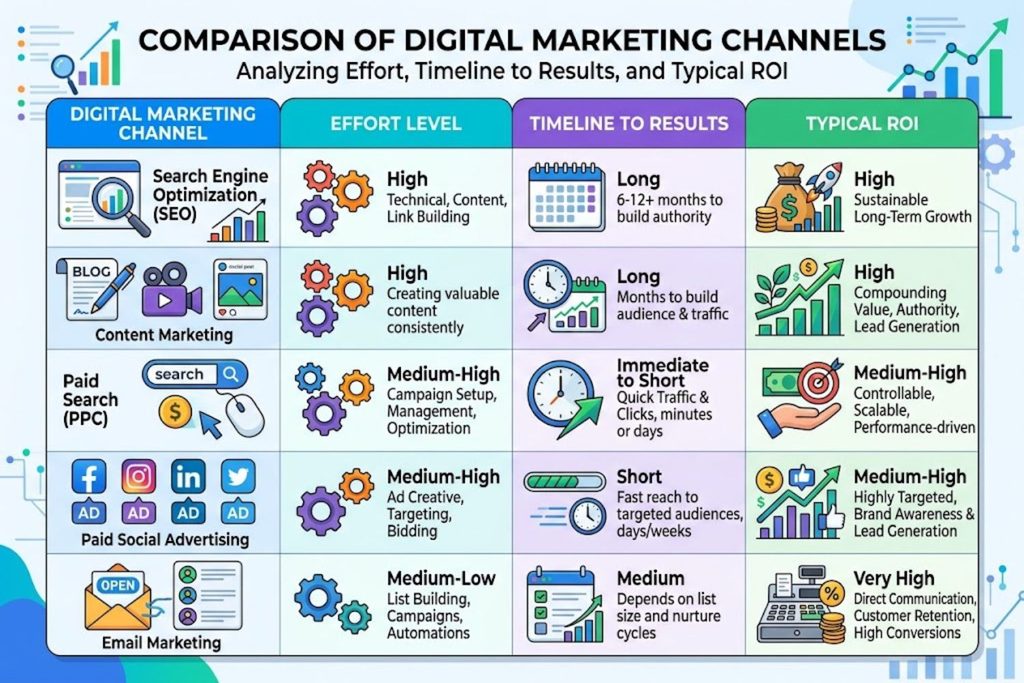
The catch: SEO takes 3-6 months to show results. Most companies abandon it too early.
Practical reality: Pick 20-30 keywords your audience actually searches for. Create content that genuinely answers their questions better than existing results. Build backlinks by creating things worth linking to. Measure improvements quarterly, not weekly.
Paid Search & Display Advertising
Paid advertising (Google Ads, LinkedIn Ads, etc.) lets you bid for immediate visibility.
When to use paid search: When you have proven conversion paths and enough budget to test. Paid search reaches people actively searching for solutions—highest intent traffic available. Expect to spend $3-10 per click in competitive tech markets.
When to use display advertising: When you want to build awareness among a specific audience. Display ads are cheaper but lower intent. Use them to reach people across the web who match your target profile.
Key insight: Paid advertising works best when you have:
- Clear conversion paths (not just “visit our site”)
- Data showing what converts (not guessing)
- Budget to test and optimize ($2,000-5,000 minimum for meaningful results)
Practical reality: Most tech companies underestimate the testing phase. Budget 20-30% of ad spend just to discover what works, then scale what wins.
Email Marketing
Email is still the highest-ROI channel for most businesses (average $36-$42 return per $1 spent).
Email works because it reaches people who have already expressed interest in your business. You’re not interrupting strangers; you’re continuing conversations with warm prospects.
How to build an email program that works:
- Capture emails through valuable content (guides, tools, research)
- Send regular, helpful content (not just promotions)
- Segment audiences by their behavior and interests
- Test subject lines and send times
- Measure opens, clicks, and conversions
Practical reality: Most tech companies send too many promotional emails and not enough educational content. Flip this ratio. Aim for 70% educational, 30% promotional. Your unsubscribe rate will drop. Your revenue will rise.
Content Marketing
Content marketing is the practice of creating valuable information that attracts, engages, and converts your audience.
This includes:
- Blog posts and guides (like this one)
- Whitepapers and research
- Video tutorials
- Podcasts
- Webinars
- Case studies
Why it matters: Every other channel depends on content. SEO requires content. Social media amplifies content. Email distributes content. Paid ads promote content.
Content is the foundation. Everything else is distribution.
Practical reality: Most tech companies underestimate the effort required. Plan for 1-2 weeks of work per high-quality piece. Expect 6-12 months before you see meaningful organic traffic. Commit to consistency over volume.
Emerging Channels (AI & Automation)
The digital marketing landscape is shifting again. AI-powered tools are creating new opportunities:
- AI-powered chatbots for immediate customer support
- Predictive analytics for smarter targeting
- Automated content generation for scaled personalization
- Voice search optimization as smart speakers grow
For tech companies, staying aware of these tools isn’t just good practice—it’s table stakes. Your competitors are experimenting. You should too.
Building Your Channel Strategy (Not Just Picking Channels)
This is where most companies fail.
They pick channels randomly. Or they chase whatever platform is trending. Or they try to be everywhere and do nothing well.
A real strategy requires a framework.
The Channel Selection Framework
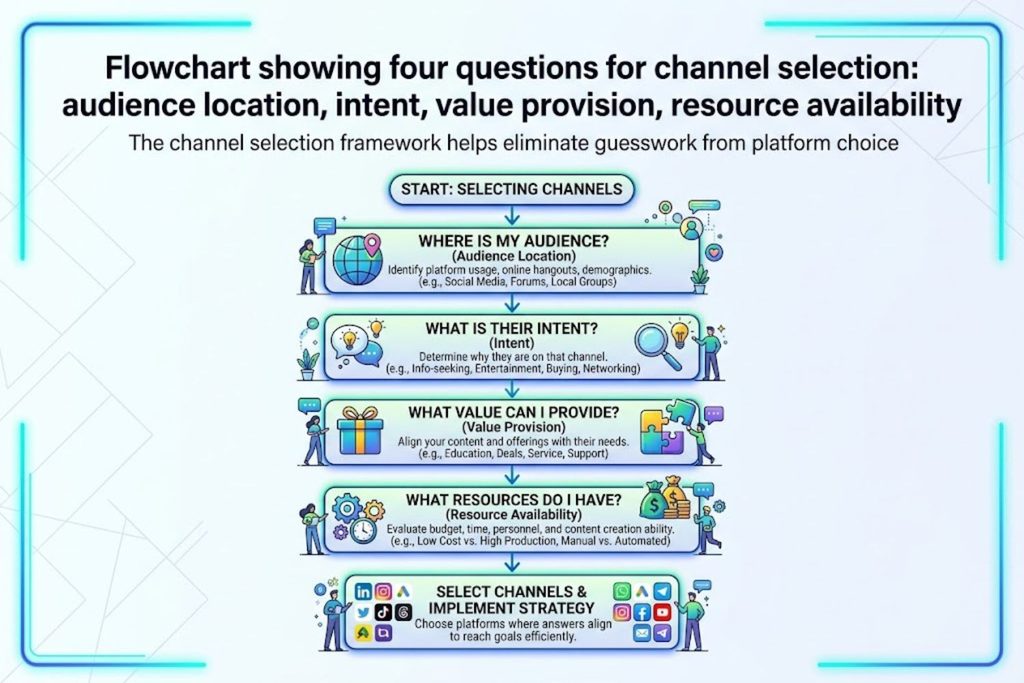
Ask these questions in order:
1. Where is your audience spending time?
Not where you think they should be. Where they actually are. If your audience researches on Reddit, LinkedIn, and Google—start there. If they’re on TikTok, start there.
2. What is the audience intent in that channel?
People on Google are searching for solutions. People on LinkedIn are building professional credibility. People on TikTok are seeking entertainment. Match your strategy to the mindset they’re in.
3. Can you provide genuine value in that channel?
If you’re a B2B SaaS company and TikTok’s audience isn’t your customer, don’t force it. Pick channels where you can authentically provide value.
4. Do you have resources to do it right?
Being mediocre across five channels is worse than being excellent in two. Better to own LinkedIn and content than to be average on eight platforms.
Start here: Pick your top 2-3 channels. Master them. Then expand.
Audience-First Thinking
Most companies start with “What channels do we want to use?” and work backward.
Start with: “Who is our customer? When do they make buying decisions? What information do they need? Where do they look for that information?”
This single shift changes everything.
A tech company targeting CTOs needs different channels than one targeting marketing managers. One targeting enterprises needs different content than one targeting startups.
How to do this:
- Interview 10-15 customers about how they discovered you
- Ask where they research solutions
- Ask what content influenced their decision
- Map this into a customer journey
- Assign channels to each stage of that journey
This framework prevents random channel selection.
Budget Allocation Rules
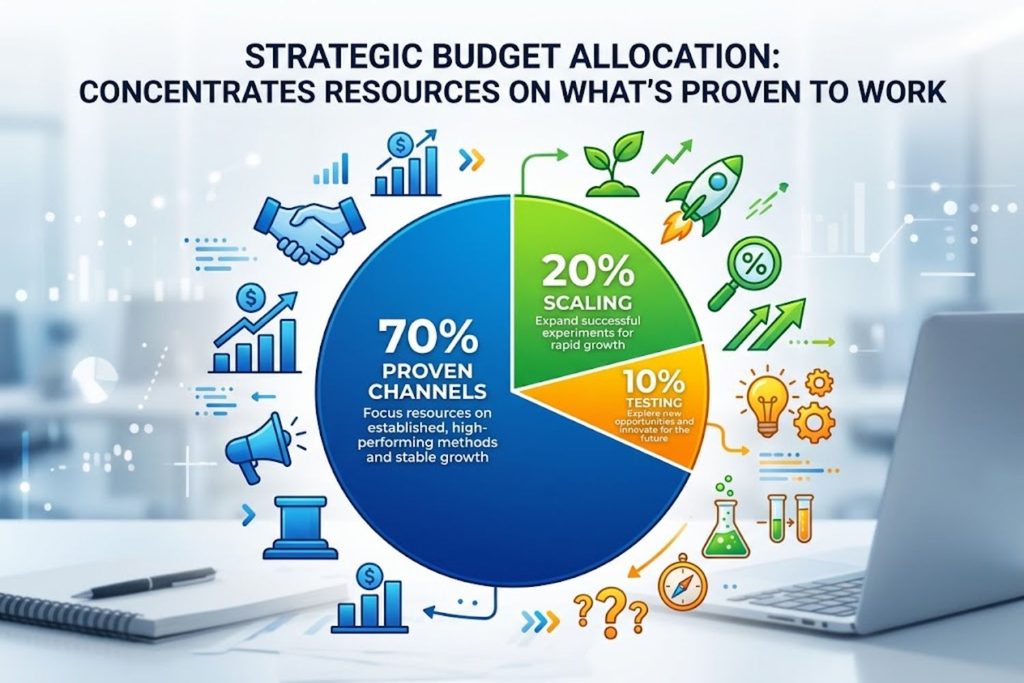
With limited budget, allocation matters.
A simple framework:
- 70% to channels with proven ROI
- 20% to scaling what’s working
- 10% to testing new channels
Don’t split budget evenly across channels. Concentrate resources on what’s working. Testing is important, but it’s not where most budget should live.
Example budget allocation for a typical B2B tech company:
- Content creation: 30% (foundation for everything else)
- Paid search: 25% (high-intent traffic)
- Email/nurture: 20% (converting warm prospects)
- Social/community: 15% (awareness and engagement)
- Testing: 10% (new channels and tactics)
Adjust based on your specific business, but the principle holds: concentrate on what works.
Integration Over Isolation
The biggest mistake companies make is running channels independently.
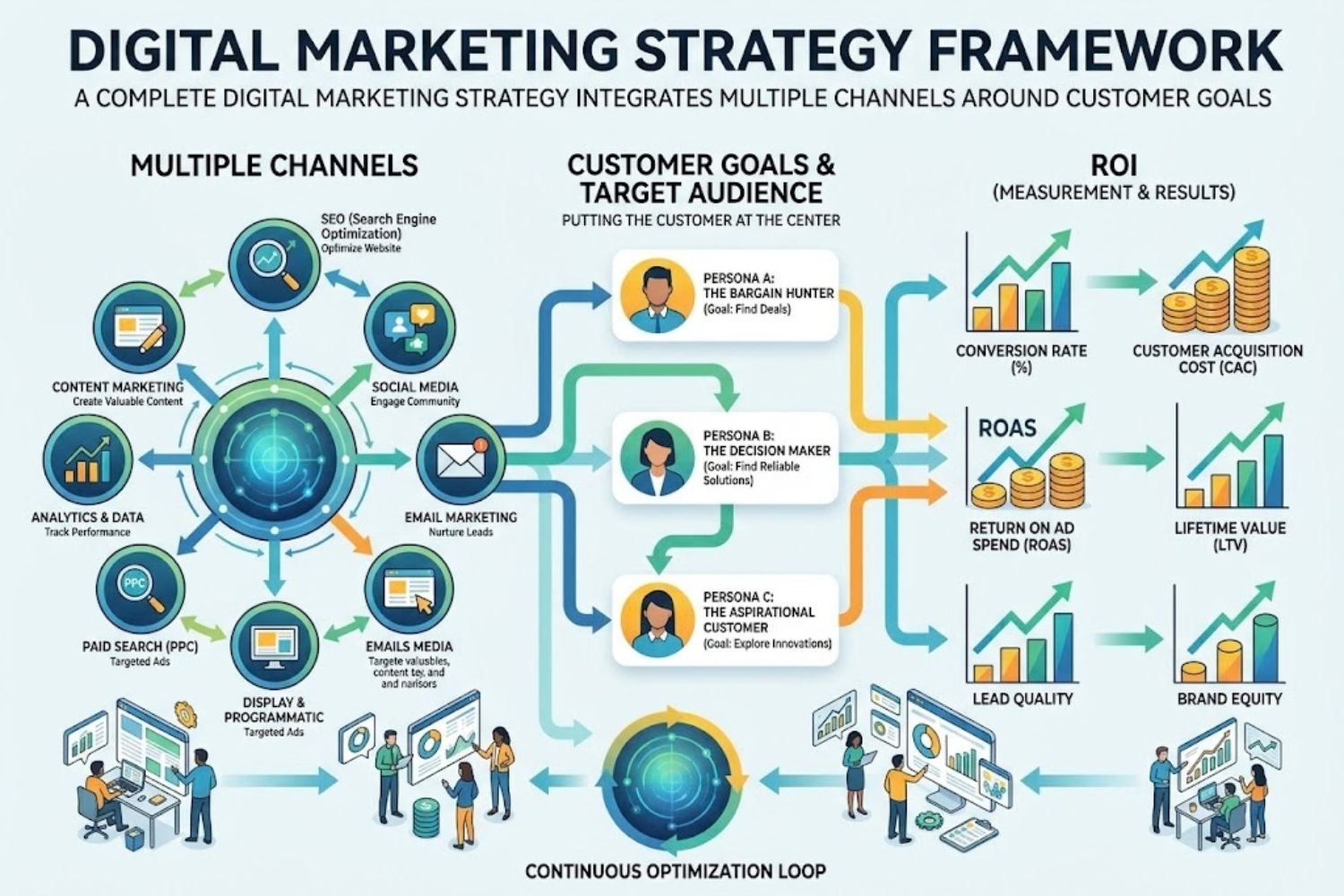
Your paid search campaign should drive traffic to content that nurtures via email. Your social content should link to SEO-optimized blog posts. Your email should promote your best-performing content.
Channels amplify each other when integrated.
How to integrate:
- Map each channel to a stage in your customer journey
- Create content that flows between channels
- Use data from one channel to improve others
- Measure everything through a unified dashboard
The Metric That Actually Matters: Attribution
This section separates strategic marketers from tactical ones.
Most companies measure vanity metrics. Traffic, impressions, followers. These feel good but don’t tell you if marketing is actually driving revenue.
Real marketing success is measured by revenue impact.
Why Vanity Metrics Fail
Example: A company celebrates 10,000 website visitors this month. But none of them convert. None of them become customers.
10,000 visitors is meaningless without conversion context.
Similarly:
- Page views don’t matter if no one takes action
- Impressions don’t matter if no one clicks
- Followers don’t matter if no one engages
- Reach doesn’t matter if your audience isn’t in there
Vanity metrics are easy to measure and look impressive in reports. They’re also nearly useless for strategy.
Multi-Touch Attribution Basics
Here’s the reality: Most customers interact with your business multiple times before buying.
They might:
- Find you via Google search
- Read your blog post
- See a retargeting ad
- Click an email
- Schedule a demo
- Finally convert
Which channel gets credit? All of them contributed. But traditional metrics only credit the last one (the demo request).
This is why multi-touch attribution matters. It distributes credit across all touchpoints.
Common models:
- First-touch: Credit the channel that first brought someone to you
- Last-touch: Credit the channel that directly converted them
- Linear: Give equal credit to all touchpoints
- Time-decay: Give more credit to touchpoints closer to conversion
- Position-based: Give more credit to first and last touchpoints
No model is perfect. But recognizing that every channel contributes is crucial.
How to Measure What Matters
Start simple:
- Define what “conversion” means for your business (demo request, trial signup, purchase, etc.)
- Track every conversion back to the first touchpoint and last touchpoint
- Assign revenue to that conversion (actual if you have it, estimated if you don’t)
- Calculate channel ROI (revenue generated ÷ channel spend)
- Adjust budget based on ROI, not vanity metrics
Most companies have the tools to do this (Google Analytics 4, Mixpanel, even basic UTM parameters). They just don’t implement it.
Start measuring revenue impact this month. It changes how you think about marketing.
Common Digital Marketing Mistakes That Waste Budget
Every company makes these mistakes. Recognizing them saves thousands.
Mistake 1: Spreading Budget Too Thin
Company creates accounts on 8 platforms, hires junior team, expects results.
Result: Mediocre presence everywhere. Excellence nowhere.
The fix: Pick your strongest 2-3 channels. Dominate them. Then expand.
One excellent LinkedIn strategy beats five mediocre strategies.
Mistake 2: Ignoring Audience Research
Company assumes they know their audience, creates content accordingly.
Real audience: completely different.
Result: High traffic from wrong people. $0 conversions.
The fix: Interview actual customers before creating strategy. Ask what problems they had. Where they looked for solutions. What content influenced them.
This takes 2 weeks of research. Saves months of wrong work.
Mistake 3: Fire-and-Forget Campaign Management
Company launches campaign, assumes it’ll work, doesn’t monitor.
Result: Campaign gradually performs worse (audience fatigue, algorithm changes, etc.). Company blames channel instead of management.
The fix: Weekly performance reviews. Daily monitoring for technical issues. Weekly optimization. This isn’t optional.
Campaigns need continuous attention.
Mistake 4: Chasing Trends Instead of Strategy
Company sees competitor on TikTok, instantly launches TikTok strategy.
Result: Brand looks desperate. Content feels inauthentic. Competitors move on; company is stuck in last month’s trend.
The fix: Strategy before tactics. Does this channel fit our audience? Does it align with our goals? Can we do it well?
If no, don’t do it. Let someone else waste budget on trends.
Building a Sustainable Digital Marketing Process
Strategy without process dies.
You can have a perfect plan, but if there’s no process to execute it, nothing happens. Or worse, execution becomes ad-hoc and inconsistent.
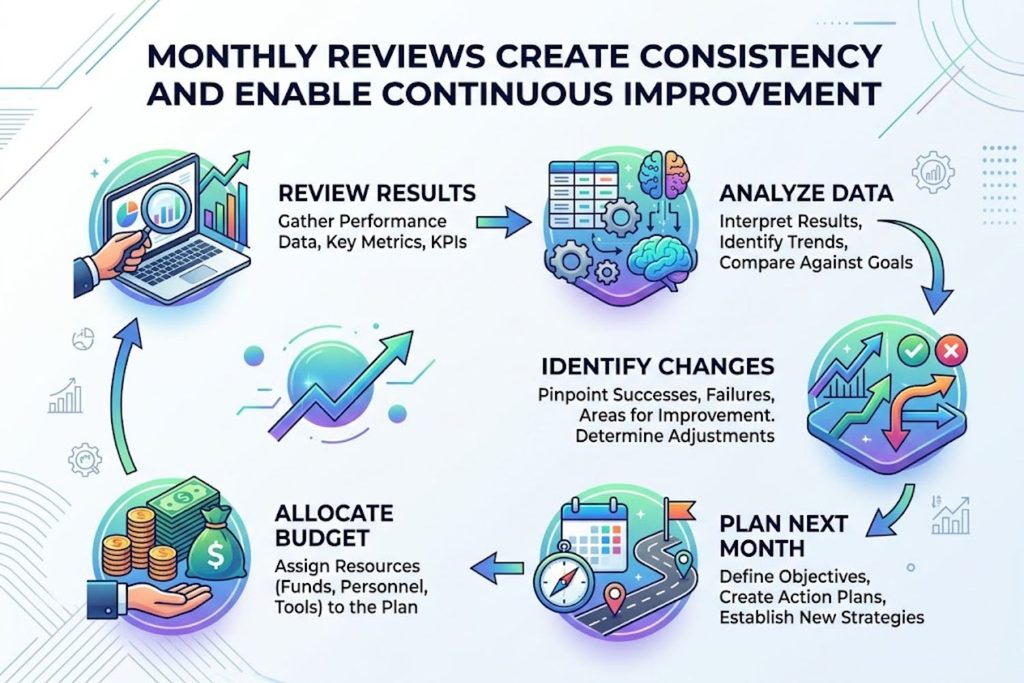
Monthly Planning & Review
Every month, do this:
- Review last month: What worked? What didn’t? Why?
- Review data: Traffic, leads, revenue. Compare to goals.
- Identify changes: What algorithm changes affected results? What did competitors do?
- Plan next month: Based on what worked, what’s your focus?
- Allocate budget: Concentrate on what’s winning.
- Share with team: Everyone knows the priorities.
This takes 4-6 hours. It saves weeks of wasted effort.
Tool Stack Essentials
You don’t need every tool. But you need these:
- Analytics: Google Analytics 4 (free) or Mixpanel (paid)
- Email: Mailchimp (free), HubSpot (paid), or ConvertKit (for creators)
- SEO: Ahrefs, SEMrush, or Moz (paid) or free alternative like Ubersuggest
- Advertising: Google Ads, LinkedIn Ads, or whatever platform matches your audience
- Content: Google Docs (free), Notion (free), or Confluence (paid)
- Social: Buffer or Hootsuite (paid) or native platform scheduling
- CRM: HubSpot (free tier exists) or Salesforce for enterprises
Start with free tools. Upgrade as you grow. Don’t buy everything at once.
Team Structure Basics
Who owns what?
Unclear ownership kills strategy.
Minimum structure:
- Strategy owner: Someone accountable for overall marketing performance
- Content owner: Someone creating/managing content
- Paid ads owner: Someone managing paid channels
- Analytics owner: Someone tracking and reporting results
Roles can overlap (one person can own multiple), but someone must own each function.
Digital Marketing ROI: Setting Goals That Stick
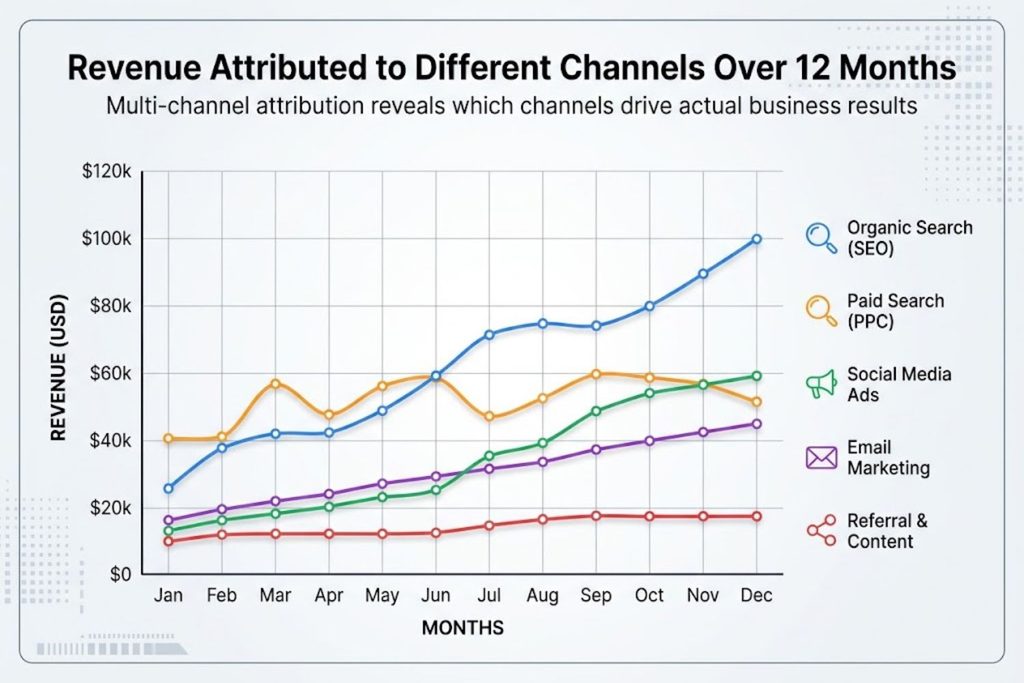
Goals without measurement are wishes.
Goals that can’t be measured are useless.
Revenue-Focused Metrics
Stop setting vanity metric goals. Set revenue goals.
Bad goals:
- “Get 10,000 website visitors”
- “Reach 5,000 followers”
- “Get 100,000 impressions”
Good goals:
- “Generate $100,000 in attributed revenue from digital marketing”
- “Reduce customer acquisition cost from $2,000 to $1,500”
- “Increase qualified leads from 20 to 50 per month”
Revenue goals force you to think about what actually matters.
Building a Dashboard

You can’t manage what you don’t measure.
Build one dashboard that shows:
- Traffic: Total visitors, source breakdown, trend
- Engagement: Pages per session, time on site, bounce rate
- Conversions: Leads, trials, demos, customers
- Revenue: Revenue attributed to marketing, revenue per channel, ROI per channel
- Efficiency: Cost per lead, cost per customer, customer lifetime value
Update it weekly. Look at it weekly.
This single dashboard prevents strategy drift.
Knowing When to Pivot
Data should drive decisions.
You’ve tried a channel for 3 months. Results are poor. What do you do?
Don’t immediately quit. Ask:
- Did you give it enough budget to test properly? ($2,000+ minimum)
- Did you optimize based on data? Or did you set it and forget it?
- Are you measuring the right metrics?
Only after you’ve verified those things should you consider pivoting.
But if you’ve done the work and results are genuinely poor, pivot fast. Sunk cost fallacy kills strategy.
FAQ Section
Q: How long does digital marketing take to show results?
A: It depends on the channel. Paid ads show results in weeks. SEO takes 3-6 months. Email shows results immediately. Social takes months to build momentum. Plan for 6 months of investment before expecting meaningful returns.
Q: How much should I spend on digital marketing?
A: Start with 5-10% of revenue. As you scale, this often decreases to 2-5% because efficiency improves. Early stage companies often spend 15-20% because they’re building from zero.
Q: Which channel should I start with?
A: The channel where your audience is already spending time. Interview customers first. They’ll tell you where to start.
Q: Do I need to hire an agency or do it in-house?
A: Start in-house with one person. Agencies are expensive and often misaligned with your goals. Move to agency support (or hybrid) once you’ve proven strategy.
Q: Should I focus on organic or paid marketing?
A: Both. Organic (SEO, content) is free but slow. Paid is fast but costs money. You need both for sustainable growth.
Q: How do I measure ROI on brand awareness campaigns?
A: This is hard. Use proxy metrics: search volume for your brand term, social mentions, email signup rate from social, customer surveys about awareness. Brand campaigns compound over time; measure quarterly, not weekly.
Q: What if my audience is small or niche?
A: This actually simplifies strategy. Niche audiences are easier to reach. Focus on one channel where they congregate. Master it completely. Volume matters less when targeting is precise.
Q: How often should I post on social media?
A: Quality over frequency. 3-5 high-quality posts per week beats 10 mediocre posts. Consistency matters more than volume.
Q: Should I use influencers for marketing?
A: Only if your audience follows them and they align with your brand. Micro-influencers (10K-100K followers) often outperform mega-influencers. Choose influencers your customers actually follow, not vanity metrics.
Q: How do I know if my content is working?
A: Track: traffic to the page, time on page, shares/backlinks, conversions from that page. If traffic is high but conversions are zero, the content isn’t working for business goals.
Q: What’s the best time to post on social media?
A: Tuesday-Thursday, 9 AM – 5 PM (when your audience is working). But test your specific audience. Platform analytics show when your followers are active. Use that data.
Q: How do I compete with bigger companies that have larger budgets?
A: Be more specific. They have massive budgets; they target everyone. You target a specific niche perfectly. They’re mediocre everywhere; you’re exceptional somewhere. Niche advantage beats budget advantage.
Q: Should I A/B test everything?
A: No. Test important things (headlines, ad creative, email subject lines). Don’t test small things endlessly. You’ll never finish testing. Test what has highest impact on goals.