
Protecting valuable equipment during storage, shipping, or outdoor use requires more than hope—it requires the right tools. Crate covers are one of the most underrated yet essential solutions for safeguarding your investments from weather damage, UV degradation, dust accumulation, and accidental impacts.
Whether you’re managing warehouse inventory, shipping sensitive electronics, or storing machinery outdoors, understanding crate covers transforms how you approach equipment protection. This guide covers everything you need to know about selecting, installing, and maintaining the right cover for your specific needs.
What Is a Crate Cover and Why It Matters
A crate cover is a protective shell designed to fit securely over storage crates, equipment boxes, or wire containment systems. Rather than functioning as a simple blanket or tarp, purpose-built crate covers are engineered with specific attachment points, ventilation channels, and material properties that address real-world protection challenges.
Unlike generic tarps that slip, fray, and deteriorate quickly, quality crate covers feature reinforced stitching, weather-resistant fabrics, and strategic design elements that keep your equipment safe while maintaining accessibility.
Why Equipment Owners Choose Crate Covers:
- Weather Protection: Water, dirt, and debris stay off valuable assets
- UV Defense: Prevents sun damage, fading, and material degradation
- Dust Prevention: Critical for electronics and sensitive machinery
- Organization: Clearly marks stored items and creates visual inventory
- Quick Access: Designed for repeated opening and closing
- Professional Appearance: Looks intentional rather than makeshift
- Cost-Effective: Far less expensive than relocating equipment to climate-controlled spaces
The difference between a covered crate and an uncovered one often determines whether equipment arrives damaged, deteriorates prematurely, or maintains full functionality. For businesses managing multiple assets, this distinction directly impacts the bottom line.
Types of Crate Covers by Material
Material selection is the single most important decision when choosing a crate cover. Different materials excel under different conditions, and choosing poorly means premature failure, inadequate protection, or wasted investment.
Canvas and Cotton-Blend Covers
Canvas represents the traditional choice for crate covers. Made from tightly woven natural cotton fibers, canvas offers exceptional breathability while providing substantial physical protection against impacts and abrasion.
Advantages:
- Excellent durability when properly maintained
- Superior breathability prevents moisture accumulation
- Natural aesthetic that ages gracefully
- Comfortable handling and easy installation
- Cost-effective for many applications
Disadvantages:
- Requires regular maintenance to resist water penetration
- Can develop mildew in humid environments if not ventilated
- Heavier than synthetic alternatives
- Less UV resistant without treatment
Canvas works exceptionally well in covered or semi-covered environments where water exposure is minimal. It’s ideal for indoor storage, warehouses, and temporary outdoor placement.
Polyester and Synthetic Covers
Modern polyester covers deliver a balance of protection, durability, and ease of use that appeals to most equipment owners. Advanced synthetic fabrics often include water-resistant coatings while maintaining breathability.
Advantages:
- Lightweight and easy to handle
- Machine washable for effortless cleaning
- Resists mildew and moisture retention
- Available with stain-resistant treatments
- Lower maintenance requirements
- Quick-drying properties
Disadvantages:
- May require replacement sooner than quality canvas
- Coated versions reduce breathability
- Some synthetic fabrics deteriorate under prolonged UV exposure
Polyester is the go-to choice for applications requiring low maintenance and regular cleaning. Commercial operations and frequent-access scenarios benefit from polyester’s practicality.
Vinyl and Waterproof Covers
When water becomes the primary threat, vinyl and fully waterproof covers take priority. These covers feature complete water barriers that shed moisture aggressively.
Advantages:
- Maximum water resistance
- Extreme durability in harsh environments
- Excellent for marine and coastal applications
- Easy to clean with minimal effort
- Long lifespan in outdoor settings
Disadvantages:
- Reduced breathability increases condensation risk
- Heavier weight during installation
- Can crack in extreme cold
- More expensive than standard options
Choose waterproof covers for exposed outdoor equipment, coastal environments, or applications where moisture is the primary threat.
Mesh and Ventilated Covers
Specialized mesh covers prioritize airflow over water resistance. These covers work best in dry climates or covered areas where ventilation prevents mold and degradation.
Advantages:
- Superior ventilation eliminates moisture buildup
- Lightweight and easy handling
- Lower cost than fully waterproof options
- Excellent for temperature-sensitive equipment
Disadvantages:
- Minimal water protection
- Dust infiltration possible
- Limited UV shielding
Use mesh covers in dry storage environments, warehouses, or when combined with climate control.
Essential Features to Look for
Identifying quality construction separates functional covers from those that fail prematurely. These features directly impact protection effectiveness and lifespan.
Waterproofing and Weather Resistance
The best waterproof covers don’t simply repel water—they prevent water from pooling, penetrating seams, or accumulating underneath the cover. Look for:
- Sealed seams: Stitching sealed with waterproof tape prevents water wicking along thread lines
- Fabric coating: Water-resistant coatings on natural fibers or integrated into synthetic fabrics
- Peaked or angled design: Prevents water pooling on top surfaces
- Drainage channels: Strategic design elements that direct water away from equipment
Test water resistance by running water over the seams, not just the flat surface. Quality covers shed water decisively.
Durability and Reinforced Stitching
Cheap covers use single-pass stitching that frays within months. Premium covers feature:
- Double or triple stitching in high-stress areas (corners, attachment points)
- Heavy-gauge thread that resists breaking and fraying
- Reinforced corners where stress concentrates during installation
- Stress-relief stitching patterns that distribute tension
Check corner reinforcements closely—these areas experience the most stress and often fail first on inferior covers.
UV Protection and Fade Resistance
Extended outdoor exposure without UV protection rapidly degrades most fabrics. Quality covers include:
- UV-stabilized fabrics that resist breakdown under sun exposure
- Carbon black or other UV blockers in the material or coating
- Colorfast dyes that don’t fade under direct sunlight
- Treated underside surfaces that protect against reflection damage
UV resistance directly extends cover lifespan. A well-treated cover lasts two to three times longer in outdoor applications.
Ventilation and Airflow Design
Moisture accumulation under covers creates condensation, mold, and rust. Strategic ventilation prevents these problems:
- Ventilation flaps or vents that allow air circulation
- Mesh panels in non-critical areas
- Breathable base layers (on canvas or polyester)
- Separation feet or standoff points that create airspace between cover and equipment
Proper ventilation is essential for any equipment sensitive to moisture or temperature fluctuations.
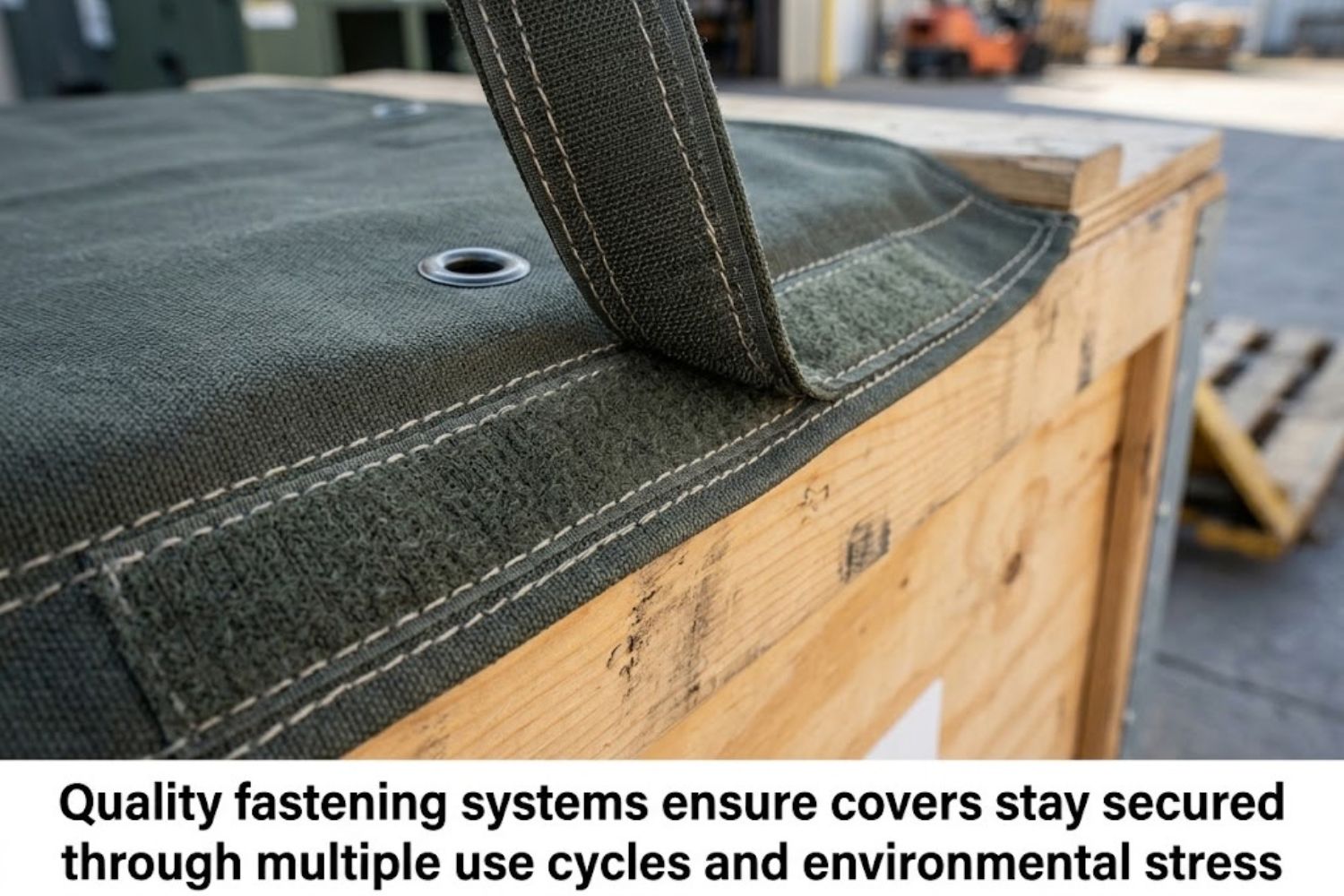
Fastening Systems and Installation
A poorly secured cover provides minimal protection. Premium fastening includes:
- Hook-and-loop fasteners (Velcro) for quick, tool-free installation
- Heavy-duty zippers for access without removing the entire cover
- Elastic straps that accommodate slight size variations
- Reinforced attachment points that won’t tear under wind stress
- Corner reinforcement to prevent rip-out failures
Test fastening systems for ease of use. You’ll be installing and removing this cover repeatedly—friction matters.
Sizing Your Crate Cover: A Practical Guide
Most cover failures result from incorrect sizing rather than material defects. A cover that’s too small won’t secure properly; one that’s too large collects water and doesn’t protect effectively.
Standard Crate Dimensions
Common industrial and storage crates follow these approximate dimensions:
Standard Shipping Crates:
- Small (24-30 inches): Electronics, retail goods
- Medium (36-42 inches): Equipment, machinery
- Large (48-54 inches): Pallets, bulk goods
- Extra-large (60+ inches): Heavy machinery, production equipment
Wire Storage Crates:
- Small: 24 × 18 inches
- Medium: 30 × 24 inches
- Large: 36 × 30 inches
- XL: 42 × 36 inches
These aren’t universal standards—manufacturers vary dimensions by 2-4 inches. Always verify specific crate measurements before purchasing.
How to Measure for the Perfect Fit
Step 1: Measure the crate perimeter
Measure length, width, and height at the widest points. Add 2-3 inches for comfortable overlap.
Step 2: Check fastening points
Identify where attachment points (handles, corner braces, or lock mechanisms) are located. Covers need to accommodate these without compromising seal.
Step 3: Account for depth
Measure from the top edge down the side. Quality covers extend to the bottom for complete protection.
Step 4: Test-fit if possible
Many suppliers offer trial fits or exchanges. Always confirm fit before final installation.
A cover that’s slightly loose can be tightened with fasteners; one that’s too small offers zero protection value.
Custom Sizing Options
For non-standard equipment or oddly-sized crates, custom covers are worth the investment. Most manufacturers offer:
- Custom dimensions to specification
- Specialized attachment points
- Integrated flaps for access points
- Company branding or identification
Custom covers cost 30-50% more but provide exactly what you need rather than compromises.
Material Comparison: Which Works Best?
Choosing between materials requires understanding your specific application context.
Canvas vs. Polyester
Canvas is superior for:
- Indoor or covered storage
- Applications prioritizing breathability
- Situations where weight matters less
- Long-term storage with proper maintenance
Polyester is superior for:
- Frequent removal/installation cycles
- Regular cleaning requirements
- Low-maintenance operations
- Cost-conscious applications
The “best” choice depends entirely on whether your priority is absolute protection (canvas) or practical convenience (polyester).
Waterproof Coatings Explained
Fabric-integrated coatings treat the base material during manufacturing, maintaining some breathability.
Applied coatings are added after fabric construction and provide maximum water resistance but sacrifice airflow.
Teflon treatments repel water and stains but don’t prevent water penetration over extended periods.
For most applications, fabric-integrated waterproofing balances protection and breathability effectively.
Weight and Portability Considerations
Canvas covers for large crates can exceed 15-20 pounds when dry. When wet, they’re substantially heavier. For frequently repositioned equipment:
- Synthetic materials reduce installation effort
- Two-person installation becomes unnecessary
- Handling time decreases measurably
- Risk of installation damage decreases
For stationary equipment, weight becomes immaterial. Prioritize protection over convenience.
Installation and Maintenance Tips
Proper installation determines whether covers function as intended or fail prematurely.
Proper Installation Techniques
Preparation:
- Clean the crate surface of debris, sharp edges, and protruding fasteners
- Ensure fastening points are accessible and properly positioned
- Verify cover orientation before installation
Installation:
- Position the cover over the crate carefully to avoid dragging
- Align attachment points before securing fasteners
- Secure fasteners progressively (all corners first, then sides)
- Verify the cover sits evenly without sagging or pulling
Post-Installation:
- Confirm ventilation flaps are open (if applicable)
- Inspect for gaps or areas where debris could accumulate
- Check fastener tension—snug but not strained
Poor installation—covering fastening points, blocking ventilation, or uneven positioning—negates the cover’s protective value.
Cleaning and Care Instructions
Regular Cleaning:
- Brush off surface debris monthly
- Rinse with clean water quarterly (avoid high-pressure washers that can separate coatings)
- Clean mesh or ventilation areas where dirt accumulates
- Remove mold or mildew with mild soap and water
Machine Washing:
Many polyester covers are machine washable. Use:
- Gentle cycle with warm water
- Mild detergent (avoid bleach or harsh chemicals)
- Air dry completely before reinstalling
- Never use fabric softener
Canvas Care:
- Hand wash or gentle machine cycle only
- Dry completely before storage
- Treat with waterproofing agent annually if not factory-coated
- Store in dry conditions to prevent mildew
Proper maintenance extends cover lifespan by 2-3 years compared to neglected covers.
Extending the Lifespan of Your Cover
Storage:
- Store in cool, dry conditions away from direct sunlight
- Fold rather than roll to prevent permanent creases
- Place breathable storage bags around covers (not plastic)
Preventive Maintenance:
- Inspect seams and fastening points seasonally
- Replace damaged fasteners immediately
- Retrigger or re-seal seams if water begins penetrating
- Apply touch-up waterproofing treatments annually
Usage Patterns:
- Avoid unnecessary removal cycles that stress fasteners
- Minimize dragging across rough surfaces
- Secure fasteners evenly to prevent localized stress
- Allow ventilation to prevent moisture accumulation
A $150 cover maintained properly lasts 5-7 years. The same cover neglected fails within 2-3 years.
Common Mistakes to Avoid
Industry experience reveals patterns in what causes premature failure or inadequate protection.
Selecting the Wrong Size
The error: Purchasing standard sizes without verifying specific crate dimensions.
The consequence: Covers fail to secure properly, collect water, or leave unprotected gaps.
The solution: Always measure your specific equipment before ordering. When in doubt, order slightly larger and use fasteners to compensate.
Ignoring Ventilation Needs
The error: Choosing a fully waterproof cover that lacks ventilation in a high-humidity environment.
The consequence: Condensation accumulates underneath, creating mold and rust despite water-resistant fabric.
The solution: Prioritize ventilation in humid climates unless equipment is completely sealed. Balanced protection combines weather resistance with airflow.
Neglecting Proper Storage
The error: Leaving covers bundled or folded in damp locations between uses.
The consequence: Mildew develops, fasteners corrode, and seams separate.
The solution: Store covers in cool, dry conditions in breathable storage bags. Inspect annually for mold or damage.
Under-investing in Quality
The error: Choosing the cheapest option to reduce initial costs.
The consequence: Covers fail within 12-18 months, requiring complete replacement and often leaving equipment damaged during the transition.
The solution: Mid-range covers ($100-$200) deliver excellent value. The cheapest options ($30-$50) typically fail quickly. Premium covers ($300+) rarely offer proportional benefit unless your equipment is exceptionally valuable.
Improper Installation Tension
The error: Over-tightening fasteners thinking more tension equals better protection.
The consequence: Seams stress and separate; fastening points tear; covers fail prematurely.
The solution: Fasteners should be snug but not strained. You shouldn’t need to force them. If a cover requires extreme tension to stay secured, it’s the wrong size.
Crate Covers for Specific Applications
Different environments create different protection priorities. These applications demand specific considerations.
Shipping and Transportation
Transportation environment challenges:
- Vibration and movement stress fasteners
- Multiple loading/unloading cycles
- Exposure to varied weather during transit
- Potential rough handling
Recommended approach:
- Heavy-duty fastening systems (double-stitched attachment points)
- Reinforced corners to withstand traction forces
- Water-resistant but not waterproof (breathability prevents condensation in trucks)
- Medium-weight materials that balance protection and handling
Best cover type: High-quality polyester with reinforced construction—it’s durable, maintainable, and handles repeated installation cycles.
Outdoor Equipment Storage
Outdoor storage challenges:
- Extended UV exposure
- Rain, snow, and weather cycles
- Temperature fluctuations causing expansion/contraction
- Wind forces pushing against covers
- Potential wildlife activity
Recommended approach:
- UV-stabilized materials
- Complete waterproofing
- Peaked design preventing water pooling
- Heavy-duty fastening that withstands wind
- Reinforced ventilation to prevent moisture accumulation
Best cover type: Premium canvas with waterproof coating or heavy-duty vinyl—these handle years of unprotected outdoor exposure.
Industrial and Commercial Use
Industrial environment challenges:
- Chemical exposure (oils, saltwater spray, industrial solvents)
- High-use environments requiring frequent removal/installation
- Regulatory or safety standards
- Rapid identification requirements
- Accountability and asset tracking
Recommended approach:
- Chemical-resistant materials
- Quick-release fastening systems
- Durable identification areas (labels, company branding)
- Easy maintenance without specialized cleaning
- Compliance with industry standards
Best cover type: Industrial-grade polyester or treated canvas—low maintenance, durable, and readily customizable for marking and compliance.
Decision Framework: Choosing Your Ideal Cover
Use this framework to systematically identify the best cover for your situation.
Budget Considerations
Budget Tier 1 ($30-$75):
- Basic polyester or cotton covers
- Suitable for short-term or light-use applications
- Lower build quality; plan for 12-18 month lifespan
- When to choose: Temporary storage, trial situations, minimal protection needs
Budget Tier 2 ($75-$200):
- Quality polyester or canvas covers with standard features
- 3-5 year lifespan
- Good balance of protection and cost
- When to choose: Most commercial and industrial applications
Budget Tier 3 ($200-$500):
- Premium materials with specialized features
- Custom sizing or heavy-duty reinforcement
- 5-10 year lifespan
- When to choose: High-value equipment, harsh environments, critical protection needs
Budget Tier 4 ($500+):
- Fully custom solutions
- Military-grade or specialized materials
- 10+ year lifespan
- When to choose: Exceptionally valuable equipment, specialized compliance needs, unique environments
Calculate cost-per-year: A $200 cover lasting 5 years costs $40/year. A $75 cover lasting 1.5 years costs $50/year. Price isn’t the deciding factor; longevity is.
Environmental Factors
Indoor/Covered Storage:
- Prioritize breathability
- Canvas or standard polyester acceptable
- Ventilation critical
- Budget tier 1-2 usually sufficient
Outdoor Exposure:
- Waterproofing essential
- UV resistance non-negotiable
- Wind resistance important
- Budget tier 2-3 recommended
Humid/Coastal Environments:
- Salt-resistant treatments necessary
- Ventilation crucial despite water exposure
- Frequent maintenance required
- Budget tier 3 materials essential
Extreme Temperature Locations:
- Expansion/contraction capacity needed
- Flexibility in cold climates (vinyl becomes brittle)
- Heat-resistant treatments in extreme heat
- Material testing in climate conditions before full deployment
Durability Requirements
Light-Use Applications:
- Stationary equipment rarely moved
- Protected environment
- Low stress on fasteners
- Budget tier 1-2 acceptable
Medium-Use Applications:
- Quarterly or annual repositioning
- Mixed indoor/outdoor exposure
- Standard wear patterns
- Budget tier 2 recommended
Heavy-Use Applications:
- Monthly repositioning
- Frequent removal/installation
- Outdoor exposure
- Harsh environments
- Budget tier 3 essential
Mission-Critical Applications:
- Equipment downtime creates significant loss
- Zero tolerance for damage
- Specialized environment
- Budget tier 3-4 necessary
FAQ
Q: Do crate covers need ventilation?
A: Yes, in almost all cases. Without ventilation, moisture condenses underneath the cover, creating rust, mold, and corrosion. The only exception is for completely sealed, dry goods in controlled environments. Strategic ventilation with water-resistance balances both protection and breathability.
Q: Can I use a tarp instead of a crate cover?
A: Tarps offer minimal protection compared to engineered covers. Tarps slip off, flap in wind, don’t secure properly, and deteriorate rapidly. They also collect water on top rather than shedding it. For temporary protection, a tarp works. For serious equipment protection, a proper crate cover is far superior.
Q: How often should I clean my crate cover?
A: Clean covers quarterly for outdoor storage—more frequently in dusty or coastal environments. After rain, inspect covers for water accumulation and ensure drainage channels function. For indoor storage, cleaning annually is usually sufficient unless debris accumulates.
Q: Are custom crate covers worth the cost?
A: Absolutely, if your crate is non-standard sized or has unusual attachment points. A custom cover provides exact fit and protection without compromise. For standard-sized equipment, off-the-shelf covers offer better value.
Q: Can crate covers be waterproofed after purchase?
A: Fabric waterproofing treatments can extend water resistance, but they’re not equivalent to factory waterproofing. These treatments work best on canvas or untreated fabrics. Coated fabrics don’t benefit from additional treatment. If waterproofing is critical, buy a cover designed with waterproofing rather than relying on aftermarket treatments.
Q: What’s the best material for coastal environments?
A: Vinyl or heavy-duty canvas with waterproof coating and salt-resistant treatment. Polyester without special treatment deteriorates under salt exposure. Canvas requires more maintenance but offers superior breathability, preventing corrosion underneath. Budget for annual re-treatment of waterproofing coatings.
Q: How do I prevent mold on crate covers?
A: Ensure adequate ventilation (the primary prevention method), allow airflow underneath covers, avoid complete moisture sealing, and clean covers regularly. In extremely humid climates, periodic inspection and rapid removal of accumulated moisture prevents mold growth.
Q: Can I machine wash all crate covers?
A: No. Canvas covers require gentle washing to avoid shrinkage and damage. Heavily treated or waterproof covers may be damaged by aggressive washing. Check manufacturer instructions. Most quality polyester covers handle machine washing; premium covers often include specific care instructions preventing common damage patterns.
Q: Do crate covers protect against UV damage?
A: Quality covers with UV-stabilized fabrics provide substantial UV protection to the cover itself. However, this primarily protects the cover material, not the equipment underneath. For outdoor storage, UV protection of the cover extends its lifespan; separate UV blocking (dark colors, reflective materials) minimizes heat buildup underneath that might damage temperature-sensitive equipment.
Q: What size cover do I need for a pallet?
A: Standard pallets measure 40 × 48 inches. Most large crate covers (48+ inches) will accommodate standard pallets. Verify your specific pallet dimensions before ordering. Oversized covers offer flexibility; a 54-inch cover works on 48-inch pallets with fasteners securing excess material.
Q: Are expensive crate covers always better?
A: Not necessarily. The best cover matches your specific application, environment, and durability needs. A $500 premium cover offers minimal benefit for indoor, light-use applications where a $100 cover excels. Conversely, a $50 budget cover fails quickly in harsh outdoor environments where the mid-range investment is justified. Match cost to actual requirements.
Q: How can I tell if a crate cover is poor quality?
A: Indicators include thin, flimsy fabric, single-pass stitching (especially visible at seams), weak fastening systems, unreinforced corners, no ventilation provisions, and unclear waterproofing. Hold the cover and feel the weight and construction quality. Quality covers have substantial heft, reinforced stress points, and obviously professional construction throughout.