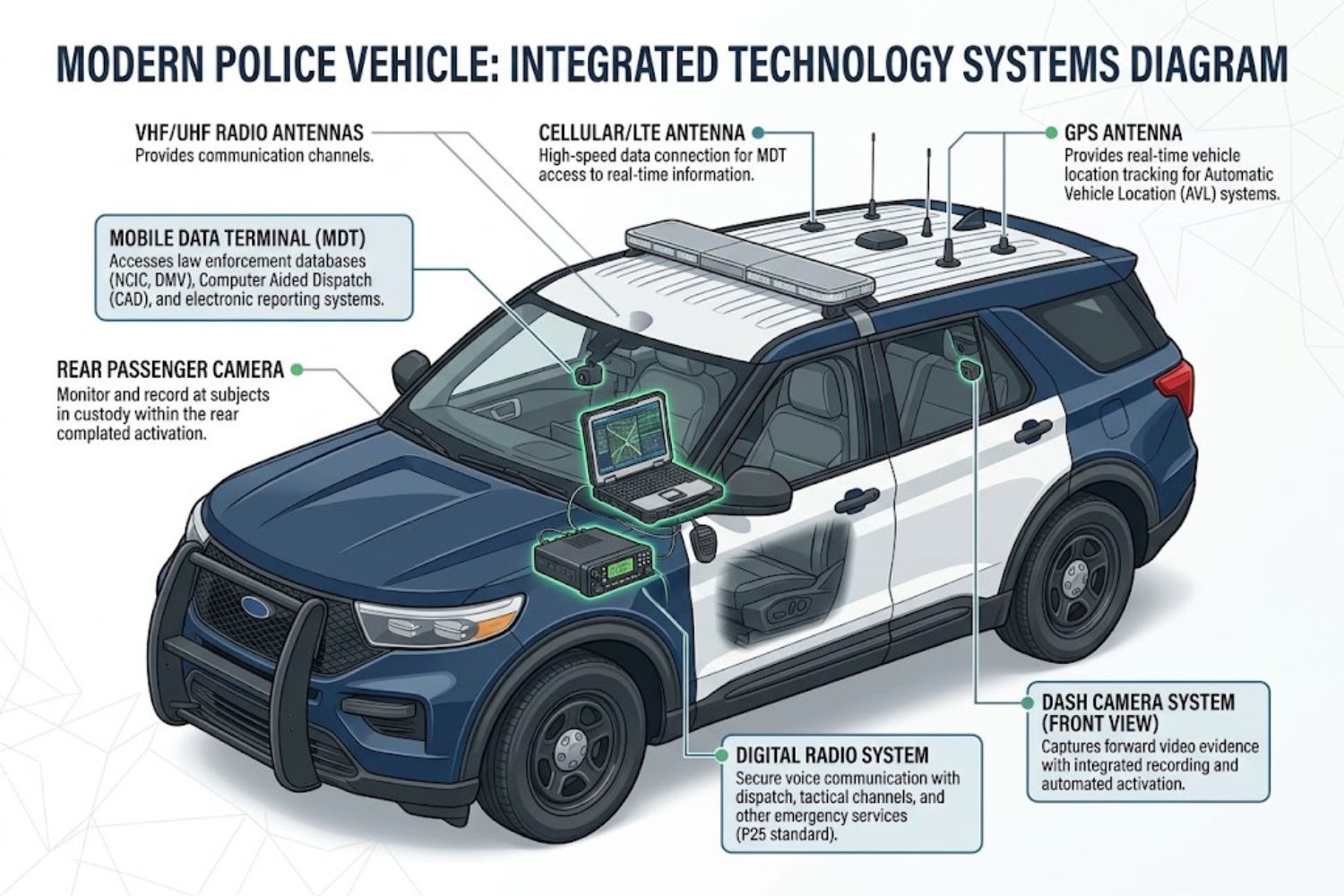
When you see a police car speeding past with lights flashing, you probably don’t think about the sophisticated technology humming inside. Modern police vehicles are far more than transportation—they’re mobile command centers packed with interconnected systems designed to help officers respond faster, access critical information, and stay safe on the job.
For anyone interested in how technology actually works in the real world, police car systems offer a fascinating case study. They combine hardware, software, databases, networks, and user interfaces in ways that most people never see. This guide breaks down exactly how police cars work and why the technology inside them matters.
What Makes Modern Police Cars Different From Regular Vehicles
Hardware vs. Software Integration
Police vehicles start with a base model—often a sedan, SUV, or truck—and transform it into a specialized platform. The key difference isn’t always what you see. Most of the sophistication lives in software and systems integration rather than physical modifications.
A typical police car adds 50-100 pounds of equipment: mobile computers, radios, servers, wiring, sensors, and backup power systems. But the real challenge isn’t the hardware itself. It’s making hardware from different manufacturers—computer systems from one company, radios from another, cameras from a third—work together seamlessly.
Why Police Vehicles Need Specialized Systems
Police officers operate under unique constraints compared to other professionals:
- They need access to real-time data while driving
- They manage split attention (driving safely while handling information)
- They operate 24/7 with unreliable outside connectivity
- They must maintain evidence integrity and legal compliance
- They work in high-stress situations where equipment must be 100% reliable
These constraints drive the design of police vehicle technology. Everything from processor selection to user interface design reflects the reality of what officers actually do in the field.
The Evolution From Basic Patrol Cars to Mobile Command Centers
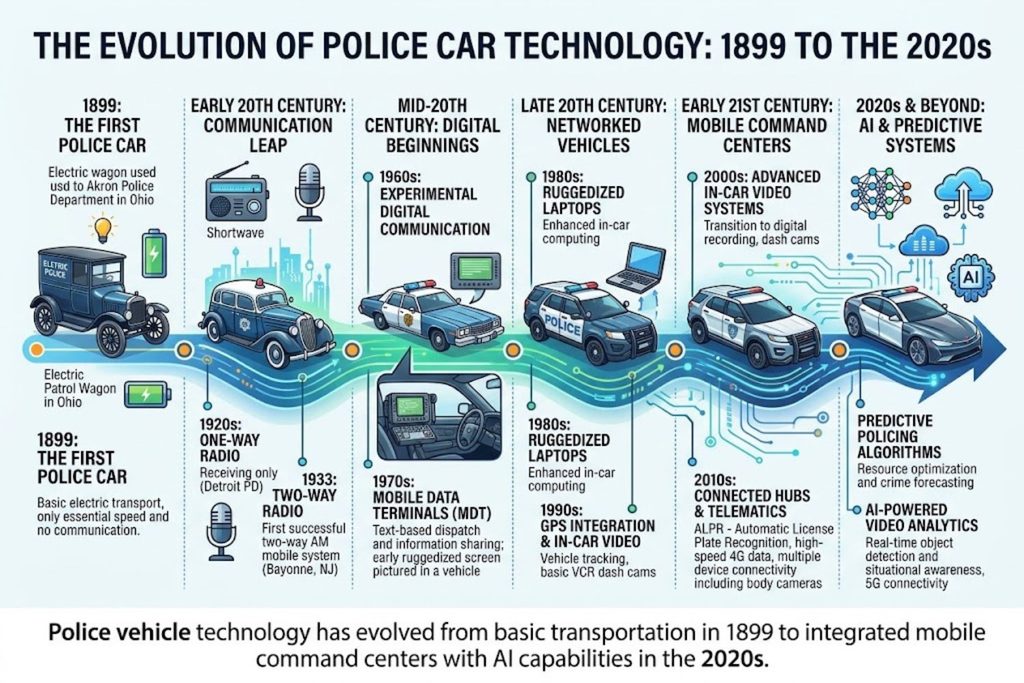
The first police car, an electric wagon used by the Akron Police Department in 1899, had one job: transportation. By the 1920s-1960s, police added radios—allowing dispatch to reach officers without waiting at a station.
The 1980s brought the first mobile data terminals (MDTs), allowing officers to run license plate checks and access arrest records without leaving the vehicle. The 1990s added GPS and computer integration. The 2000s brought video cameras and integrated systems. Today’s police vehicles are genuinely mobile command centers with multiple overlapping systems all operating simultaneously.
This evolution happened because technology enabled new capabilities, but also because law enforcement realized that keeping officers in the field—rather than returning to the station—improved response times and public safety.
The Core Technology Systems in Police Vehicles
Modern police cars typically run three to four major systems simultaneously. Understanding each one reveals how the technology ecosystem actually works.
Mobile Data Terminals (MDTs): The Command Center
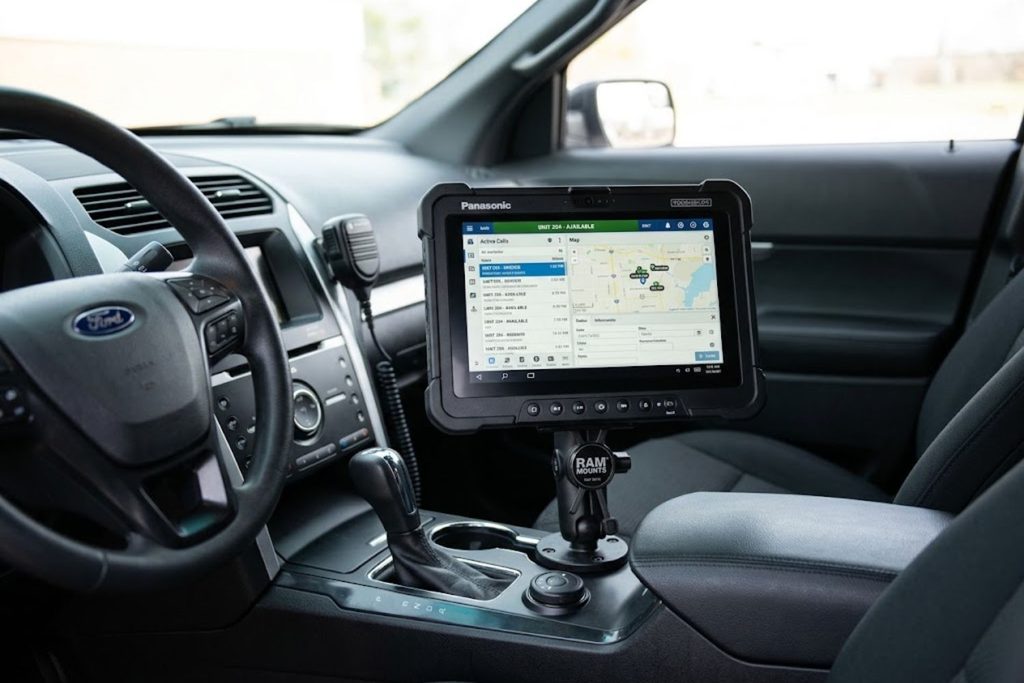
The MDT is arguably the most important technology in a police vehicle. It’s the system that allows officers to access information and stay connected to dispatch while driving.
How MDTs Connect to Dispatch
An MDT is essentially a hardened, vehicle-mounted computer running specialized software. Unlike a laptop, it’s engineered for mobile use with ruggedized components, enhanced cooling (vehicles get hot), and backup power systems. The computer connects to the police department’s network via cellular data, often using dedicated law enforcement networks rather than commercial cellular.
The typical MDT setup includes:
- A vehicle-mounted computer (often a modified industrial PC)
- A touchscreen or keyboard interface
- A mobile router (for network connectivity)
- Backup power management systems
- Custom software connecting to dispatch and records systems
Real-Time Data Access
When an officer runs a license plate check, the MDT sends a request through the police network to the state motor vehicle database, gets results back, and displays them on screen. This entire process typically takes 5-15 seconds. Before MDTs, an officer would call dispatch, who would manually check records—a process taking 2-5 minutes.
That speed difference compounds across thousands of stops. If an officer can run 10 license plate checks using an MDT versus 3 using manual dispatch, they’re generating dramatically more law enforcement activity in the same shift.
Modern MDTs also provide:
- Real-time dispatch updates and call assignments
- Access to wants and warrants databases
- Criminal records and arrest history
- Vehicle registration and insurance information
- Mugshot databases
- Call history and officer location
Officer Productivity Features
The best MDT systems reduce the time officers spend on administrative work. Some modern MDTs include voice recognition, allowing officers to run searches by speaking rather than typing. The University of New Hampshire’s Project 54 system demonstrated this approach, letting officers perform searches while keeping their hands on the wheel and eyes on the road.
Other systems use in-field reporting software, letting officers complete incident reports directly in the vehicle rather than returning to the station to type at a desk. This is a genuine productivity enhancement—studies show officers can spend 30-50% of their shift on administrative work if systems aren’t optimized.
Automatic Number Plate Recognition (ANPR)
ANPR—also called License Plate Recognition (LPR)—is one of the most visible police technologies. It’s also one of the most misunderstood.
How ANPR Technology Works
ANPR systems use specialized cameras mounted on the police vehicle—typically on the front, rear, or sides—to photograph license plates of other vehicles. Optical character recognition (OCR) software reads the plate number from the image. That plate number is then checked against databases of:
- Stolen vehicles
- Vehicles with outstanding warrants
- Registered owners with active criminal investigations
- Vehicles involved in hit-and-runs or AMBER Alerts
The entire process—image capture, OCR, database lookup—typically takes 1-2 seconds. When there’s a match, the officer gets an alert on their MDT.
Modern ANPR systems can scan 100-1000 license plates per hour depending on traffic conditions. A single police vehicle running ANPR during an 8-hour shift might check 2,000-4,000 plates. Across a police department, ANPR systems check millions of plates annually.
Integration With Law Enforcement Databases
The value of ANPR comes entirely from database integration. The camera and OCR technology are almost worthless without access to accurate, real-time law enforcement databases. A police department using ANPR needs:
- A centralized database of flagged plates
- Real-time update mechanisms (when a stolen vehicle is recovered, the flag must be removed immediately)
- Integration with state and federal systems
- Quality control processes to prevent false matches
Many modern ANPR systems integrate with FBI databases, state motor vehicle records, and specialized law enforcement networks. The technical challenge isn’t reading the plate—it’s ensuring the data behind the plate is accurate.
Accuracy and Privacy Considerations
ANPR technology typically achieves 85-95% accuracy depending on conditions. Weather, plate condition, and lighting all affect accuracy. When OCR fails to read a plate with high confidence, the system flags it as uncertain rather than making a guess.
Privacy concerns around ANPR are legitimate. A single police vehicle can photograph thousands of law-abiding citizens’ plates daily. This has led to regulations in many jurisdictions:
- California requires ANPR data retention policies
- Some states limit how long ANPR data can be stored
- Certain jurisdictions require transparency reports on ANPR hits
- A few places restrict ANPR use entirely
These regulations represent a genuine tension between law enforcement effectiveness and privacy rights.
Video Systems and Evidence Capture
Police vehicles increasingly include multiple camera systems:
- Forward-facing camera (records incidents ahead of the vehicle)
- Rear-facing camera (records what happens behind the car)
- Interior cabin camera (records interactions inside the vehicle)
In-Car and Body Camera Integration
Modern police departments are moving toward integrated camera systems where both in-car video and body camera footage are automatically synchronized and stored together. When an officer exits the vehicle and continues into a building or stops a pedestrian, the body camera picks up where the in-car camera left off.
The technical challenge is managing massive amounts of video data. A single 12-hour shift from one officer, with body camera and vehicle camera recording, generates 50-100 GB of video. A single police department with 100 officers generates terabytes of video daily.
This drives investment in:
- High-compression video codecs
- Automated metadata tagging
- Cloud storage systems
- Rapid search and retrieval systems
Evidence Management and Chain of Custody
Video evidence is only useful if it meets legal standards. This means:
- Accurate timestamping
- Tamper-proof storage
- Clear chain of custody documentation
- Easy retrieval for court proceedings
- Compliance with discovery rules
Modern evidence management systems use cryptographic techniques to ensure video hasn’t been modified. When a video file is stored, a cryptographic hash (a unique digital fingerprint) is generated. If the video is ever altered, even slightly, the hash changes. This makes it immediately obvious if video evidence has been tampered with.
Real-Time Streaming and Supervision
Emerging systems allow police supervisors to watch what’s happening in real-time. A sergeant at the station can view an officer’s dashboard camera and audio feed during a traffic stop or incident. This enables:
- Better decision-making (supervisors understand context before it escalates)
- Officer safety (backup can see what’s happening before arriving)
- Training (actual footage provides concrete examples for academy training)
- Accountability (real-time observation provides transparency)
The technology challenge here is bandwidth—streaming high-quality video from multiple vehicles simultaneously requires significant network capacity.
Communication Infrastructure in Police Vehicles
Police vehicles need reliable communication systems for dispatch, inter-officer communication, and data transmission.
Radio Systems and Encryption
Police use specialized radio systems separate from commercial cellular networks. Most commonly, these are either VHF (Very High Frequency) or P25 (Project 25) digital radio systems. P25 is increasingly standard because it supports:
- Encryption (preventing unauthorized listening)
- Better coverage in difficult terrain
- Integration with multiple agencies (mutual aid becomes simpler)
- Digital data transmission over radio
A typical police vehicle has at least 2-3 radios for different frequencies—perhaps one for local dispatch, one for countywide coordination, and one for statewide traffic.
Wireless Data Networks
Beyond radio, police vehicles need wireless data connectivity for their MDT systems. Options include:
- Dedicated law enforcement wireless networks (expensive but controlled)
- Commercial 4G/LTE networks (faster but depends on commercial infrastructure)
- Hybrid systems using both dedicated networks and commercial backup
The choice involves tradeoffs between cost, reliability, and speed. A police department with a dedicated wireless network can guarantee coverage and capacity but pays millions annually to maintain it. A department using commercial cellular networks has cheaper infrastructure but depends on carrier reliability and coverage.
Integration With Emergency Services
Modern police vehicles are part of a larger ecosystem including fire departments and EMS. Integration means:
- Automatic dispatch to fire and EMS for certain incidents
- Shared MDT systems showing real-time location of fire and EMS resources
- Interoperable communication frequencies
- Coordinated response planning
This integration has genuinely improved emergency response—fire, police, and EMS can coordinate arrival timing and resource deployment in real-time.
Common Challenges in Police Communication Tech
The fundamental challenge is coordinating multiple systems with different manufacturers, standards, and update cycles. When a police department wants to upgrade their radio system, it might require updating 200 vehicles and retraining hundreds of officers. These projects routinely take 3-5 years and cost tens of millions of dollars.
Interoperability remains a persistent problem. Many police departments use older systems incompatible with neighboring jurisdictions’ systems, making mutual aid and coordination difficult during large incidents.
Emerging Technologies in Law Enforcement Vehicles
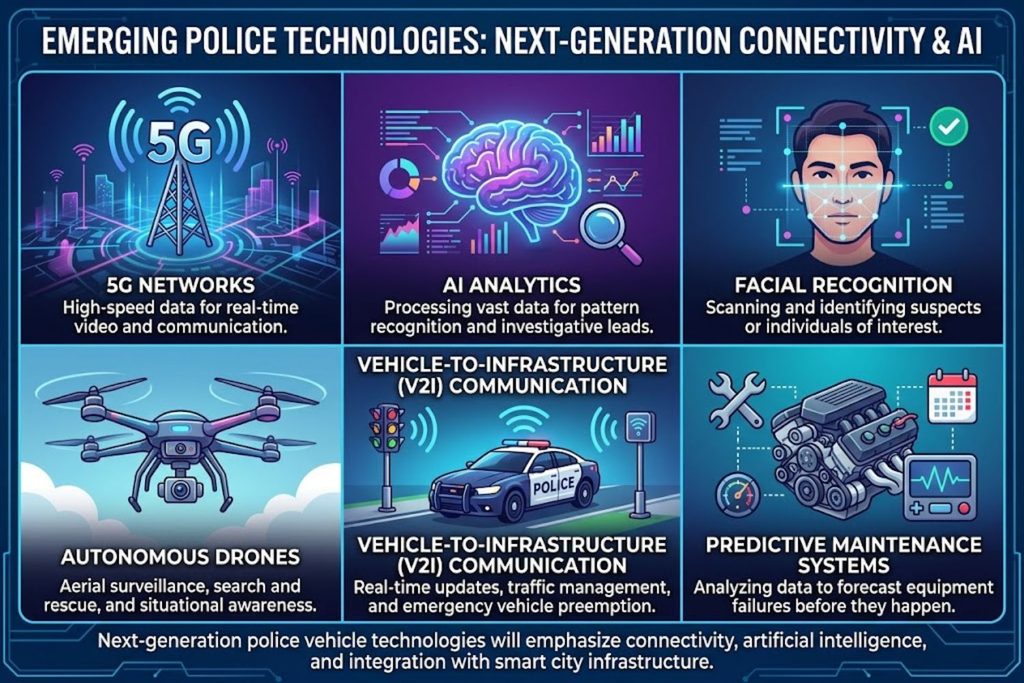
Police car technology is evolving rapidly. Several emerging systems are reshaping law enforcement.
AI and Predictive Policing
AI systems are beginning to appear in police vehicles. Some systems use machine learning to:
- Prioritize which calls officers should respond to (based on historical data)
- Identify patterns in criminal activity
- Recommend optimal patrol routes
- Alert officers to areas with high crime rates during their shift
These systems operate on historical data, which introduces bias issues. If historical data reflects discriminatory policing patterns, AI systems trained on that data will replicate and amplify those biases. This is an active area of debate in police reform discussions.
Facial Recognition and Biometric Systems
Some police vehicles are equipped with facial recognition cameras. When an officer photographs someone, the system can attempt to identify them by comparing facial features against mugshot databases.
Facial recognition technology has accuracy rates of 70-99% depending on image quality and the size of the comparison database. These systems also have documented accuracy disparities—they work better on some racial groups than others, a bias that compounds during law enforcement use.
Privacy advocates argue that ubiquitous facial recognition in police vehicles enables mass surveillance. Law enforcement argues it’s a valuable investigative tool. This remains an active policy debate in many jurisdictions.
Vehicle-to-Infrastructure (V2I) Communication
V2I systems allow police vehicles to communicate with smart traffic signals, road sensors, and infrastructure systems. This enables:
- Automatic traffic signal changes to clear routes for emergency vehicles
- Real-time road hazard warnings
- Coordination with other vehicles and infrastructure
- Predictive maintenance data
V2I infrastructure is still emerging, but police vehicles are early adopters because law enforcement benefits significantly from efficient routes and signal coordination.
Autonomous and Semi-Autonomous Systems
Autonomous vehicle technology is primarily being developed for commercial applications, but law enforcement has interest in specific use cases:
- Autonomous drones for perimeter patrol
- Remotely operated vehicles for bomb disposal
- Autonomous response vehicles (arriving at minor accidents to direct traffic before officers arrive)
Full autonomous police cars remain science fiction, but specific autonomous functions are emerging in police departments.
How Police Car Systems Are Integrated
The real sophistication in modern police vehicles isn’t any single technology—it’s the integration of multiple systems.
The Challenge of Multiple Manufacturers
Police departments don’t buy their vehicles pre-equipped with technology. Instead, they:
- Purchase a base vehicle (Ford Police Interceptor Utility, Dodge Charger, etc.)
- Send it to a specialty upfitter company
- The upfitter installs equipment from multiple manufacturers
- The department tests everything together
This means:
- The vehicle’s computer (from the manufacturer) must integrate with the police MDT (from another company)
- The radio system (from a third manufacturer) must work with the MDT
- The camera systems must integrate with the MDT
- Everything must have backup power systems
- All devices must work in extreme temperatures and conditions
Centralized Control Systems
Modern police vehicles use centralized control systems that consolidate many functions:
The University of New Hampshire’s Project 54 system is a great example. It created a single interface where officers could control:
- Light bar illumination
- Siren sounds and patterns
- Radio channel switching
- MDT functions
- Video recording
- License plate reader activation
All through voice commands, touchscreen, or physical buttons.
This centralization reduces cognitive load on officers. Rather than remembering that the radio is controlled with one interface, the camera with another, and the lights with a third, everything is unified.
Voice Command and Touchscreen Interfaces
Modern police vehicles support multiple input methods:
- Voice commands: “Run plate X123ABC” or “Activate dashboard camera”
- Touchscreen: For complex queries requiring multiple steps
- Physical buttons: As redundancy when other systems fail
- Keyboard: For detailed report writing
The best interfaces combine all of these, recognizing that the best input method depends on context. While driving and handling an emergency, voice commands are safest. While parked and writing a report, a keyboard might be most efficient.
Real-World Integration: Project 54 and TACNET
Two real-world examples illustrate how police vehicle integration works:
Project 54 (University of New Hampshire) Developed with National Institute of Justice funding, Project 54 created a fully integrated system compatible with most manufacturers’ equipment. The modular design meant if one component failed, the system could operate with reduced functionality rather than failing entirely. Voice commands were designed to be accent-tolerant (recognizing that officers come from diverse backgrounds). The system could be easily modified in the field as departments’ needs changed.
TACNET (Texas A&M Transportation Institute) TACNET created a centralized control system for patrol cars. All major functions—lights, sirens, radios, MDT, video, radar—were controlled through a single touchscreen interface. This reduced installation complexity and made the system easier to operate.
Both systems demonstrate that successful police vehicle integration requires:
- Modularity (parts should work independently if needed)
- Redundancy (critical functions should have multiple control methods)
- Simplicity (interfaces should be intuitive under stress)
- Robustness (systems should degrade gracefully if components fail)
Budget, Implementation, and Training
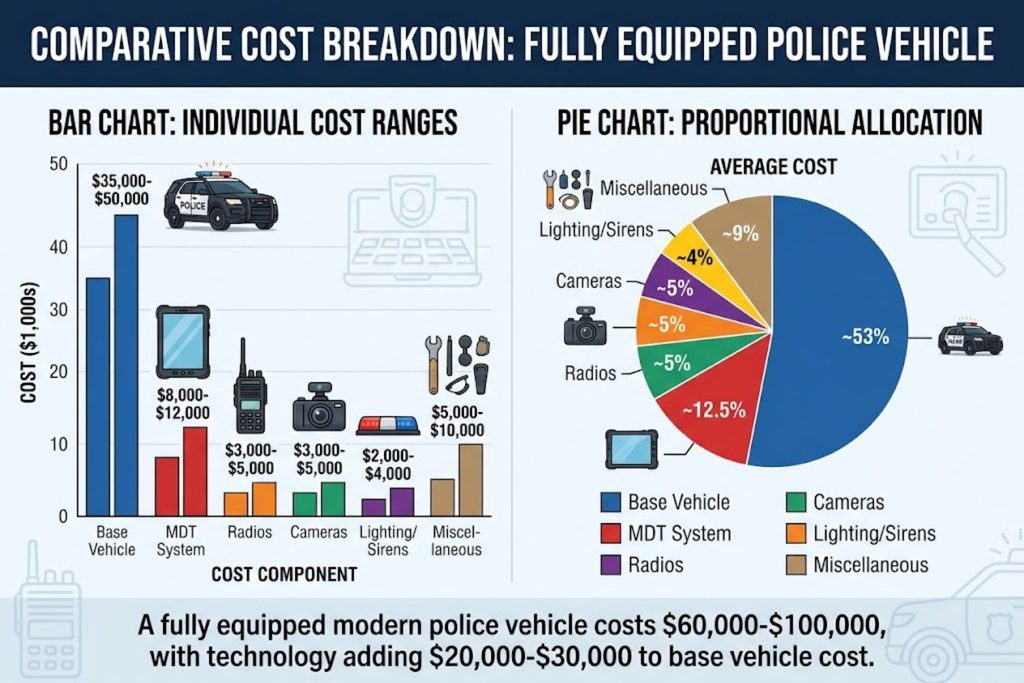
Police car technology isn’t cheap, and implementation creates real operational challenges.
Cost of Police Car Technology
A fully equipped modern police vehicle costs $60,000-$100,000. Breaking this down:
- Base vehicle: $35,000-$50,000
- MDT system: $8,000-$12,000
- Radio system: $3,000-$5,000
- Camera systems: $3,000-$5,000
- Lighting and siren: $2,000-$4,000
- Miscellaneous equipment and installation: $5,000-$10,000
For a mid-size police department with 100 officers, a full fleet replacement costs $6-10 million. Smaller towns struggle with this cost, which leads to mixed-technology fleets where newer vehicles have current systems and older vehicles have outdated systems.
Installation and Maintenance Challenges
Modular vs. Custom Installation
Police departments face a choice: use standardized modular systems or custom-design installations for each vehicle.
Modular systems are cheaper and faster to deploy but may not perfectly match the department’s specific needs. Custom installations are more expensive and slower but create exactly the right configuration.
Most departments use a hybrid approach—a standardized modular core with custom additions for specialized units.
Standardization Across Departments
Police departments historically developed their own technology solutions, leading to thousands of different systems nationwide. This creates huge challenges:
- Officers transferring between departments must relearn systems
- Evidence from one jurisdiction isn’t compatible with another’s systems
- Inter-agency cooperation is complicated
The National Institute of Justice and the Department of Homeland Security have funded initiatives promoting standardization, but progress is slow because police departments are conservative and hesitant to abandon existing investments.
Officer Training Requirements
A modern police vehicle is so complex that officer training is substantial:
- Basic operation: 4-8 hours
- System troubleshooting: 4-6 hours
- Evidence collection and chain of custody: 6-10 hours
- Legal compliance and data protection: 4-6 hours
New officers need 20-30 hours of initial training on vehicle systems alone. Experienced officers need refresher training whenever new systems are added or major updates occur.
Security and Privacy in Police Technology
Police car technology creates genuine security and privacy concerns.
Data Protection in Mobile Systems
Mobile devices are inherently less secure than stationary systems. An MDT in a police vehicle could theoretically be:
- Hacked if an officer connects to unsecured networks
- Stolen if the vehicle is broken into
- Compromised by malware introduced through USB devices
Police departments address this through:
- Encrypted communications (most MDT data is encrypted in transit and at rest)
- Access control (only authorized officers can log in)
- Physical security (MDT hardware is secured to the vehicle)
- Network security (police departments run isolated networks, not the public internet)
Cybersecurity Threats to Connected Vehicles
As police vehicles become more connected, cybersecurity risks increase. A vehicle connected to wireless networks, cellular systems, and the internet is inherently more vulnerable than an isolated vehicle.
Potential threats include:
- Ransomware attacks (criminal gangs encrypt police vehicle systems to extort departments)
- Data breaches (hackers accessing law enforcement databases through vehicle systems)
- System compromise (criminals gaining control of vehicle functions)
- Man-in-the-middle attacks (intercepting and modifying communications)
Police departments increasingly employ dedicated cybersecurity staff to protect vehicle systems, but the resources required exceed what most small departments can afford.
Privacy Regulations and Oversight
Governments are increasingly regulating how police use vehicle technology:
- California requires ANPR data retention policies and regular reports to elected officials
- Some states limit ANPR data storage to 30-90 days
- Federal law restricts how long location data from GPS devices can be stored
- Some cities require transparency reports on how many ANPR hits were accurate vs. false positives
These regulations represent attempts to balance law enforcement effectiveness against privacy rights.
Public Transparency and Accountability
Many police departments are providing public transparency regarding vehicle technology:
- Publishing statistics on ANPR use (plates scanned, hits, false positives)
- Releasing body camera footage (though often with delays and restrictions)
- Publishing policies on data retention and system use
- Engaging in community discussions about technology practices
This transparency varies dramatically by jurisdiction. Some departments are highly forthcoming; others provide minimal information.
The Future of Police Car Technology
Police vehicle technology will continue evolving. Several trends are predictable:
5G and Real-Time Data
5G networks will provide much higher bandwidth to police vehicles. Current systems often wait for data because network capacity is limited. 5G enables:
- Real-time streaming video without compression
- Rapid facial recognition lookups
- Instant access to larger databases
- Real-time officer location tracking across entire jurisdictions
The infrastructure investment is substantial, and rural areas will lag urban areas in 5G deployment.
AI-Powered Analytics
Machine learning will increasingly analyze police data:
- Predictive analytics identifying where crimes are likely to occur
- Pattern recognition identifying crime series and connecting cases
- Natural language processing analyzing incident reports
- Image analysis of surveillance footage
The bias and fairness concerns are significant—systems trained on biased historical data will replicate and amplify those biases.
Predictive Maintenance and Vehicle Health
Police vehicles increasingly include systems monitoring mechanical health. Sensors track:
- Engine performance and emissions
- Brake wear and safety systems
- Battery health and electrical systems
- Tire wear and suspension components
This data predicts maintenance needs before failures occur, reducing breakdowns and extending vehicle life.
Integration With Smart City Infrastructure
As cities invest in smart infrastructure—connected traffic signals, traffic sensors, parking systems—police vehicles will integrate with these systems:
- Automatic traffic signal changes for emergency vehicles
- Real-time traffic flow data informing deployment
- Connected sensors identifying accidents and hazards
- Coordination with municipal services (potholes, traffic hazards)
Frequently Asked Questions About Police Car Technology
Q: How much does police car technology cost?
A: A fully equipped modern police vehicle costs $60,000-$100,000. The technology alone typically accounts for $20,000-$30,000 of that cost.
Q: Can police use ANPR on my vehicle?
A: Yes. ANPR systems scan all visible license plates. Some jurisdictions have regulations limiting how ANPR data is used and stored, but most police departments can legally scan any plate.
Q: How accurate is ANPR technology?
A: Modern ANPR systems achieve 85-95% accuracy. Accuracy depends on lighting, weather, plate condition, and camera positioning. Some false positives occur, requiring officer verification.
Q: What information can police access through their MDT?
A: Typically: vehicle registration and ownership, driver’s license information, wants and warrants, criminal history, and stolen vehicle reports. Specific access varies by jurisdiction and what databases are integrated.
Q: Is police vehicle video recorded 24/7?
A: No. Most systems record only when officers activate them, though some departments record continuously during shift. Recording practices vary by jurisdiction.
Q: Can police vehicles be hacked?
A: Theoretically yes, though it’s rare. Police vehicle systems are generally more hardened than consumer devices. Concerns primarily focus on network vulnerabilities rather than individual vehicle compromise.
Q: What happens to police vehicle data when a vehicle is retired?
A: Data storage systems are typically removed and securely wiped or destroyed. Hard drives may be physically destroyed. Practice varies by department.
Q: Are police required to tell me what technology they’re using?
A: This varies by jurisdiction. Some require transparency reports; others don’t. You can request information through freedom of information requests in most places.
Q: How long is police vehicle footage retained?
A: This varies widely. Some departments keep footage indefinitely; others delete it after specific periods. Jurisdictional law determines retention requirements.
Q: What’s the next major technology advancement for police vehicles?
A: Likely candidates are: AI-powered predictive policing, improved facial recognition, 5G-enabled systems, and integration with smart city infrastructure. Development and deployment vary by department.
Key Takeaways
Police car technology represents a fascinating convergence of hardware, software, databases, networks, and user interface design all working toward a specific goal: helping officers respond faster and make better decisions. Understanding how these systems work—and their limitations—provides genuine insight into modern law enforcement operations.
The sophistication isn’t in any single technology but in the integration of multiple systems working together. The challenges aren’t primarily technical; they’re organizational, budgetary, and political. The future of police technology will be shaped as much by policy decisions about privacy and fairness as by technological capabilities.
For anyone interested in how technology actually operates in mission-critical environments, police vehicle systems offer excellent real-world examples of complex systems integration, user interface design under stress, and the interplay between technology, law, and policy.
Conclusion: Why Understanding Police Car Tech Matters
Police vehicle technology directly affects public safety, privacy, and civil rights. Understanding how these systems work—their capabilities and limitations—enables more informed conversations about:
- Public safety and technology
- Privacy rights and surveillance
- Police accountability and transparency
- Equipment budgets and resource allocation
Whether you’re a technology enthusiast, policy advocate, or simply curious about how things work, police car technology is worth understanding. These systems represent significant investment and genuine innovation, but also legitimate questions about fairness, privacy, and effectiveness.