A free AI checker can flag text that reads like machine output in seconds, and that speed is the appeal. The catch is that the results are less certain than the interface suggests. Vendor-run tests often claim accuracy in the high 90s. Independent comparisons put the best free tools well below that, and they disagree with each other. This guide explains what these tools measure, where they fail, what limits you’ll hit on free plans, and a workflow that keeps one percentage from driving a serious decision.
What a Free AI Checker Actually Measures
Quick definition: A free AI checker estimates how likely a passage was generated by a language model. It looks for statistical patterns, such as how predictable word choices are and how much sentence length varies, then compares them with samples of human and machine writing. The output is a probability, not proof of who wrote the text.
The signals behind the score
Most detectors rely on predictability. Language models pick likely next words, so their output tends to read smoothly and evenly. Human writing is usually less uniform: sentence lengths swing, word choices get idiosyncratic, and the rhythm shifts. Detectors measure these differences.
That design explains both their strengths and their weaknesses. Clean, formal prose can look machine-like even when a person wrote it. Heavily edited AI text can look human. Neither outcome means the tool is broken. It means the tool is reading patterns, not intent.
Why a percentage is a probability, not proof
A score of 85% does not mean 85% of the text came from AI. It means the tool’s model judged the passage likely to resemble its AI training samples. Treat the number as a signal to investigate, not a finding.
Where Free Tools Stand Today
Vendor claims versus independent tests
Independent results are inconsistent. In one comparison, Scribbr’s premium detector scored 84% accuracy, while QuillBot’s and Scribbr’s free detectors both scored 78% and were among the most accurate free tools in that test. scribbr
Vendor-written content is less reliable. One post says a tool achieves over 95% accuracy on raw AI content, but a separate roundup by the same publisher lists that tool at about 90% and later at 82–86%. Another vendor reports 99.20% accuracy for its own detector. Treat any accuracy figure published by the company that sells the tool as a marketing claim until you verify it yourself.
Free limits at a glance
Free plans vary, and they change often. A 2026 roundup notes that free plan limits have shifted across most tools, and several have become more restrictive. The limits reported in current sources include:
- Scribbr: up to 500 words per check, with unlimited checks and no sign-up.
- QuillBot: a 1,200-word free limit with no sign-up, but it needs a minimum of 80 words for a meaningful scan.
- Grammarly: one scan of up to 1,400 characters with no account required.
- Originality.ai: three scans per day and 12,000 characters on its free tier.
Check each site before you recommend a tool. A limit that was accurate last quarter may not be accurate today.
Why Free Checkers Get It Wrong
False positives on human writing
False positives are the biggest practical risk. A checker can flag a paragraph a person wrote carefully, especially formal, structured or heavily edited prose. Scribbr notes that these tools are relatively easy to get around and can sometimes produce false positives. A flag is not evidence of misconduct.
Short text, other languages and paraphrasing
Three limits matter most in daily use:
- Short passages: A few sentences give the model too little pattern to work with. Scores on short text are mostly noise.
- Language support: Some tools are English-only. One review of Detector.io notes that its detector supports English only, so if you write in German, Spanish, or anything else, the score is far less meaningful.
- Paraphrasing: Detection of paraphrased AI text is uneven. Even Scribbr’s premium tool doesn’t always detect use of paraphrasing tools.
A Five-Step Workflow for Real Decisions
Use this process whenever a flag affects a grade, a hiring decision, a client deliverable or a publishing decision.
- Scan 300 words or more at a time. Split long documents into sections. Most free tiers cap input length, and short scans are unreliable.
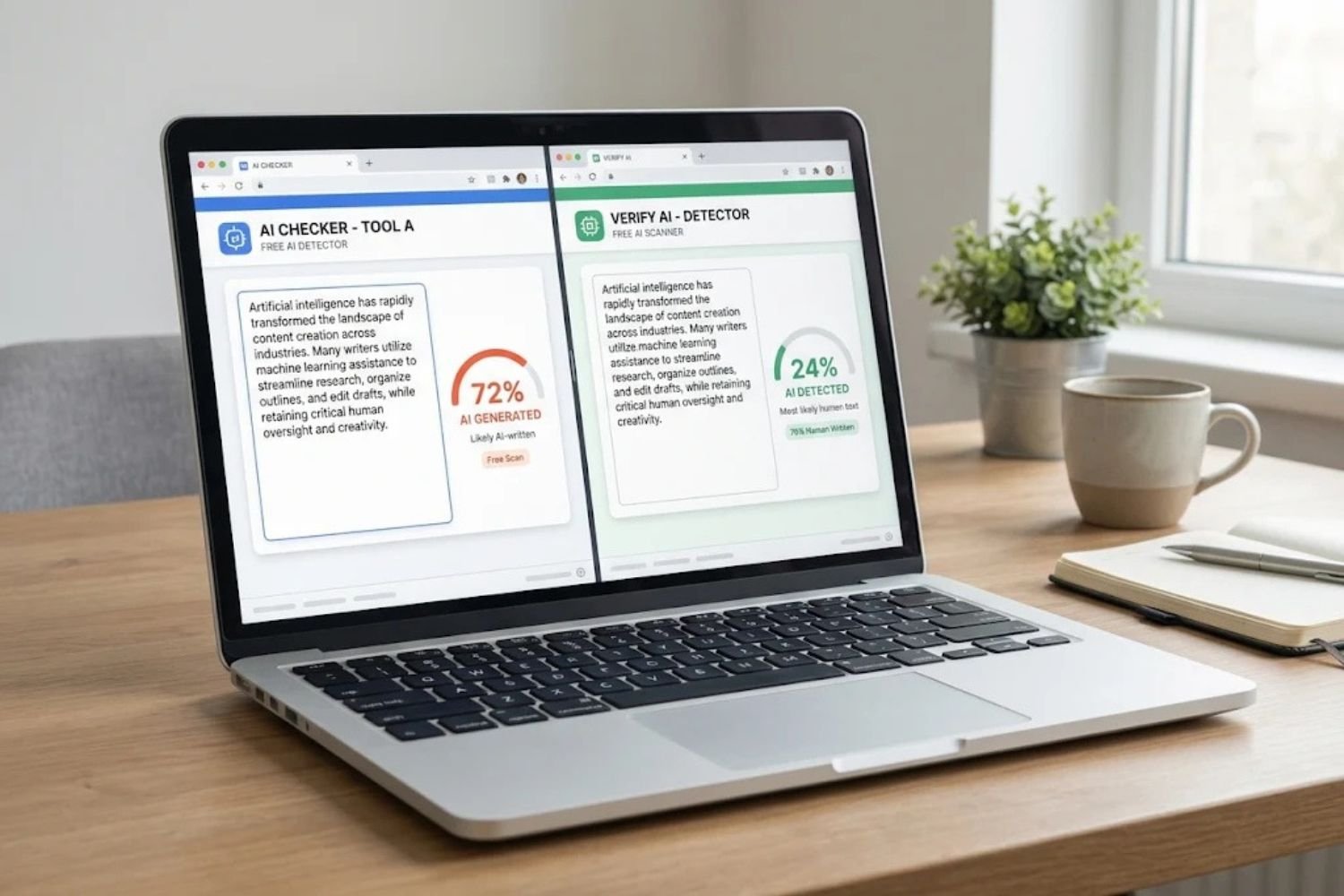
- Run the same passage through two tools. Agreement carries more weight than one high score. Disagreement is itself a signal to slow down.
- Read the sentence-level highlights, not the headline number. If the flagged text is generic and unsourced, that tells you more than the percentage does.
- Check the process. Version history in Google Docs, research notes, outlines and source lists are stronger evidence than any detector score.
- Treat a flag as a reason to ask, not a verdict. Ask the writer to walk you through their sources and approach.
Illustrative scenario
This is a hypothetical example, not a documented case. An editor sees an 85% score on a 1,100-word freelance draft. Two tools disagree. The highlights cluster in one product-comparison section full of unsourced superlatives. The editor asks for research notes and a 10-minute call. The fix is a rewrite of that section with named sources, not a rejected article.
Mistakes That Cost People Time
- Treating a percentage as a verdict. Scores are probabilities with error rates.
- Scanning a 4,000-word document in one pass and trusting the result, especially when the tool truncates input.
- Using a humanizer to beat the checker. Rewriting text to lower a score removes the evidence you were trying to assess and makes the final call harder to defend.
- Scanning non-English text in English-only tools.
Choosing the Right Free Checker
Decision guide by use case
| Your situation | What to prioritize | Practical starting point |
|---|---|---|
| Quick spot-check of a blog draft | No sign-up, workable word limit | A free detector with a clear word limit, such as Scribbr’s |
| Student or academic paper | Your institution’s policy | Confirm which tool your school accepts before scanning |
| Content team with volume | Batch checks and team features | A paid plan from a dedicated detector |
| Non-English writing | Verified language support | Confirm support in writing before relying on scores |
What a Free Checker Can’t Tell You
No free checker can confirm authorship. A score can’t reveal whether a writer used AI for an outline, a grammar fix or a full draft. Use scores to start a conversation, then decide using policy, context and the writer’s own process.
Bias is also a documented concern. A 2023 Stanford study published in Patterns found that several GPT detectors misclassified writing by non-native English speakers as AI-generated at high rates. That finding is a reason to read scores cautiously when the writer’s first language is not English.
Google’s public guidance on search quality focuses on whether content is helpful and people-first, not on whether a detector flags it. A detector score is not a quality measure.
Need a second opinion on your content workflow? [Insert TechWoid CTA: link to the most relevant guide or tool at techwoid.com. Confirm before publishing.]
Key Takeaways
- A free AI checker estimates likelihood. It doesn’t prove authorship.
- Vendor accuracy claims conflict with independent tests. Verify before trusting any percentage.
- Free limits change often, and several tools have tightened them. Check current limits before recommending a tool.
- False positives are the main risk, especially for formal, edited, or non-native English writing.
- Scan 300+ words, compare two tools, read the highlights, check the writer’s process, and ask before concluding.
- Use detectors to start a conversation, not to end one.
FAQ
Is a free AI checker accurate?
Accuracy varies. Independent tests show the best free tools are useful but imperfect, and they often misclassify some human writing. Verify any claim with your own test before relying on it.
What is the most accurate free AI checker?
Results differ across tests and publishers. In one independent comparison, the free detectors from Scribbr and QuillBot tied at 78%. Re-test the tools yourself with your own content.
Can free AI checkers detect ChatGPT text?
Many detect unedited output from popular models with reasonable consistency. Lightly edited or paraphrased text is harder to catch, and detection rates drop further as models improve.
Do AI checkers give false positives?
Yes. Human writing, especially formal or heavily edited prose, can be flagged. Never make a serious decision based on one score alone.
How many words can I scan for free?
It depends on the tool. Limits range from a few hundred words to more than 1,000 per check, and some use character counts. Check the current free limit on the tool’s site.
Do I need an account to use a free AI checker?
Some don’t require one, while others do. Requirements change, so verify before you recommend a tool.
Are AI checkers reliable for non-English text?
Only if the tool explicitly supports that language. English-only tools produce scores that are much less meaningful for other languages.
Can a paraphrasing tool fool an AI checker?
It can, and many checkers miss paraphrased AI text. That’s why a score should never be the only evidence.
Should teachers rely on free AI checkers?
Teachers should follow their school’s policy and avoid treating any score as proof of misconduct. Use the score to start a conversation with the student.
Is using an AI checker against Google’s rules?
No. Google’s public guidance focuses on whether content is helpful and original, not on how it was produced. A detector score doesn’t measure search quality.
Why do different AI checkers give different scores for the same text?
Each tool uses its own model, training data and thresholds, so results can diverge. That disagreement is a reason to read the highlights and check the writing process.
What should I do if my own writing gets flagged?
Keep drafts, version history and research notes. Explain how you wrote the piece, and ask for the specific sections flagged so you can respond to them directly.