If you’ve searched for “what is droven.io,” you’ve probably encountered the same confusion as hundreds of other tech professionals. Is it software? A course platform? A tool marketplace?
None of the above.
Understanding what droven.io actually is—and isn’t—is the first step to using it effectively. In 2026, when AI adoption decisions are worth millions and missteps cascade across entire organizations, having a vendor-neutral layer of context before you commit time and budget matters more than it sounds.
This guide walks through what droven.io does, who benefits most, how to integrate it into your workflow, and honest assessment of when it’s useful versus when you need something else entirely.
What Droven.io Actually Is (And Isn’t)
The name doesn’t help. “Droven” sounds like it could be anything. So let’s start by eliminating what it’s not.
It’s Not Software
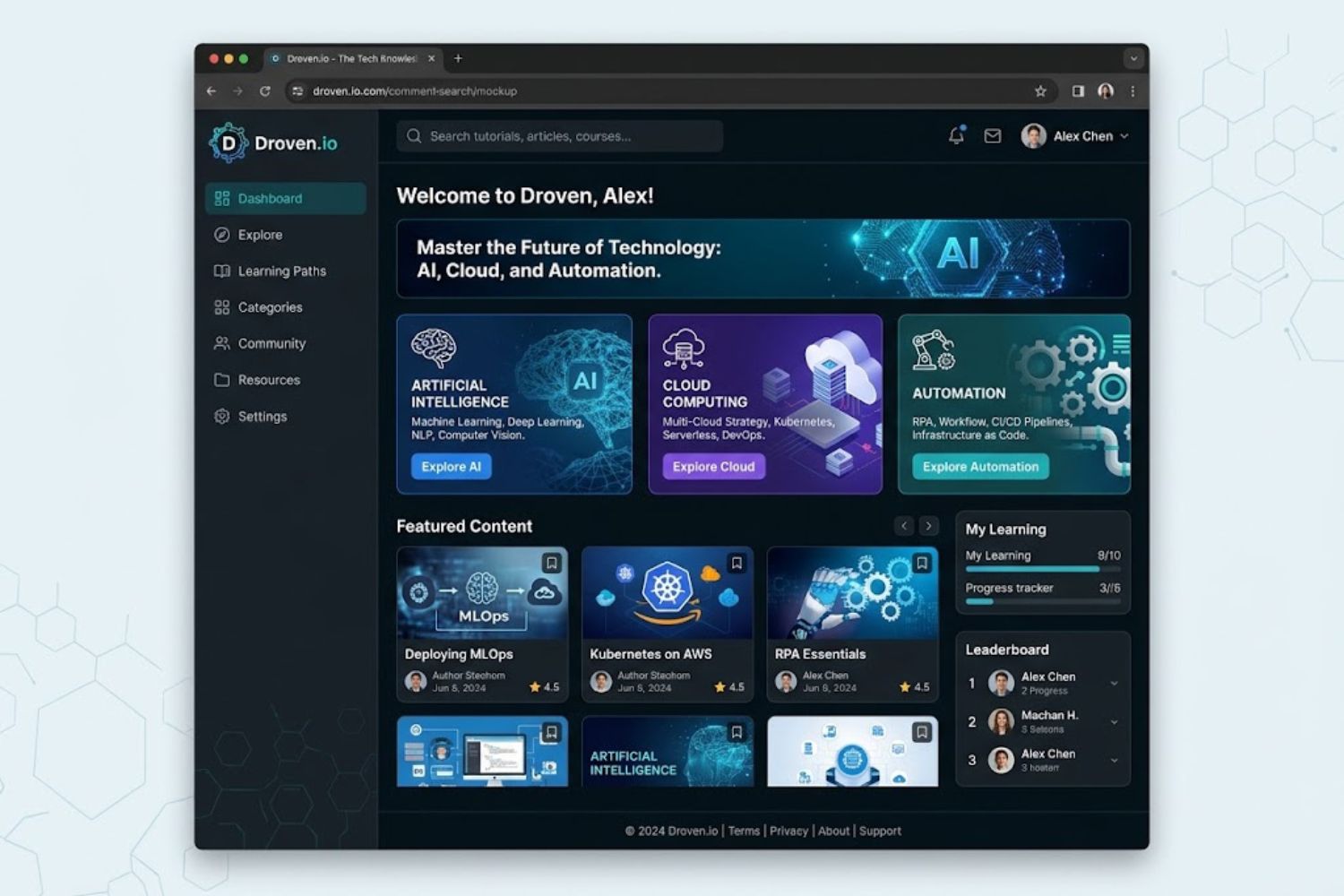
There’s no login. There’s no dashboard. You don’t download anything or install anything. There’s no free tier that converts to paid plans. It’s not competing with Zapier, Make, n8n, or UiPath. If you’re looking for an automation tool, droven.io won’t automate anything for you.
It’s Not a Course Platform
It’s not Coursera, LinkedIn Learning, or edX. There are no progress bars, no certificates, no structured learning paths you can complete. You’re not working toward a credential. The content is available immediately, in full, without enrollment.
It’s Not a Tool Marketplace
It’s not AppSumo or a vendor directory. It doesn’t sell products, doesn’t affiliate-link you to tools, and doesn’t funnel you into sales conversations. When you read an article comparing Zapier and Make, you’re not being pushed toward either one.
What It Is: A Vendor-Neutral Knowledge Layer
Droven.io is an editorial platform that publishes research-backed articles on artificial intelligence, cloud computing, automation, cybersecurity, and emerging technology. Think of it as a structured blog written for tech professionals who need context before making adoption decisions.
The practical distinction: most “AI platforms” you encounter online are either vendor-funded (pushing their product) or affiliate-driven (making commission on referrals). Droven.io is positioned as neither.
That positioning has real value in a market drowning in marketing noise. Your job isn’t to find the best demo. Your job is to understand the category well enough to make a smarter decision. Droven.io attempts to bridge that understanding gap.
Who Benefits Most From Droven.io
Not everyone gets value from the same knowledge resources. The platform works best when aligned with specific roles and decision points.
For Developers & Engineers
Developers using droven.io typically search for explanations of emerging patterns (machine learning pipelines, NLP implementations), infrastructure concepts (Kubernetes, microservices architecture), and real-world deployment concerns (CI/CD pipelines, containerization trade-offs).
The value: articles written for understanding, not promotional purposes. If you’re deciding whether to containerize your application, you want to read about actual tradeoffs—performance implications, operational complexity, team learning curve—before you commit.
For DevOps & Cloud Architects
Cloud decisions carry operational and financial weight. DevOps teams benefit from droven.io coverage of cloud platforms (AWS, Azure, Google Cloud), infrastructure patterns, security frameworks, and cost optimization strategies.
The platform covers comparisons between major cloud providers without vendor preference. That doesn’t eliminate the decision-making burden, but it removes the sales-driven bias from the conversation.
For Product Managers & Decision-Makers
Product leaders evaluating AI adoption, automation implementation, or cloud migration often face a credibility gap: technical teams speak vendor language, sales reps optimize for commission, and your own research time is limited.
Droven.io provides plain-language explainers on what different technologies actually do, where they typically fail, and what operational readiness you actually need before implementation. That’s strategic context.
For IT Leaders Evaluating Platforms
IT leaders comparing automation tools, assessing AI integration paths, or planning cybersecurity upgrades benefit from seeing technology positioned neutrally. You’re not shopping for a single tool; you’re understanding a category.
For Career-Focused Tech Professionals
The platform covers certification guides, skill development paths, and career progression advice alongside technical content. If you’re transitioning into cloud engineering or machine learning, you get both conceptual grounding and practical guidance.
The 5 Content Pillars Droven.io Covers
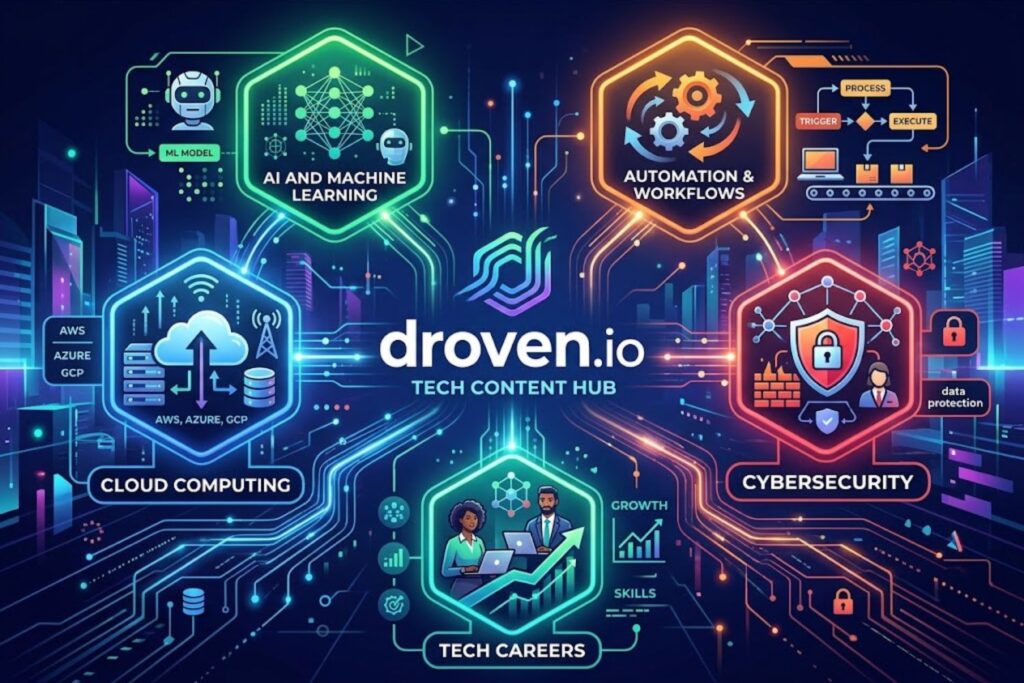
The platform organizes content into five major areas. Understanding what lives where helps you navigate quickly.
AI & Machine Learning Applications
This pillar covers practical AI implementations: predictive analytics, neural network systems, NLP advances, and real-world deployments in healthcare, finance, and logistics. The focus stays on application over theory—answering “what does this mean for my business” rather than proving mathematical concepts.
Cloud Computing & Infrastructure
SaaS versus IaaS versus PaaS. Serverless architecture. Containerization. Multi-cloud strategy. The platform strips jargon and explains deployment models, scalability decisions, and major platform comparisons accessibly.
Automation & Workflow Tools
This covers the automation category broadly: workflow orchestration, RPA (robotic process automation), no-code and low-code platforms, and integration patterns. If you’re deciding between Zapier, Make, n8n, or UiPath, you’ll find comparative context here.
Cybersecurity & Data Protection
Threat detection frameworks. Data protection strategies. Zero trust architecture. The platform acknowledges limitations of AI security tools rather than overselling capabilities. Coverage balances defensive security with offensive security applications.
Tech Careers & Skill Development
Career advice, certification guides, technical skill-building, and interview preparation. Useful if you’re planning a transition or evaluating which certifications actually matter in the job market.
How to Actually Use Droven.io in Your Workflow
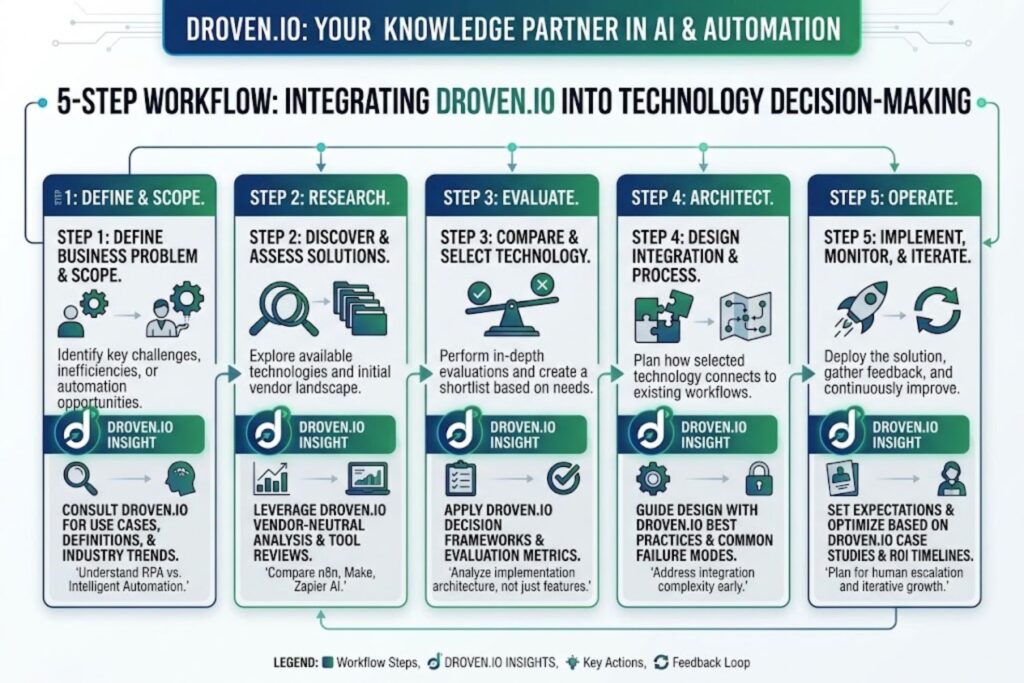
Knowing what droven.io is doesn’t tell you how to integrate it effectively. Here’s a practical framework.
Step 1 — Map Your Knowledge Gaps
Before visiting droven.io, be specific about what you don’t understand. “I need to learn about AI” is too broad. “I need to understand the difference between supervised and unsupervised machine learning before evaluating our data classification options” is actionable.
The platform works best when you search with intent. You’re filling a specific gap, not browsing.
Step 2 — Use Droven.io as Pre-Research
Read the relevant article before vendor demos, product trials, or technical discussions. You’re building a mental model. The article gives you vocabulary, concepts, and realistic tradeoffs before a salesperson optimizes the conversation for their product.
This ordering matters. Pre-research changes what questions you ask.
Step 3 — Cross-Reference Before Decisions
When evaluating specific tools, read droven.io coverage of the category, then request trials from your shortlisted options, then speak to implementation specialists or practitioners in your industry. The platform bridges knowledge gaps; it doesn’t bridge execution gaps.
Step 4 — Track Emerging Trends
Subscribe to updates in areas critical to your role. Cloud infrastructure evolves constantly. AI capabilities advance monthly. Cybersecurity threats shift quarterly. Reading droven.io periodically keeps you informed without requiring full-time learning.
Step 5 — Build Internal Knowledge Base From Insights
Save or bookmark articles relevant to your organization’s strategy. Share insights with relevant team members before strategy meetings. Use platform content as anchoring material for internal training.
Droven.io vs. Alternative Knowledge Platforms
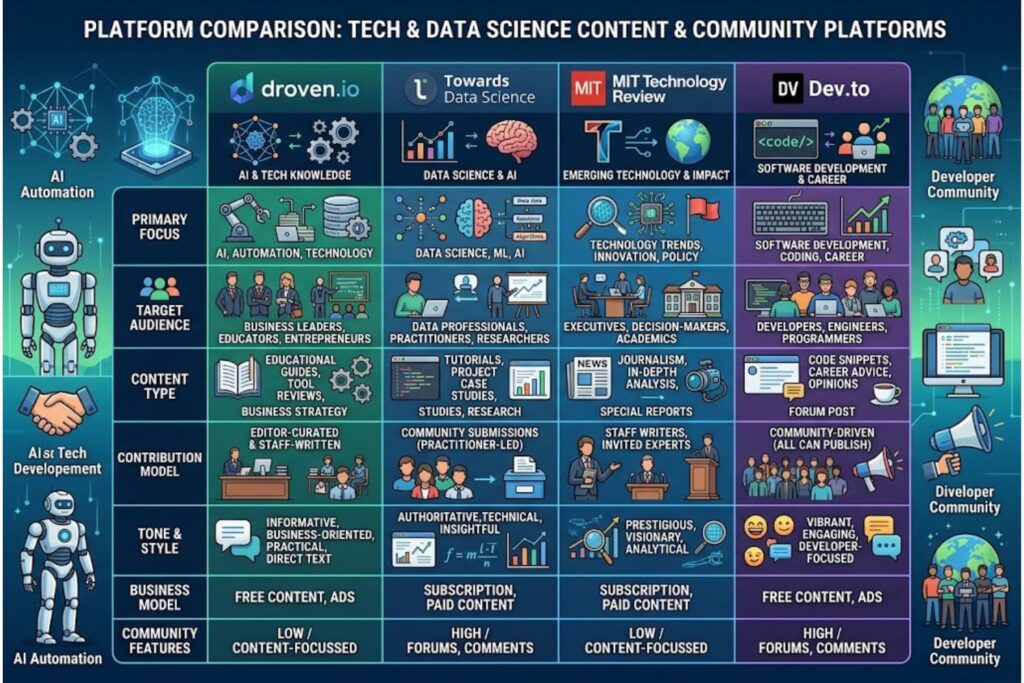
Droven.io isn’t the only vendor-neutral knowledge resource. How does it compare?
vs. Towards Data Science (TDS)
Towards Data Science focuses on data science, machine learning, and AI from an academic or practitioner perspective. Content is written by data scientists, for data scientists.
TDS is deeper on machine learning theory and implementation. Droven.io is broader across technology categories and written for mixed technical audiences. Choose TDS for ML depth; choose droven.io for cross-category context.
vs. MIT Technology Review
MIT Tech Review covers technology news, analysis, and trends with editorial credibility. Content is timely and frequently provocative.
MIT focuses on news and forward-looking analysis. Droven.io focuses on explanation and decision-support. They serve different needs. MIT for industry trends; droven.io for topic fundamentals.
vs. Dev.to & Community Platforms
Dev.to is a community platform where engineers publish articles, tutorials, and experiences. Content varies dramatically in quality and credibility.
Dev.to is peer-generated and free. Droven.io is curated editorial. Dev.to for cutting-edge practitioner tips; droven.io for foundational understanding from consistent editorial voice.
vs. Vendor Documentation & Demos
AWS documentation, Zapier tutorials, Kubernetes guides—every major platform publishes extensive documentation.
Vendor docs optimize for adoption of their specific product. Droven.io compares across the category. Use both, but in sequence: understand the category via droven.io, then dive into specific product documentation.
Comparison Table:
| Platform | Depth | Breadth | Bias | Best For |
|---|---|---|---|---|
| Droven.io | Medium | Very High | Minimal (vendor-neutral) | Cross-platform understanding, decision-making |
| Towards Data Science | Very High | Low (ML-focused) | Academic/practitioner | Deep learning, ML theory |
| MIT Tech Review | High | High | Editorial | Industry trends, forward analysis |
| Dev.to | Variable | Very High | Community-driven | Practitioner tips, edge cases |
| Vendor Docs | Very High | Low (single product) | High (product-focused) | Specific implementation |
What Droven.io Covers Well vs. What It Doesn’t
Strengths:
- Vendor-neutral comparison: You get honest assessment of tradeoffs without sales bias
- Practical application focus: Content answers “what does this mean for my business” not just “how does it work”
- Broad category coverage: One platform covering AI, cloud, automation, security, and careers
- Accessibility for mixed audiences: Explained without requiring PhD-level background
- Emerging technology tracking: Regular coverage of advancing fields (quantum computing, NLP advances, etc.)
Limitations:
- Doesn’t bridge execution gaps: Understanding what a tool does isn’t the same as implementing it successfully
- Limited real-time updates: Cutting-edge developments move faster than editorial cycles
- No hands-on practice: You’re reading about concepts, not applying them
- Limited specialized depth: For very specialized topics, domain-specific resources go deeper
- No proprietary data or research: All analysis is secondary; there’s no original investigation
- No implementation support: Droven.io doesn’t help you actually deploy what you learned
Not Suitable For:
- Learning to code (use interactive platforms like Codecademy, LeetCode)
- Hands-on tool training (use official tutorials and practice environments)
- Cutting-edge research (use academic publications and conference talks)
- Vendor-specific implementation (use official documentation and support)
- Certifications (use structured learning platforms)
Common Mistakes Teams Make
Mistake 1: Treating Articles as Implementation Guides
Reading “How to Implement Kubernetes” isn’t the same as successfully containerizing your application. Articles explain concepts. Implementation requires hands-on work, usually specialist expertise, and operational adjustment.
Fix: Use droven.io for concept validation and decision-making. Use official documentation, tutorials, and implementation specialists for actual deployment.
Mistake 2: Skipping Hands-On Validation
Understanding RPA (robotic process automation) through reading is different from evaluating it on your specific business processes. Real complexity emerges when you test.
Fix: After reading platform context, request trials from tools you’re seriously considering. Test on actual workflows before committing.
Mistake 3: Over-Relying Without Specialist Input
Articles from a vendor-neutral platform are still secondary sources. They’re not substitutes for discussing real-world challenges with people who’ve implemented these systems in your industry.
Fix: Use droven.io as starting point research. Validate insights with domain practitioners, implementation partners, or consultants with relevant experience.
Mistake 4: Expecting Real-Time Updates on Bleeding Edge
AI moves fast. If you’re researching the absolute latest in large language models or multimodal AI, droven.io articles might be weeks behind emerging developments.
Fix: For cutting-edge research, supplement with conference talks, arxiv papers, and direct tool documentation. Use droven.io for foundational understanding of established concepts.
Mistake 5: Using It as Solo Decision-Making Source
One platform, even a good one, doesn’t provide enough perspective for major technology decisions.
Fix: Cross-reference droven.io with alternative platforms (Towards Data Science, MIT Tech Review, vendor documentation, practitioner experiences). Build decision-making on multiple sources.
Implementation Strategy for Teams
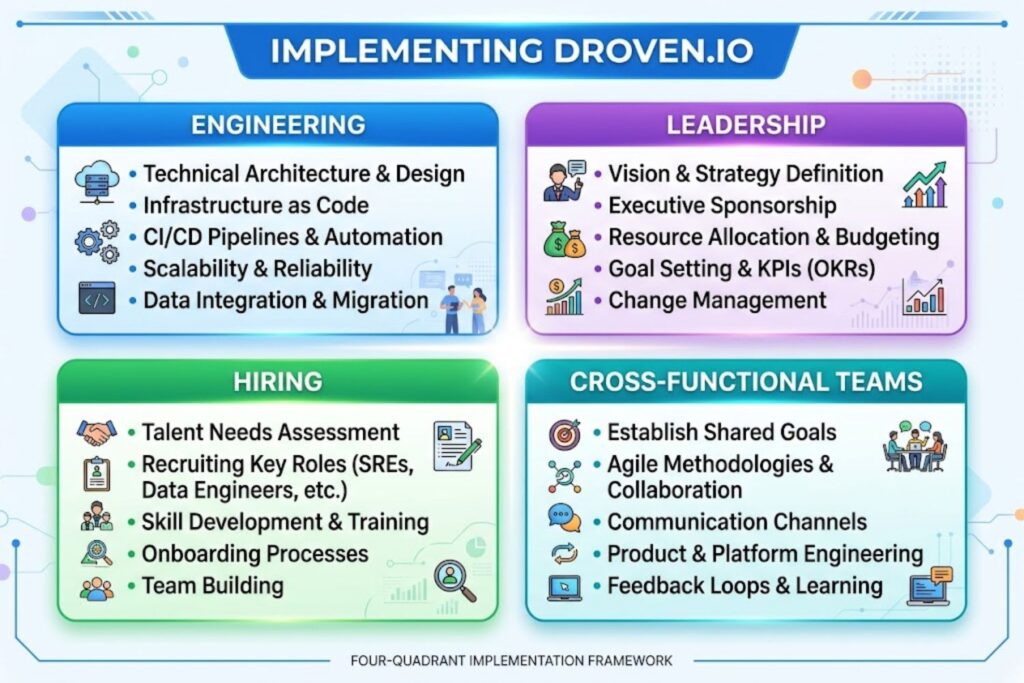
Different teams extract value from droven.io differently. Here’s how to structure usage by organizational function.
For Engineering Teams
- Weekly learning rotation: Assign team members to read specific droven.io articles and present findings to the group
- Technology decision support: Before evaluating new frameworks, languages, or architectural patterns, read relevant droven.io coverage
- Knowledge gaps: When new team members join, use droven.io articles as context-setting material
- Code review preparation: Understand the reasoning behind architectural decisions before implementation
For Leadership & Strategy
- Quarterly trend review: Set aside time to read droven.io coverage of emerging technologies relevant to your roadmap
- Risk assessment: Articles often cover limitations and failure modes—valuable input for strategy planning
- Budget justification: Use platform coverage to ground technology investment discussions in reality
- Team training: Share articles with executives and non-technical stakeholders to build shared understanding
For Hiring & Recruitment
- Interview preparation: Understand skill requirements before interviewing for new roles
- Job description grounding: Reference droven.io articles when defining what a role actually needs to know
- Candidate assessment: Use platform content to evaluate whether candidates understand concepts at required depth
For Cross-Functional Decision-Making
- Shared vocabulary: Articles establish common understanding across teams (engineering, product, leadership)
- Pre-meeting research: Assign relevant droven.io reading before major strategy discussions
- Objection handling: Use vendor-neutral research to ground decisions in evidence rather than opinion
FAQ: Questions People Actually Ask
What is droven.io, and do I need it?
Droven.io is a free editorial platform covering AI, cloud, automation, cybersecurity, and tech careers. You need it if you make technology decisions and want vendor-neutral context before committing resources. You don’t need it if you’re exclusively using proprietary platforms or have access to implementation specialists.
Does droven.io have a paywall?
No. All content is free and accessible without registration, login, or email capture.
Is droven.io content trustworthy?
The platform positions itself as vendor-neutral and appears to honor that positioning. However, all secondary sources carry some bias. Cross-reference important decisions with multiple sources, domain practitioners, and implementation specialists.
How often is droven.io updated?
Update frequency isn’t formally published. Based on visible publication dates, new articles appear regularly. For rapidly evolving topics (LLMs, cybersecurity threats), supplement with real-time news sources.
Can I use droven.io articles for training?
Yes. Many organizations share relevant articles with teams for context-building and knowledge alignment. The content is accessible and written for understanding, making it suitable for team learning.
How does droven.io compare to ChatGPT or Claude?
Completely different category. ChatGPT and Claude are AI tools you interact with to generate content or answer questions. Droven.io is a knowledge platform you read to build understanding. One is a product; the other is educational content.
What should I do after reading a droven.io article?
Depends on context. If it’s background learning, move on. If it’s supporting a decision, move to hands-on validation: request trials, test on your workflows, speak with implementation specialists. Don’t skip the practical validation phase.
Does droven.io cover my specific technology?
Probably not comprehensively. The platform covers major categories and tools. For niche or very new technologies, use domain-specific resources. Use droven.io for foundational category understanding, then go deeper with specialized sources.
Can I cite droven.io in technical decisions?
Cite it as a knowledge platform resource, yes. Don’t cite it as the sole justification for major decisions. Use it as one input among multiple sources, alongside vendor documentation, practitioner experiences, and specialist consultation.
Is droven.io AI-generated content?
The platform doesn’t formally disclose its content generation process. Based on readability and specificity, articles appear to be written by humans rather than AI models.
How do I stay updated with droven.io?
Visit regularly or subscribe to category-specific updates if available. Unlike course platforms with notifications, droven.io doesn’t have built-in notification systems. Visit periodically to catch new content.
Summary
Droven.io fills a real need in technology decision-making: vendor-neutral understanding of categories, tools, and concepts before you commit time and budget.
It’s not a tool. It’s not a course. It’s not a certification path. It’s a knowledge layer—editorial content designed to help technology professionals make smarter decisions.
Use it when: You’re evaluating technologies, understanding categories, building team knowledge, or planning strategy.
Skip it for: Hands-on implementation, cutting-edge research, vendor-specific learning, or tools that need deep specialization.
Structure it into your workflow: Pre-research before decisions, cross-reference before commitments, use it to build team vocabulary, supplement with hands-on validation.
The real value isn’t in reading the articles—it’s in making better decisions afterward.
Ready to Transform Your Technology Decision-Making?
The difference between average technology adoption and exceptional execution often comes down to one thing: understanding the landscape before making commitments.
At TechWoid, we help technology leaders and teams evaluate platforms, understand categories, and build decision-making frameworks that work.
Whether you’re evaluating AI tools, planning cloud migration, assessing automation platforms, or building team knowledge—we’ve built the frameworks and analysis to accelerate your decisions.
[Get Strategic Guidance on Your Next Technology Decision] →
Not ready yet? Start with droven.io. Then talk to us when you need practical help implementing what you learned.