
Generative AI already writes, tests, and reviews code for a large share of working developers. The harder question is what comes next: which tasks will shift to machines, which skills will matter most, and where the risks sit. Current research points to a clear answer. The technology is spreading quickly, but the gains depend heavily on how teams verify and manage what AI produces. This guide covers where the field stands, where it’s heading, and how to prepare without buying into the hype.
Where Generative AI Stands Today
The future of generative AI in software development is a shift from AI as an autocomplete tool to AI systems that handle multi-step work across the whole software lifecycle. Humans remain responsible for design decisions, verification, and accountability. The biggest open questions involve code quality over time, trust, and how to measure real productivity.
Adoption Is Nearly Universal
Usage has moved past the experimental stage. In a 2026 State of Code survey from SonarSource, 72% of developers who have tried AI coding tools now use them every day. The survey drew over 1,100 responses, and because the sponsor sells code-quality tools, read its findings as directional rather than definitive.
Productivity Gains Are Harder to Prove
Speed is the metric most people reach for, and it’s the one researchers trust least. A study by BNY Mellon, presented at ICSE 2026, combined a survey of 2989 developer responses and 11 in-depth interviews. The researchers found that survey results expose conflicting perspectives on AI tool usefulness, and they argued for measuring productivity in more than one way.
The practical lesson: if your team measures success by lines of code or tasks closed, you may be measuring activity, not value.
The Trust Gap Is the Real Story
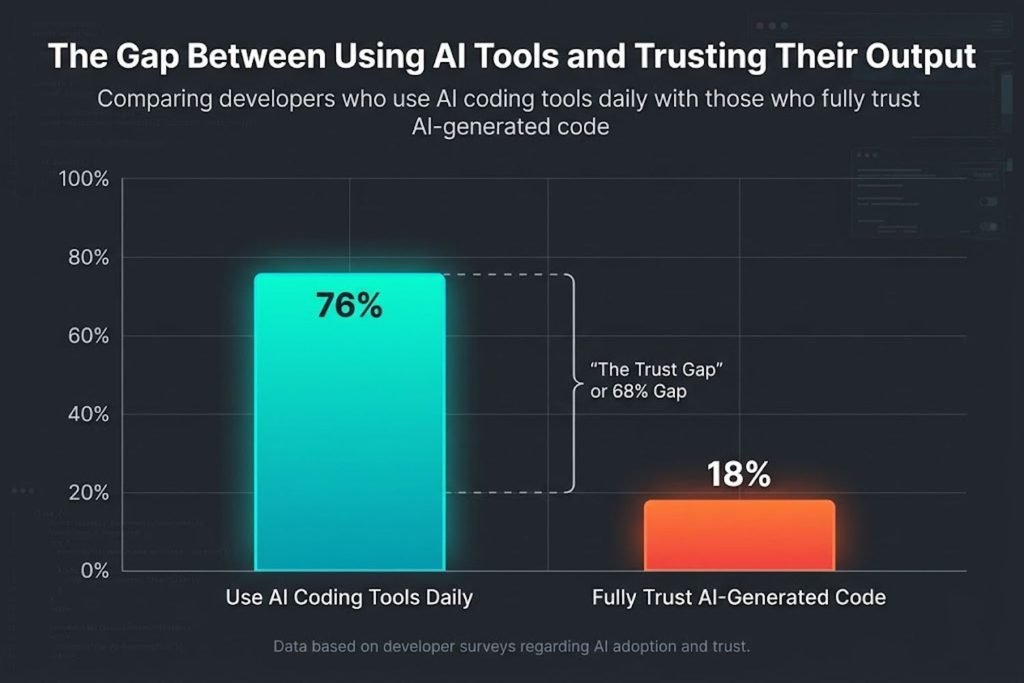
The most important number in the current data isn’t adoption. It’s trust. The same Sonar survey found that 96% of developers don’t fully trust that AI-generated code is functionally correct. Yet only 48% say they always check AI-assisted code before committing it.
That gap explains why productivity gains feel uneven. Generating code is now cheap. Verifying it is still expensive.
Why Verification Becomes the Bottleneck
Every line of AI-written code needs someone to confirm it does what it should, handles edge cases, and doesn’t introduce security flaws. When verification lags generation, the backlog shows up later as bugs, review fatigue, and maintenance work. Over the next few years, I expect the most valuable tools to be the ones that make checking code faster and more reliable, not the ones that generate more of it.
How the Software Lifecycle Is Likely to Change
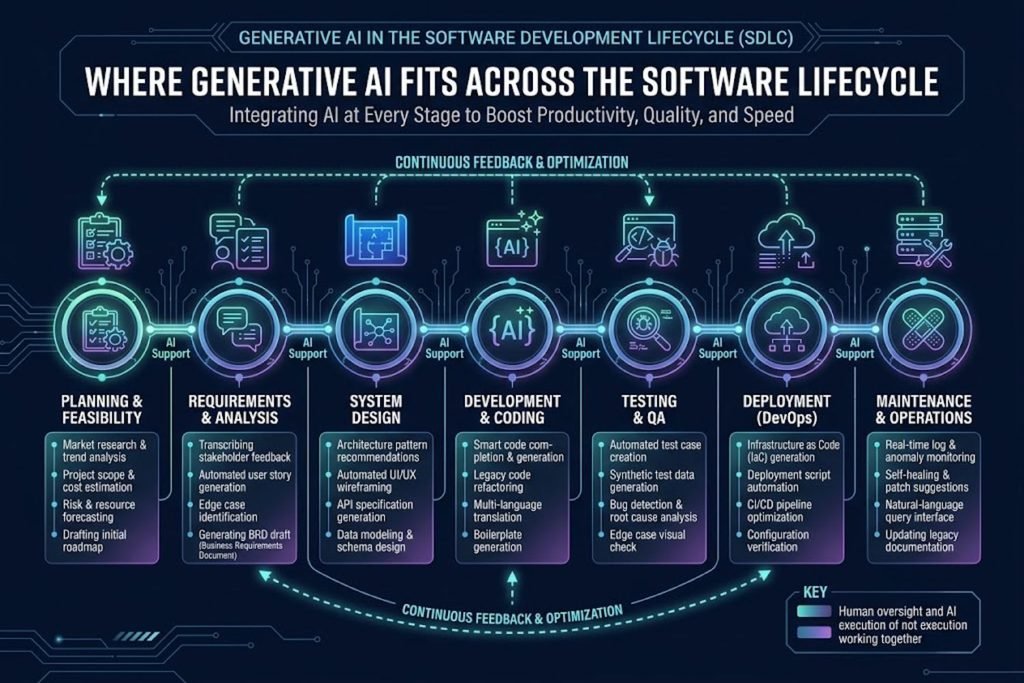
Coding is the most mature application of generative AI. A vision paper from the European GENIUS project, which combines industry and academic input, notes that GenAI has already demonstrated its potential to transform software engineering practices, especially in the coding phase. The next frontier is applying it to the other phases: requirements, design, testing, deployment, and maintenance.
AI Agents Move Beyond Autocomplete
Today’s typical workflow looks like this: a developer writes a prompt, reviews a suggestion, and accepts or edits it. The emerging pattern gives AI a bigger task, such as “add this feature across these three services and update the tests.” The AI plans the steps, edits multiple files, and reports back for review.
This works best when the task is bounded, the codebase has clear standards, and a human reviews the result before merging. Teams that succeed with agents usually invest first in good test coverage and documentation, because agents perform poorly in codebases with unclear conventions.
Testing and Code Review Get Automated
Expect AI to generate unit tests, flag risky changes in pull requests, and check code against security and style rules. This is useful, but it creates a subtle risk: if AI writes the code and AI reviews it, nobody may truly understand it. Keep at least one human reviewer on anything that touches customer data, payments, or authentication.
Maintenance Becomes the Hidden Cost
Code is written once and maintained for years. AI-generated code can speed up the first version but leave behind code that’s harder to understand later. The Sonar report notes that the burden has simply shifted to correcting and rewriting unreliable AI-generated code. Teams that track maintenance time for AI-assisted modules, not just delivery time, get a more honest picture of the return. sonarsource
What Happens to Developer Roles
A 2024 study published in Automated Software Engineering by Sauvola and colleagues proposes four primary scenarios, model trajectories for transitions between them, for how software work could evolve. The paper’s most useful point is not which scenario wins. It’s that teams should watch for early signals and adjust.
Its authors also note that with generative AI, new software industry roles are emerging and some existing roles may be replaced. The realistic outlook is change in the mix of tasks, not the disappearance of the profession.
Skills That Gain Value
- Reviewing and verifying code, including security review
- Writing clear requirements and specifications that AI can act on
- Designing system architecture and making tradeoff decisions
- Debugging code you didn’t write
- Evaluating AI tools against your own codebase
Skills That Lose Value
- Memorizing syntax for routine patterns
- Writing boilerplate and standard CRUD code by hand
- Producing large volumes of code as the main measure of output
A Decision Framework: Where AI Fits and Where It Doesn’t
Use this table to decide how much autonomy to give AI on a given task:
| Task type | AI suitability | Required human checkpoint |
|---|---|---|
| Boilerplate, scaffolding, docs | High | Quick review |
| Unit tests for existing logic | High | Confirm tests fail when logic breaks |
| Business logic changes | Medium | Peer code review plus integration tests |
| Authentication, payments, personal data | Low to medium | Expert review and threat modeling |
| Architecture and system design | Low | Humans decide; AI acts as a sounding board |
Rule of thumb: The higher the cost of a mistake, the more human verification the task needs.
Common Mistakes Teams Make
- Measuring output volume. More code is not better code. Track defects, review time, and time to fix.
- Trusting passing tests too much. Tests written by the same AI that wrote the code can share its blind spots.
- Skipping context. Teams that give tools coding standards, architecture notes, and examples get far better output than teams that rely on default behavior.
- Ignoring licensing and security policy. Confirm what data your tools send and how they handle your code before rollout.
- Rolling out without training. Developers need guidance on when to trust suggestions and when to reject them.
A 30-Day Plan to Prepare Your Team
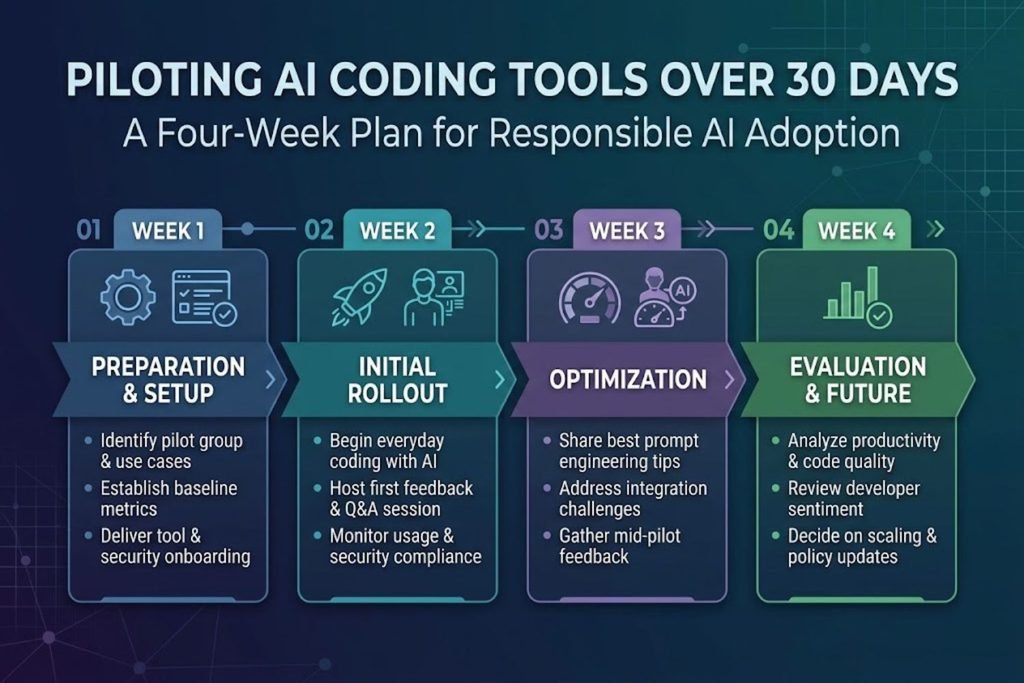
- Week 1: Baseline. Measure current defect rates, review time, and time to release for a few representative projects.
- Week 2: Pilot one use case. Choose a low-risk area, such as test generation or documentation, and limit tools to that scope.
- Week 3: Set review rules. Define which changes require human review and who signs off on security-sensitive code.
- Week 4: Measure and decide. Compare results against your baseline. Expand only where quality holds up.
Key Takeaways
- Adoption is high, but trust in AI-generated code is low, and that gap is where the real work lies.
- Verification, not generation, is the bottleneck, so invest in review and testing.
- AI is moving from autocomplete toward multi-step agents, and those work best in well-documented codebases.
- Measure maintenance and defects, not just speed.
- Match human oversight to the cost of a mistake.
Conclusion
Generative AI will keep changing software development, and the teams that benefit most won’t be the ones that adopt it fastest. They’ll be the ones that verify well, measure honestly, and keep humans responsible for decisions that matter. Start small, define your review standards, and expand as the evidence supports it.
Ready to build an AI-ready development process? Talk to the TechWoid team about assessing your current workflow and planning a rollout that fits your codebase.
FAQ
Will generative AI replace software developers?
Unlikely in the near term. It’s more likely to change the mix of tasks, reducing routine coding and increasing the value of design, review, and judgment. Some roles may shrink while new ones emerge.
How accurate is AI-generated code?
It varies by task and tool. Recent industry surveys show most developers don’t fully trust AI-generated code without checking it, so always test and review it.
What is an AI coding agent?
An AI system that plans and carries out multi-step programming tasks, such as editing several files and running tests, with human review of the result.
Is AI-generated code safe to use in production?
It can be, with proper review, testing, and security checks. High-risk areas like authentication and payments need expert human review.
Which tasks are best suited to AI today?
Boilerplate code, documentation, unit test generation, and refactoring within well-tested code.
Which tasks should stay mostly human-led?
Architecture decisions, security-sensitive logic, and anything where a mistake has serious consequences.
How should teams measure AI productivity?
Use several measures together: defect rates, review time, time to fix bugs, maintenance effort, and delivery speed. Speed alone can be misleading.
What skills should developers build for an AI-assisted future?
Code review, system design, requirements writing, debugging, security awareness, and evaluating tools critically.
Do AI coding tools create technical debt?
They can, if teams accept generated code without understanding it. Regular refactoring and clear coding standards reduce this risk.
How do I start adopting generative AI in my dev team?
Begin with a small pilot on low-risk tasks, define review rules, measure against a baseline, and expand based on results.
Are there legal or licensing concerns with AI-generated code?
Yes. Review your tool’s terms, your organization’s policy, and applicable licensing rules. Consult legal counsel for specific guidance.
Will AI make coding education obsolete?
Not entirely. Fundamentals still matter for verifying and debugging AI output. Education is shifting toward judgment and review skills.