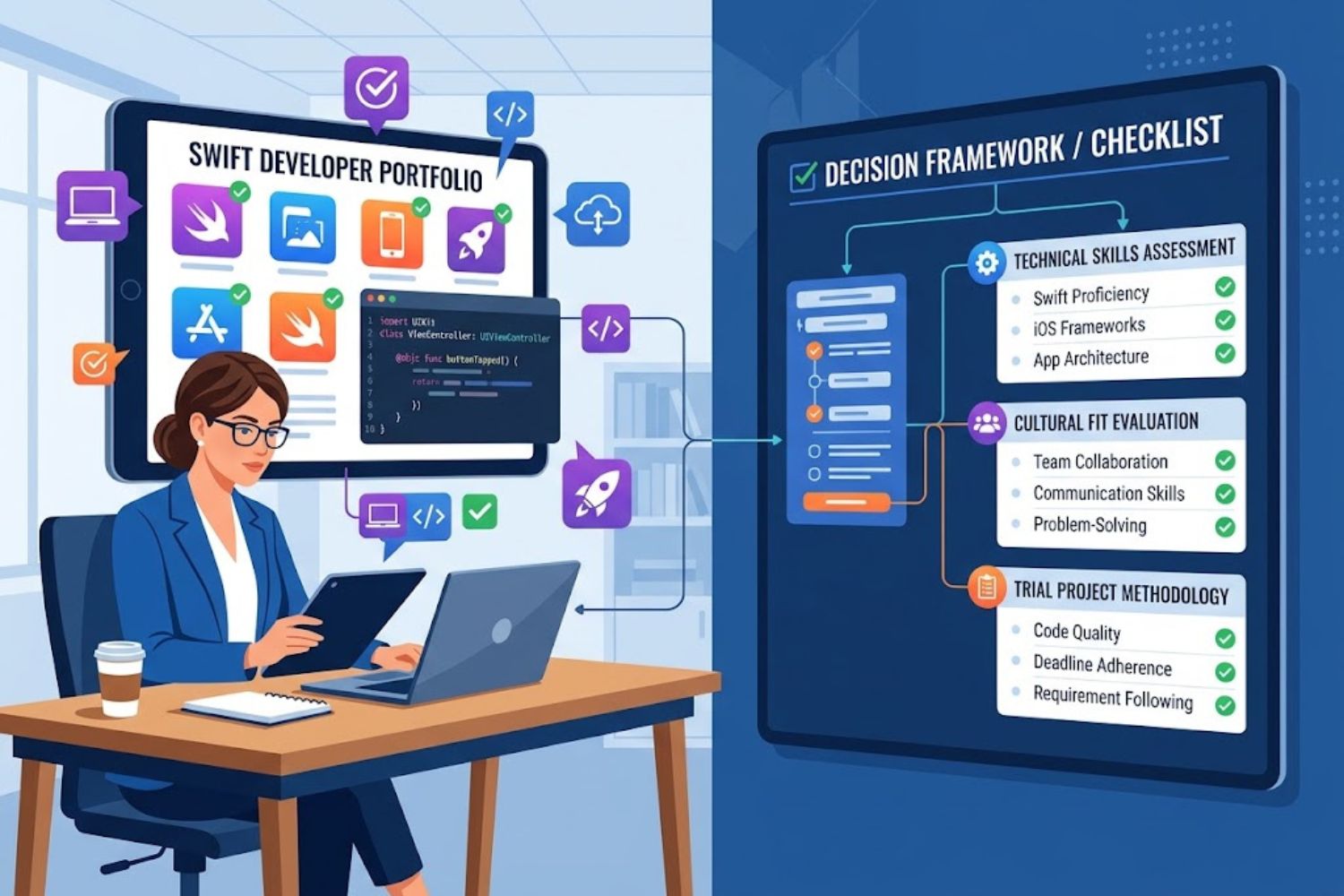
Hiring the right Swift developer isn’t about finding the most skilled coder—it’s about finding someone who combines technical excellence, communication ability, and alignment with your project vision. This guide breaks down exactly how to evaluate candidates, spot red flags, and build a productive long-term relationship.
1. Understand Your Project Requirements Before You Hire
Before evaluating any candidates, get crystal clear on what you actually need. Too many hiring mistakes start here.
Define Your Technical Scope
Write down specifically what your app must accomplish. Don’t just say “iOS app”—document:
- Target platforms (iOS only? macOS? watchOS? Multiple?)
- App complexity level (simple utility, complex financial app, real-time multiplayer game?)
- Integration needs (APIs, third-party services, backend systems?)
- Performance requirements (resource-intensive features, offline capability?)
- Timeline and budget constraints
This clarity matters because a developer excellent at building real-time collaborative apps might struggle with privacy-critical fintech applications. They’re different skill sets.
Assess Your Internal Capability
Here’s what competitors skip: honestly evaluating your team’s ability to manage the developer.
Can you provide clear feedback? Do you have technical leadership on staff? Will the developer receive direction from someone technical or non-technical?
A brilliant developer working with a non-technical product owner creates friction. A mid-level developer with excellent guidance from a strong technical lead ships better work faster.
Match Developer Level to Your Situation
Junior developers (1-2 years experience) cost 40-50% less but need direction, code review, and mentoring.
Mid-level developers (3-5 years) work more independently, need less hand-holding, and typically cost 60-80% more.
Senior developers (6+ years) make architectural decisions independently, mentor others, and cost 100%+ more.
The mistake: hiring junior developers to save money when you need senior-level decision-making. This always costs more in the end through rework, missed architecture decisions, and timeline slippage.
2. Build Your Technical Evaluation Framework
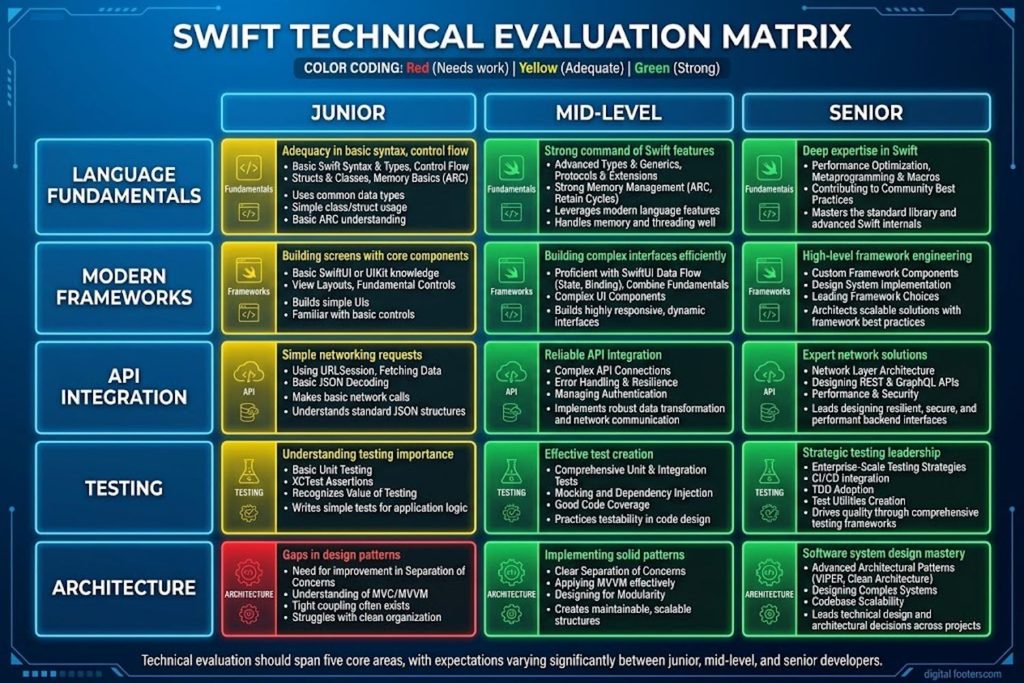
Technical assessment has specific components. Most hiring processes evaluate only one or two.
Core Swift & iOS Knowledge Areas
Evaluate candidates across these technical pillars:
Language Fundamentals: Can they explain optionals, error handling, value vs. reference types, and memory management? Understanding these shows they grasp Swift’s core philosophy, not just syntax.
Ask: “How would you explain Swift’s approach to memory management compared to Objective-C?” Their answer reveals whether they understand the ‘why’ behind Swift, not just the mechanics.
Modern iOS Frameworks: The Swift ecosystem evolves rapidly. SwiftUI represents a paradigm shift from UIKit. Combine changes how developers handle asynchronous operations.
Check their portfolio for recent apps using SwiftUI (released 2019+). If everything they’ve built uses UIKit, understand why. Sometimes there are valid reasons (legacy app maintenance). Often it signals they’re not staying current.
API Integration & Networking: Most apps fetch data. Can they discuss:
- REST API best practices
- Handling authentication securely
- Error handling and retry logic
- Parsing JSON efficiently
- Working with third-party SDKs
A quick test: “Walk me through how you’d integrate a payment API.” Their response reveals whether they think about security, error cases, and user experience.
Testing & Code Quality: Ask about their testing philosophy. Do they write unit tests? Integration tests? Are they familiar with XCTest, Quick/Nimble, or other frameworks?
Red flag: “Testing slows me down.” This signals quality issues down the road.
Architecture & Design Patterns: Can they discuss MVVM, MVC, VIPER, or other architectural approaches? Do they understand when to use each?
Their portfolio should show consistent, organized code. If projects lack clear structure, they’ll likely create messy codebases under pressure.
Portfolio Deep Dive (The Non-Obvious Parts)
Most hiring managers scroll through portfolio apps and move on. This is a missed opportunity.
Quality over Quantity: Five shipped apps matter more than twenty unfinished projects. Do they have apps still running in the App Store? What are the user ratings?
Code Inspection Rights: Ask to review actual code they’ve written. Not anonymized, not “their part” of a large project—code they’re genuinely proud of. This reveals:
- Consistency and organization
- Comment quality and documentation
- Error handling approach
- Testing implementation
- Naming conventions (reveals thought process)
User Experience Details: Download their apps. Actually use them. Notice:
- Loading state handling
- Error messaging clarity
- Animation smoothness
- Edge case handling
- Responsiveness across devices
A developer who ships polished experiences thinks differently than one shipping merely “functional” apps.
Version Control Practices: Ask to see their GitHub. Do they:
- Write clear commit messages?
- Organize branches logically?
- Contribute to open source?
- Keep repositories updated and documented?
A clean GitHub signals professional practices. Chaotic Git history suggests they code in isolation without rigor.
Ask About Technical Decisions, Not Just Facts
Skip questions like “What’s a optional?” (they can Google this in 10 seconds).
Instead ask: “Tell me about an architecture decision you regret. What would you do differently?”
This reveals self-awareness, learning orientation, and judgment—far more valuable than reciting facts.
3. Evaluate Communication & Collaboration Skills
Here’s what most hiring managers ignore until it’s too late: Swift developer skill means nothing if they can’t communicate.
Communication Red Flags During Interview
Watch for:
Dominance: Do they listen or monologue? In an interview, you should ask questions and they should answer thoughtfully. If they’re talking 70% of the time, they likely won’t listen to requirements.
Jargon Overload: Can they explain technical concepts simply? If they can’t explain their app to a non-technical user, they’ll struggle translating requirements across your team.
Vagueness About Problem-Solving: Ask, “Tell me about a project that went wrong. What happened?”
Good answer: “We underestimated complexity of real-time sync. We initially chose a simple approach, but when we hit scaling issues around month three, we rebuilt with CouchDB. Timeline slipped two weeks, but we learned to validate assumptions earlier.”
Bad answer: “There were some complications. We fixed them.” (No specificity, no learning, no accountability.)
Technical Question Evasion: When you ask something they don’t know, do they say, “I’m not sure, here’s how I’d approach it” or do they bullshit? The honest “I don’t know” followed by reasoning is far better than fake confidence.
Collaboration Signals
Ask behavioral questions revealing teamwork orientation:
- “Describe a time you disagreed with a designer about UX. How did you handle it?”
- “Tell me about a code review where someone found issues in your code. How did you respond?”
- “Describe your ideal team communication style.”
- “How do you handle ambiguous requirements?”
Listen for: collaborative language, appreciation for different perspectives, willingness to be questioned, and ownership of problems (not blame-shifting).
Cultural Fit Assessment
This isn’t about hiring people like you. It’s about ensuring values alignment on:
Work Style: Do they prefer structured processes or flexibility? Does this match your team?
Autonomy Expectations: Do they thrive with independence or need regular check-ins? Will your project support their preference?
Learning Orientation: Do they invest in staying current with technology? Does your company support this?
Communication Cadence: Do they prefer async communication or real-time collaboration? For remote developers, this matters enormously.
A 20-year veteran might chafe under a startup’s chaos. A young developer might flounder without structure. Neither is bad—they’re just misaligned.
4. The Trial Project: Your Biggest Asset
Before committing to a full-time dedicated developer, run a small paid trial project.
Why Trial Projects Matter
Interviews are performance theater. People behave differently when working than when interviewing.
A 2-4 week trial project (estimated at $5,000-$15,000 for a senior developer) reveals:
- Actual code quality under real pressure
- How they communicate when problems arise
- Work speed and reliability
- Collaboration style in practice
- Whether your technical needs actually match
This investment saves you from hiring mistakes that cost 10x more.
Structuring Effective Trial Projects
Choose Real Work, Not Arbitrary Tasks: Assign something your project actually needs—a feature, a redesign, an integration. This ensures you evaluate real-world capability.
Don’t ask them to build a todo app. This tells you almost nothing about their ability on your actual project.
Define Success Clearly: Before starting, agree on:
- What “done” looks like (don’t vague)
- How communication will work (daily standups? async updates?)
- Code standards and review process
- Timeline and deliverables
- Rate and payment terms
Structured Code Review: Review their work not just for functionality but for approach. Does their code align with your standards? Do they write tests? Is it maintainable?
Honest Feedback: If they’re not the right fit, be direct. They’d rather know after a small project than after committing months.
Document Your Findings: After the trial, document what you learned about their technical skill, communication style, and fit with your team. This becomes your baseline.
5. Identify Developer Red Flags Before Hiring
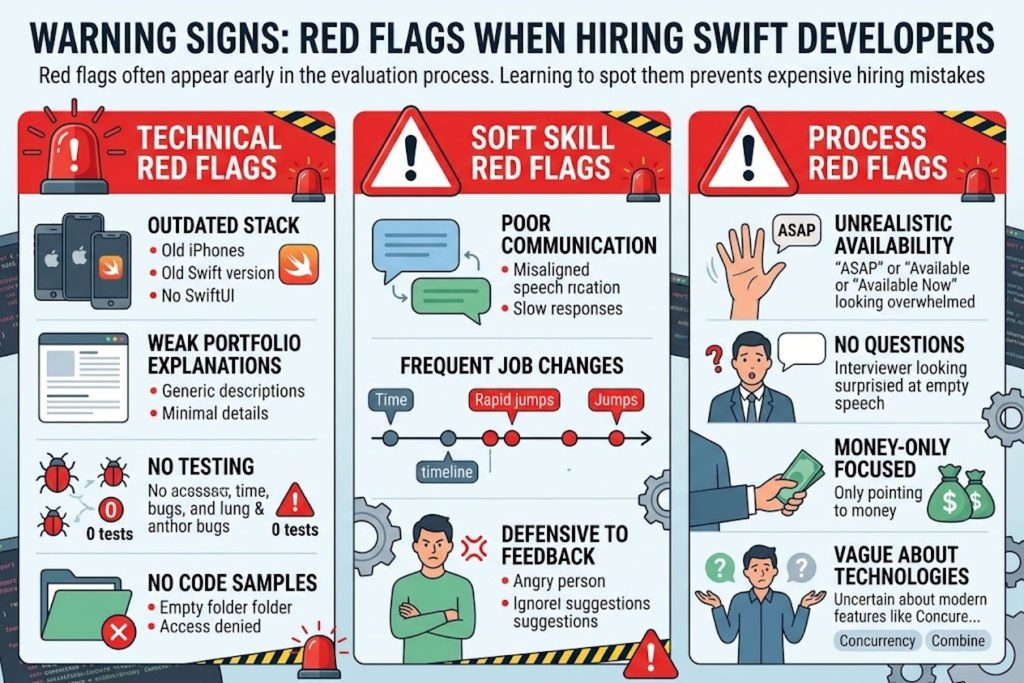
Technical Red Flags
Outdated Stack Focus If they’ve built nothing with SwiftUI (modern as of 2019) or can’t discuss async/await (standard since Swift 5.5, 2021), understand why. Legacy maintenance is valid. Refusing to learn new tools is not.
Weak Portfolio Explanation They can’t articulate design decisions in their own work. They describe features but not the architecture underneath.
Reluctance to Show Code Legitimate NDA concerns exist. But if they refuse code samples entirely, they may be hiding quality issues.
No Testing Discussion “We test manually in production” or “testing is QA’s job” reveals immature development practices.
Soft Skill Red Flags
Poor Communication in Interview How they communicate during interview is baseline. It typically gets worse under pressure, not better.
Frequent Job Changes Changing jobs every 10-14 months without clear progression story raises questions. Everyone has one bad job. Multiple suggests patterns.
Defensiveness to Feedback During interview feedback: “What areas do you see for growth?” Listen carefully. Growth-oriented people have answers. Defensive people blame circumstances.
Misaligned Expectations They want roles you can’t provide. They expect salaries far above market for their level. They need structure you can’t provide remotely.
Unrealistic Availability Claims “I work 70 hours weekly for you” is a red flag. Burnout is inevitable, and quality suffers. You want sustainable pace.
Process Red Flags
“Ready to start immediately” Good developers are usually in-demand and have notice periods. Someone with zero notice might have been fired. Or they’re between gigs juggling multiple clients.
No Questions About Project They’re interviewing you as much as you’re interviewing them. No questions suggests either overconfidence or low interest.
Money-Only Motivation “What’s the rate?” before asking about the work or team. They’re short-term focused, not building a relationship.
Vague About Specific Technologies They claim “10 years iOS experience” but can’t discuss specific frameworks or iOS versions. This suggests resume inflation.
6. Compare Hiring Models: Full-Time vs. Dedicated vs. Freelance
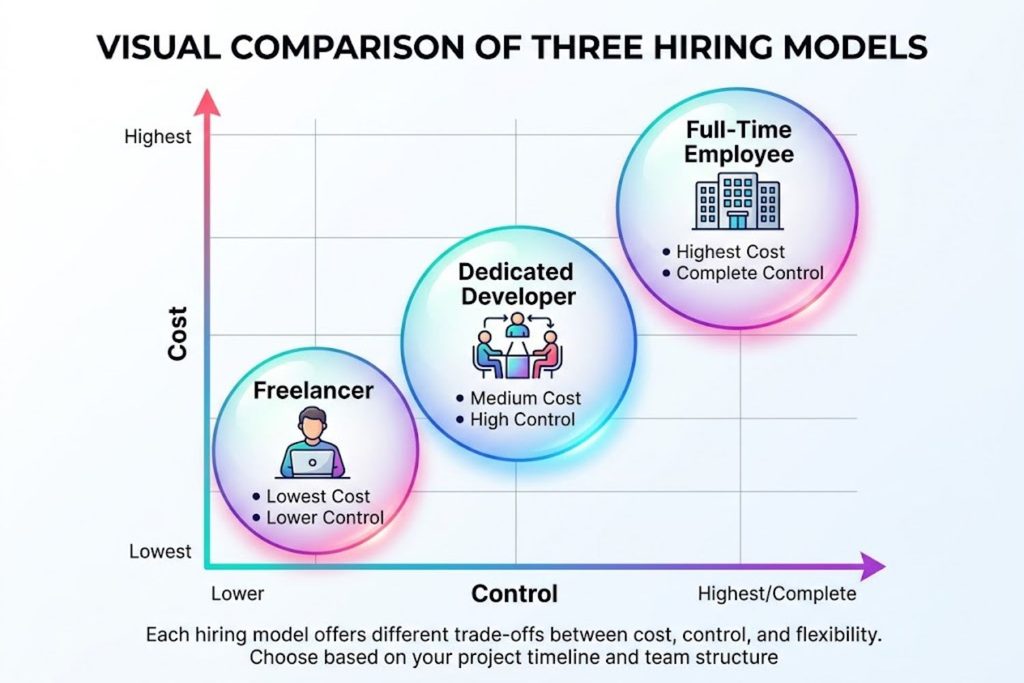
Understanding the trade-offs matters.
In-House Full-Time Employee
Advantages:
- Maximum control and oversight
- Team integration and culture alignment
- Long-term investment in project
- Full intellectual property ownership
- Easier management and communication
Disadvantages:
- Highest cost (salary + benefits + taxes + overhead)
- Hiring and onboarding time required
- Risk if person isn’t good fit (hard to exit)
- Less flexibility if needs change
- Need to manage HR/employment compliance
Best For: Ongoing, long-term projects with permanent product development needs.
Dedicated Developer (Vendor-Employed)
Advantages:
- Faster hiring (2-3 weeks vs. 2-3 months full-time)
- Vendor handles HR, taxes, benefits, compliance
- Flexibility to scale up/down
- Often more affordable than full-time (30-50% less)
- Still have significant control and oversight
- You manage the work, vendor manages operations
Disadvantages:
- Less ownership/control than in-house
- Quality varies by vendor
- Still needs your team to manage/direct
- Vendor may reassign developer if needs arise
- Potential communication/timezone complexity
Best For: Projects needing experienced developers without permanent headcount; teams with strong technical leadership.
Freelance Developer
Advantages:
- Most flexible engagement
- Lower cost for specialized work
- No long-term commitment
- Easy to hire, easy to exit
Disadvantages:
- Requires strong project management
- Higher turnover risk mid-project
- Less accountability and commitment
- Difficult for long-term product ownership
- Usually need to manage all logistics
Best For: Specific features, short-term projects, or specialized work rather than core development.
Decision Matrix
| Factor | Full-Time | Dedicated | Freelance |
|---|---|---|---|
| Project Duration | Long-term (1+ year) | Medium (3-12 months) | Short (weeks-months) |
| Cost | Highest | Medium | Varies |
| Control | Very High | High | Lower |
| Time to Hire | Longest (2-3mo) | Medium (2-3wks) | Fastest (days) |
| Communication | Easy | Medium | Requires structure |
| Turnover Risk | Lower | Medium | Higher |
| Scalability | Difficult | Easy | Very Easy |
7. Evaluate Experience Level Appropriately
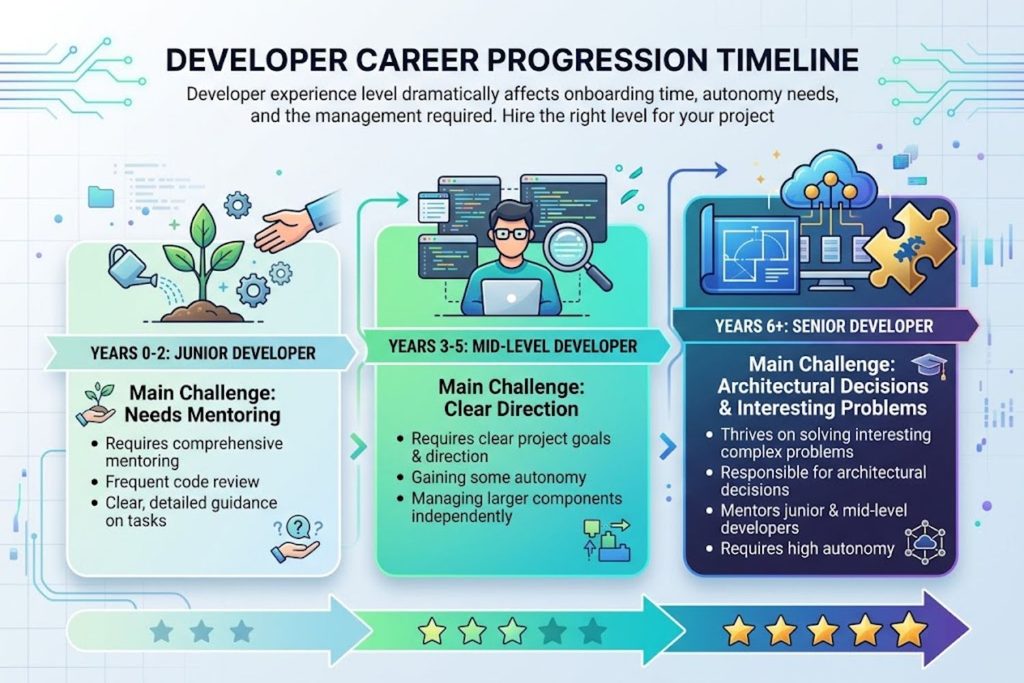
Not all experience is equal.
Junior Developer (1-2 years)
Assessment Focus:
- Clean code fundamentals
- Ability to learn quickly
- Communication clarity
- Problem-solving approach
- Coachability
Red Flags:
- Defensive about feedback
- Claims they don’t need mentoring
- Can’t explain code decisions
- Lacks version control discipline
Good For:
- Stable projects with clear requirements
- Teams with senior developers who can mentor
- Learning-oriented companies
- Cost-conscious needs without tight timelines
Risky For:
- Complex architectures requiring senior judgment
- Quick turnaround projects
- Teams without technical leadership
Mid-Level Developer (3-5 years)
Assessment Focus:
- Independent decision-making quality
- Architecture thinking
- Project delivery track record
- Teaching/mentoring ability
- How they’ve grown previous roles
Red Flags:
- Still making junior mistakes (no growth)
- Hasn’t led any projects or features
- Defensive about technical decisions
- Can’t articulate why they chose approaches
Good For:
- Most real-world projects
- Teams with clear product direction
- Balanced autonomy/oversight scenarios
- Scaling from junior developer
Risky For:
- Completely novel technical challenges
- Teams needing someone to set architectural direction
- Requiring mentoring of juniors
Senior Developer (6+ years)
Assessment Focus:
- Architecture and design decisions
- How they’ve grown/mentored others
- Understanding of business context, not just code
- Technical leadership in previous roles
- Evolution of technical thinking over time
Red Flags:
- Still operating at mid-level (no growth trajectory)
- Dismissive of other team members’ ideas
- Can’t explain business thinking behind technical choices
- Won’t use “modern” tools because “I don’t need them”
Good For:
- Complex architectural decisions
- Technically challenging projects
- Mentoring team members
- Setting quality standards
- Building systems designed to scale
Risky For:
- Roles that don’t leverage their seniority (wasted investment)
- Teams without director/leadership role
- Budget-constrained projects where mid-level suffices
8. Conduct Technical Interviews That Actually Reveal Capability
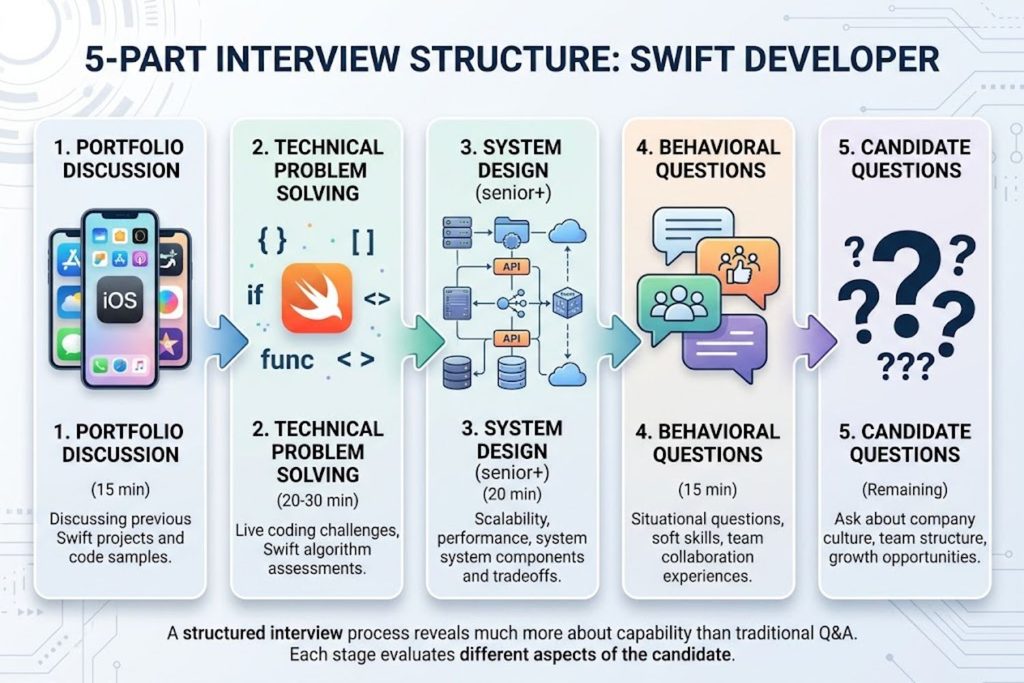
Generic interview questions waste everyone’s time.
Effective Interview Structure
Part 1: Portfolio & Background (15 minutes) Focus on their recent work, why they chose those projects, and what they’d change.
Don’t ask: “Tell me about yourself.” Do ask: “Walk me through this app in your portfolio. What was your role, and what architectural decisions did you make?”
Part 2: Technical Problem-Solving (20-30 minutes) Give them a real scenario from your project or a category of work.
Example: “We need to sync user data to our backend while handling offline scenarios. Walk me through your approach.”
Watch for:
- Do they ask clarifying questions?
- Do they think through edge cases?
- Do they discuss trade-offs?
- Are they collaborative or do they solve alone?
The actual solution matters less than their reasoning.
Part 3: System Design Thinking (20 minutes, senior+ only) Ask: “How would you architect a feature for [your key feature]? What would the component structure look like?”
Look for:
- Consideration of testability
- Separation of concerns
- Scalability thinking
- Real-world pragmatism (not over-engineering)
Part 4: Behavioral & Soft Skills (15 minutes) “Tell me about a project that failed. What happened and what would you do differently?”
Listen for maturity, accountability, and learning orientation.
Part 5: Questions for You (remaining time) What do they ask? Generic questions or thoughtful ones about specific technical challenges?
Quality questions signal engagement and strategic thinking.
Interview Mistakes to Avoid
Trick Questions: “What’s the difference between a class and struct?” If they Google it pre-interview, they’ll answer fine. This tests memory, not capability.
Theoretical Edge Cases: “What happens if you autoreleasepool this?” No one debates memory management in real projects. It’s overengineered.
Rapid-Fire Trivia: Makes candidates nervous, tests recall not judgment.
Talking Too Much: If you talk 50%+ of the interview, you learn about your project, not them.
No Hands-On Component: Coding tests aren’t everything, but interview-only evaluation misses real-world capability.
9. Assess Onboarding & Ramp-Up Needs
The first 4 weeks make or break the relationship.
Onboarding Complexity by Developer Level
Junior developers: 4-6 weeks to productive, needs structured onboarding, regular check-ins, code reviews, pair programming.
Mid-level developers: 2-4 weeks, needs documentation and direction but works more independently.
Senior developers: 1-2 weeks if architectural decisions are clear, or longer if they need to establish their approach.
What Developers Need to Ramp Up
- Codebase access and documentation
- Architectural overview and design decisions
- Build and deployment process clarity
- Communication cadence and tools
- Project history and context
- Technical standards and guidelines
- Introduction to team and key stakeholders
- Initial task clarity (don’t throw complex work week 1)
Calculate Time Cost Realistically
Even exceptional developers need ramp time. Budget for reduced productivity weeks 1-3. Account for your team’s time in onboarding (documentation, pair programming, code review).
A poor onboarding process costs more in delayed productivity than the cost of structured onboarding time.
10. Establish Clear Expectations & Ongoing Evaluation
Clarity prevents 80% of developer conflicts.
Documented Expectations Should Cover
Technical Standards:
- Code style and linting (have a style guide)
- Testing requirements (test coverage expectations)
- Git workflow and commit practices
- Code review standards
- Deployment and release process
Communication Norms:
- Daily/weekly check-in cadence
- Where to ask questions (Slack, email, etc.)
- Response time expectations
- Vacation and time-off process
- Working hours/timezone expectations
Project Requirements:
- Feature definitions and success criteria
- Timeline and milestone dates
- Budget and scope constraints
- Priority if things slip
- Escalation path for problems
Performance Metrics:
- Velocity or story completion (if using agile)
- Code quality indicators
- Bug rates in production
- Delivery dates vs. estimates
- Team feedback (collaboration, communication)
Ongoing Evaluation Framework
Monthly Check-ins (30 minutes)
- What went well last month?
- What could improve?
- Do they have what they need?
- Are there blockers?
- Feedback on code quality and collaboration
Quarterly Review (1 hour)
- Technical growth trajectory
- Adherence to standards and processes
- Team fit assessment
- Feedback from team members working with them
- Clarify expectations for next quarter
Red Flags During Ongoing Work
- Consistent missed deadlines without explanation
- Dismissive attitude to feedback
- Poor code quality increasing, not decreasing
- Communication breakdown
- Team friction or collaboration issues
Early Intervention: Address concerns early. Giving feedback after 6 months of poor performance is too late. Monthly check-ins catch issues at week 3.
11. Cost Factors: What You’ll Actually Pay
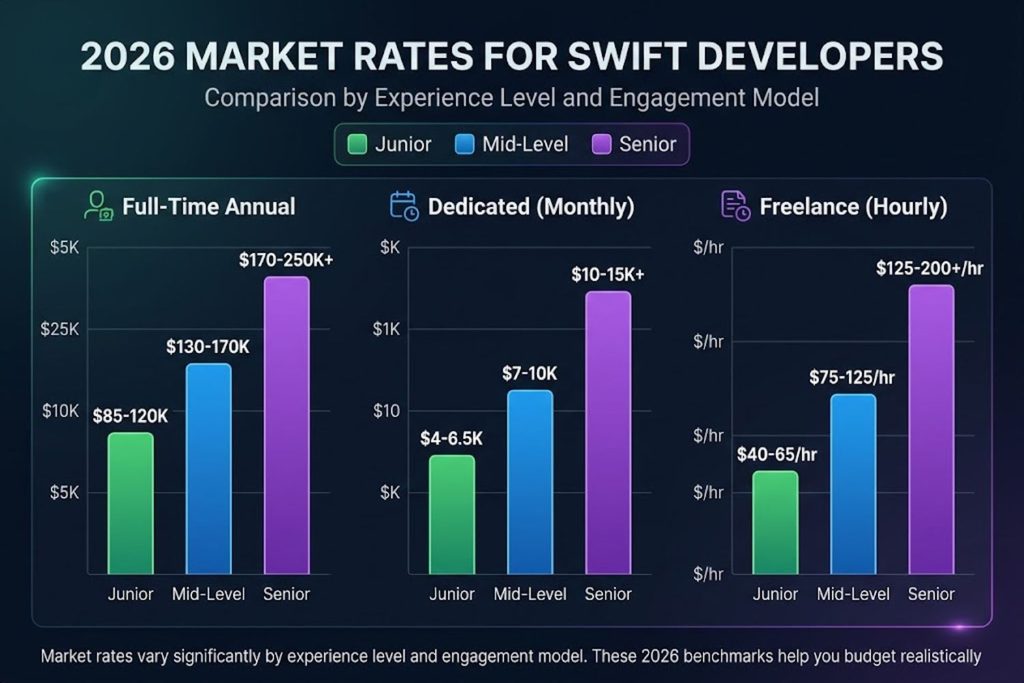
Understanding pricing prevents budget shocks.
Market Rates (USA, 2026)
Junior Swift Developer:
- Full-time: $85,000-$120,000/year
- Dedicated (vendor-employed): $4,000-$6,500/month
- Freelance: $40-$65/hour
Mid-Level Swift Developer:
- Full-time: $130,000-$170,000/year
- Dedicated: $7,000-$10,000/month
- Freelance: $75-$125/hour
Senior Swift Developer:
- Full-time: $170,000-$250,000+/year
- Dedicated: $10,000-$15,000+/month
- Freelance: $125-$200+/hour
Factors That Affect Cost:
- Experience level and track record
- Geographic location
- Specialization (SwiftUI expert vs. generalist)
- Exclusive availability vs. part-time
- Project complexity
- Remote vs. local
Hidden Costs People Forget
- Employer taxes/benefits (25-35% on salary)
- Onboarding time (your team’s investment)
- Equipment and software licenses
- Project management overhead
- Potential rework from mistakes
- Turnover costs if hire fails
Calculate total cost of ownership, not just salary.
12. Building a Long-Term Relationship
The best developers stay because they’re valued and growing.
What Retained Developers Want
Based on industry data, top priorities are:
- Clear technical challenges: They want to solve interesting problems, not repeat boilerplate.
- Continuous learning: Budget for conferences, courses, certifications. The best developers expect this.
- Autonomy: They want decision-making authority on their work, not micromanagement.
- Growth path: They should see how they develop—junior to mid, mid to senior, or specialist roles.
- Stable direction: Constantly shifting requirements and priorities frustrate everyone.
- Respect and recognition: Public acknowledgment of good work matters more than you think.
Retention Investment
- Review compensation annually (market rates shift)
- Provide learning budget
- Discuss career path progression
- Share wins publicly
- Solve their environmental issues (tools, processes)
- Get their input on technical decisions
The cost of replacing a good developer (3-6 months hiring, onboarding, lost productivity) far exceeds the cost of retention investment.
FAQ: Common Questions About Hiring Swift Developers
Q: Should I hire locally or remote?
A: Remote access to global talent is a huge advantage. Timezone differences matter for real-time communication but async work can cover most needs. Prioritize communication ability and reliability over location.
Q: How long should I expect onboarding to take?
A: Junior developers: 4-6 weeks. Mid-level: 2-4 weeks. Senior: 1-2 weeks. Add 50% if your codebase is poorly documented.
Q: What if I can’t afford senior developers?
A: Hire mid-level with strong leadership/mentoring from your team. Quality mid-level developers often deliver better than overqualified seniors who are bored. Avoid hiring junior developers to save money on complex projects—it compounds costs.
Q: How do I evaluate developers from different countries?
A: Same criteria as local hires. Time zone might shift when you hire (pick optimal overlaps for real-time collaboration). Communication and timezone reliability matter more.
Q: Should I do a coding test in the interview?
A: Yes, but make it realistic. A 45-minute algorithmic puzzle tests speed and memorization. A 1-2 hour realistic scenario (build a simple feature, integrate an API) reveals actual capability.
Q: What if they can’t explain their code?
A: That’s a red flag. Good developers explain their reasoning. If they say “I don’t remember why I did it that way,” they weren’t thoughtful in writing it.
Q: How do I know if it’s a cultural fit issue or a capability issue?
A: Capability: specific technical struggles, learning quickly but needs time, asks good questions. Culture fit: dismissive of team input, resistant to feedback, communication gaps, conflicting work style.
Q: Can I hire multiple developers simultaneously?
A: Yes, but understand each needs onboarding time. Your team’s capacity to onboard limits scaling speed. Hire one, ramp them, then hire the second.
Q: What if a developer gets sick or quits mid-project?
A: This is why code quality and documentation matter. Unclear code with one person means project death if they leave. Well-written, documented code transfers more easily.
Q: Should I hire developers in the same timezone?
A: Overlapping hours help for real-time problem solving, but async-first practices minimize timezone dependency. Judge by your actual need for real-time collaboration.
Q: How do I handle disagreement on technical approach?
A: Your lead engineer and developer should align. If they don’t, surface it early. Forcing decisions creates resentment. Collaborative decision-making builds ownership.
Q: What if the developer is great technical but poor communicator?
A: This is a significant risk. Technical skill doesn’t offset communication weakness in team environments. Can they improve? Will they invest? If not, it’s not a good fit.
Q: How much should I pay for a trial project?
A: Enough to feel real ($5,000-$15,000 minimum). If the amount seems trivial to them, they’re not taking it seriously. If it’s unaffordable, they’re misaligned on your budget reality.
Key Takeaways
- Clear Requirements First: Define what you need before evaluating anyone. This guides every decision that follows.
- Evaluate All Dimensions: Technical skill is necessary, not sufficient. Communication, collaboration, and cultural fit matter equally.
- Trial Projects Beat Interviews: A small paid project reveals more than months of interviewing.
- Developer Level Matters: Junior, mid, and senior developers are different. Hire the right level for your actual need.
- Soft Skills Are Non-Negotiable: Poor communication or collaboration undermines technical excellence.
- Onboarding Takes Time: Budget realistically. A well-onboarded mid-level developer outperforms a poorly-onboarded senior.
- Red Flags Appear Early: Poor communication in interview, defensive about feedback, weak portfolio explanation—these don’t improve with hiring.
- Trial Projects Cost Less Than Bad Hires: $5,000-$15,000 trial project prevents $100,000+ hiring mistake.
- Portfolio Review Beats Resume Review: Actually examine their code and apps. This reveals far more than credentials.
- Communication > Credentials: A developer who communicates clearly and collaborates well scales your entire team. A brilliant loner creates bottlenecks.
Final Thoughts
Choosing the right Swift developer isn’t a one-time decision—it’s the start of a relationship. The best outcomes come from clear communication, realistic expectations, and ongoing investment in the relationship.
Start with clarity on your needs. Evaluate thoroughly across technical and soft skills. Run a trial project. Then commit to supporting their success through strong onboarding and continuous feedback.
Skip this process, and you’ll learn expensive lessons. Follow it, and you’ll build something great.