
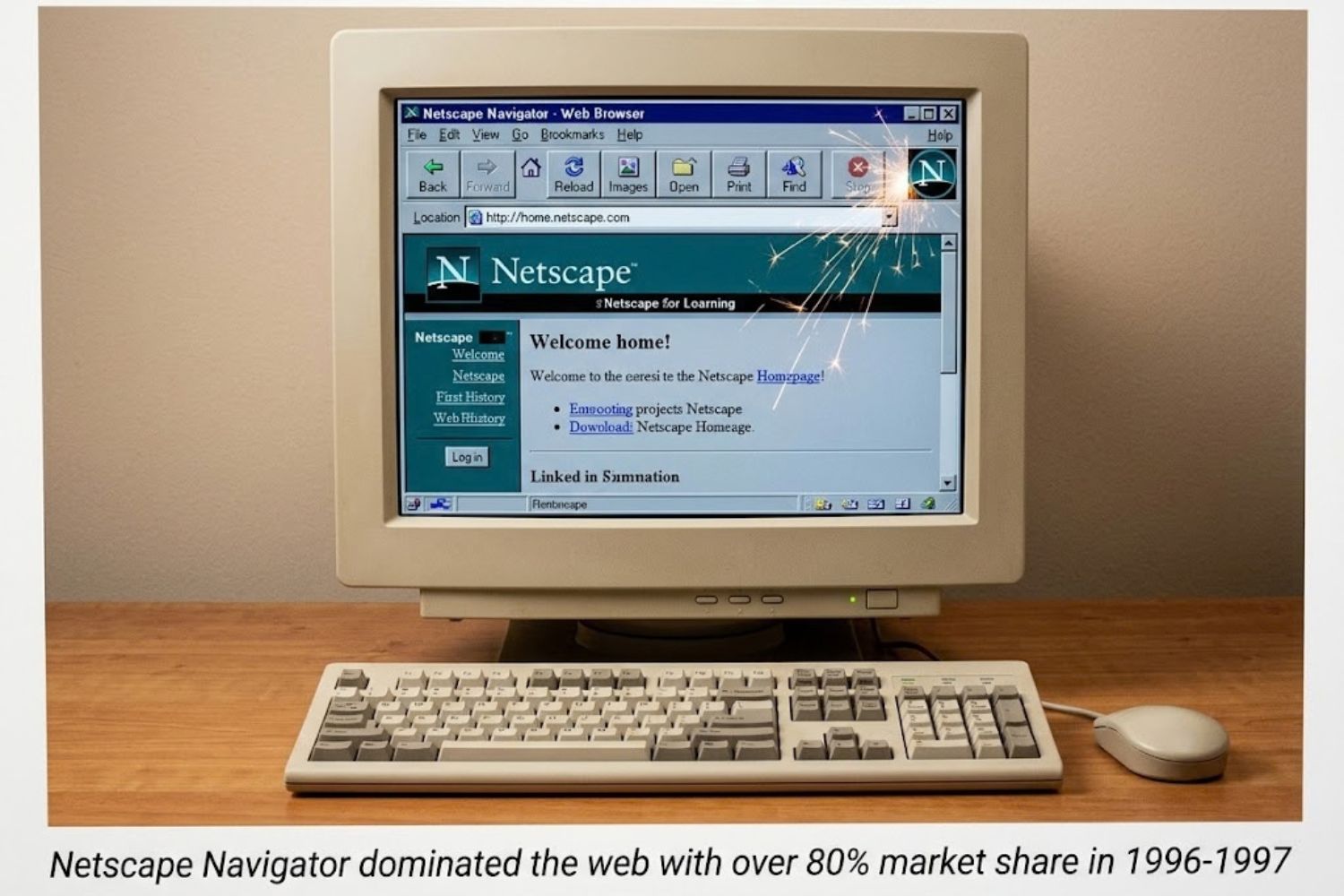
In the mid-1990s, Netscape Navigator wasn’t just a web browser—it was the internet itself. If you wanted to go online, you used Netscape. Its market dominance was so complete that most people didn’t know alternatives existed.
By 2008, Netscape was dead. Dissolved. Forgotten.
What happened in 14 years wasn’t just the fall of a company. It was the story of how complacency, strategic missteps, and a ruthless competitor with an operating system monopoly can destroy even the most dominant market player.
But Netscape’s legacy shaped everything you use today. Every modern browser carries DNA from Netscape’s innovations. Every secure website connection uses technologies Netscape pioneered. And the open-source movement that spawned Firefox—Netscape’s spiritual successor—fundamentally changed how software gets built.
This is how a visionary company lost a technological war it essentially invented.
What Was Netscape? A Brief Overview
Netscape Navigator was the world’s first commercially successful web browser. Released in December 1994 by Netscape Communications Corporation, it transformed the internet from an academic oddity into a mass-market phenomenon.
Before Netscape, the web browser called NCSA Mosaic existed. But Mosaic was clunky, slow, and primarily the domain of universities and tech professionals. Netscape was different. It was fast. It was stable. It was built for regular people.
Netscape Navigator didn’t just display web pages. It created the internet experience that billions of people now take for granted.
The Company Behind the Browser
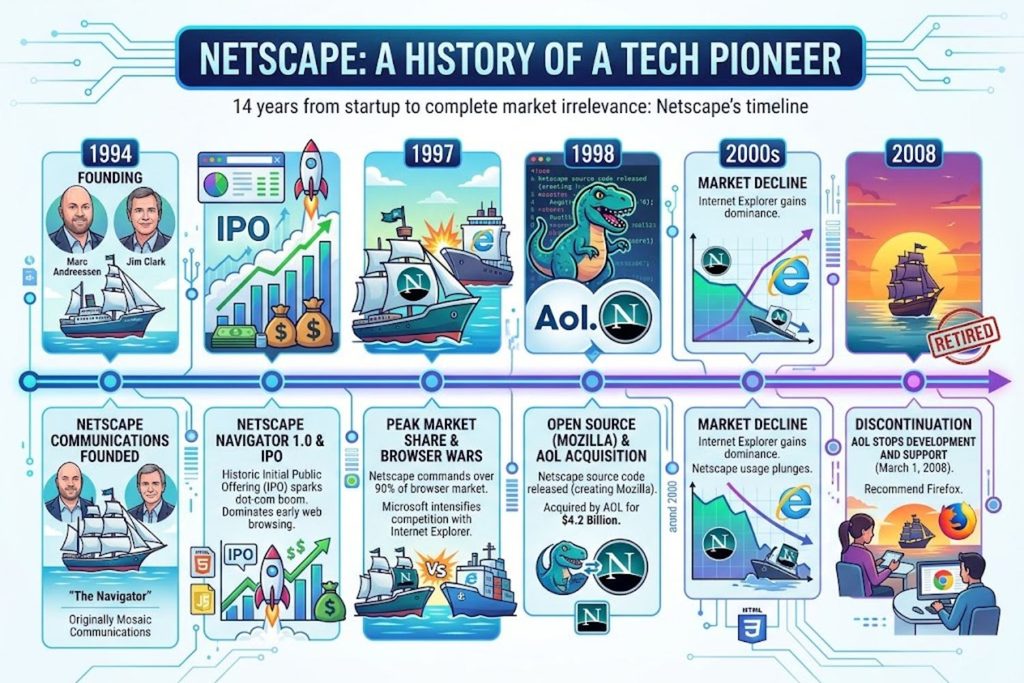
Netscape Communications Corporation was founded in April 1994 by Marc Eckert, Jim Clark, and a team of engineers that included some of the original Mosaic creators. The company grew at an almost mythical pace—going from startup to public company in just 16 months.
When Netscape went public on August 9, 1995, the stock opened at $28 per share and closed at $58.25. People were literally bidding up the price because they believed this company would define the future of computing.
At its peak, Netscape employed over 3,000 people across multiple divisions, building not just browsers but servers, development tools, and an entire ecosystem around the web.
Netscape’s Rise: The Browser Wars Begin (1994–1998)
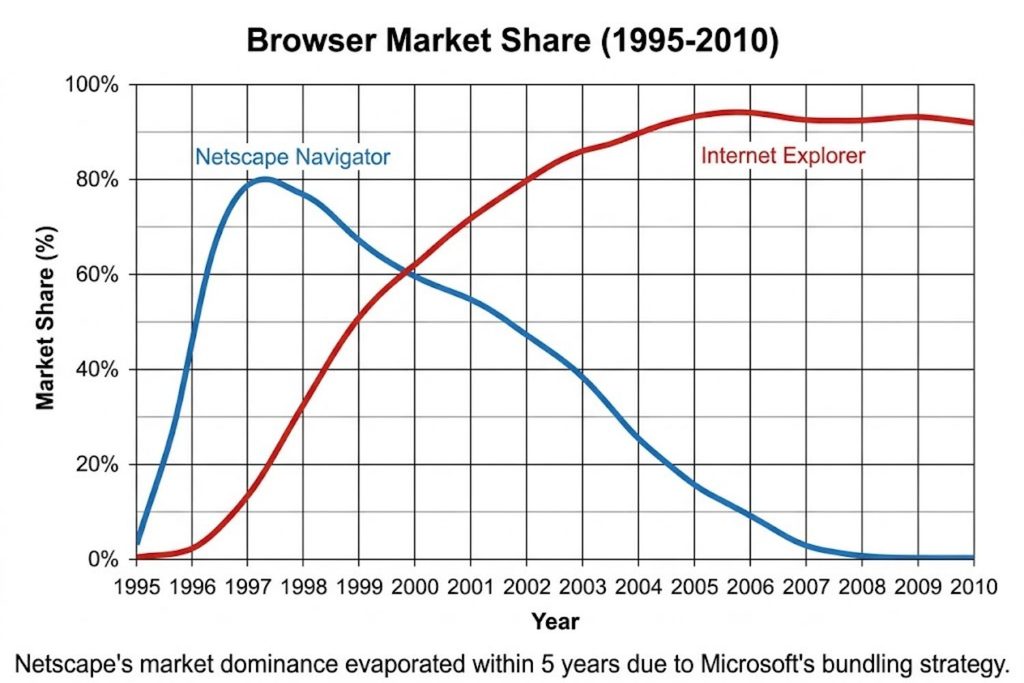
The early internet moved at hyperspeed. In 1994, the web barely existed. By 1996, it was transforming business, media, and communication. Netscape rode that wave with almost unnatural timing.
Dominance in the Early Web Era
By 1996, Netscape controlled over 80% of the browser market. Eight out of ten people accessing the web were using Netscape Navigator.
This wasn’t accidental. Netscape was simply better than alternatives. The browser was fast, relatively stable, and added features users actually wanted:
- Support for tables (essential for early website design)
- Cookies (enabling personalized experiences)
- Frames (allowing modular page layouts)
- Dynamic content scripting (through JavaScript)
- Secure connections (SSL/TLS for e-commerce)
Websites were literally built around Netscape’s capabilities. Web developers would test first in Netscape and adjust for other browsers, not the other way around.
The company also pioneered a bold distribution model: give the browser away for free. This was revolutionary. Netscape made its money from server software and web services, not licensing fees. The browser was the loss leader that generated an ecosystem.
Market Share and User Adoption
Netscape’s growth was stunning. Between 1995 and 1997, internet usage exploded from 16 million users to over 100 million. Netscape grew with it, shipping major updates roughly every six months.
Version history tells the story:
- Netscape 1.0 (1994): The original
- Netscape 2.0 (1995): JavaScript support, cookies
- Netscape 3.0 (1996): Added inline images, better performance
- Netscape 4.0 (1997): Dynamic HTML, better standards support
Each version added meaningful features. The software felt like it was getting exponentially better, which it was.
By 1997, Netscape wasn’t just the market leader. It was the market. Internet Explorer existed but was considered a poor second choice.
The Netscape IPO Moment
The August 1995 IPO didn’t just make investors wealthy. It announced to the world that the internet was real, that it mattered, and that Netscape was the company leading it.
The stock doubled on the first day. Netscape’s market cap briefly exceeded $2 billion. To context: the company had existed for four months and wasn’t yet profitable.
This moment represented peak confidence. The market was saying: Netscape owns the future of computing. Betting against them was foolish.
That confidence would become dangerous.
Technical Innovations That Mattered
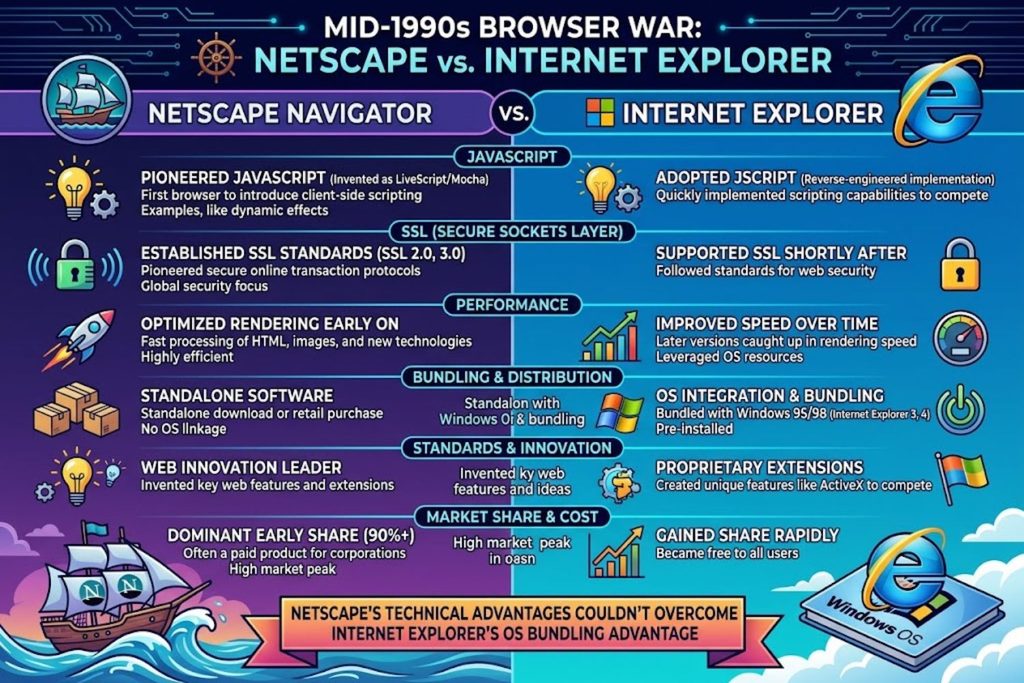
Netscape didn’t just dominate because it was first. It dominated because it was better, and because it championed technical advances that shaped the web itself.
JavaScript and Dynamic Web Experiences
In 1995, Marc Eckert created JavaScript specifically to run inside Netscape Navigator. The language was designed in just 10 days—a surprisingly short timeframe that explains some of JavaScript’s quirks, which persist today.
But JavaScript did something radical: it made web pages interactive without requiring server calls for every interaction.
Before JavaScript, clicking a button meant waiting for the server to respond. With JavaScript, forms could be validated instantly. Interactions could be rich and responsive. The browser became a platform, not just a viewer.
This was revolutionary. JavaScript became the foundation for modern web development. Every interactive experience on the modern web—autocomplete suggestions, infinite scrolling, real-time validation—traces back to this innovation running inside Netscape Navigator.
Microsoft later reverse-engineered JavaScript and called it JScript. But Netscape defined what it should be.
SSL/TLS and Secure Web Browsing
Netscape also pioneered secure web communications through SSL (Secure Sockets Layer), developed by Netscape and introduced in Navigator 2.0.
SSL was essential for e-commerce. Before SSL, transmitting a credit card number across the internet felt like shouting it in public. SSL encrypted the connection, making it safe for commerce at scale.
Every HTTPS connection on today’s internet is the direct successor to Netscape’s SSL innovation. The technology evolved into TLS (Transport Layer Security), which is what modern security uses. But Netscape invented it because they understood that the web couldn’t grow commercially without trust.
The Gecko Rendering Engine
By 1998, Netscape realized that Netscape 4’s code architecture was becoming a liability. The browser was accumulating technical debt—layers of fixes, patches, and workarounds that made development slower and slower.
So Netscape did something ambitious: they decided to rewrite the entire browser from scratch, building a new rendering engine called Gecko.
Gecko was designed with modern principles:
- Modular architecture
- Standards compliance
- Performance optimization
- Extensibility for features
Gecko first shipped in a Netscape beta in 1999. It was powerful and modern.
But Netscape made a fateful decision: they open-sourced Gecko. The code was released to the Mozilla project, an open-source community. While Netscape used Gecko to build Netscape 6, the best version of the engine was controlled by a distributed community that didn’t necessarily prioritize the commercial browser.
This open-source decision was visionary for the web’s long-term health. It was commercially disastrous for Netscape.
Standards Advocacy and Web Development
Netscape also pushed the web toward standards. Working with the W3C (World Wide Web Consortium), Netscape advocated for HTML standards, CSS standards, and JavaScript standardization.
This advocacy meant developers could write once and deploy to multiple browsers. It meant the web itself became more predictable. Netscape was essentially voting to reduce its own lock-in on developers.
Again: brilliant for the web. Disastrous for maintaining monopoly control.
Why Netscape Lost to Internet Explorer
Netscape’s dominance in 1997 felt unshakeable. The company had the talent, the market share, the momentum, and the resources. Internet Explorer was universally considered inferior.
Then everything changed.
Microsoft’s Bundling Strategy
In 1995, Bill Gates issued a directive: the internet was now Microsoft’s strategic priority. The company hadn’t taken it seriously initially—Gates had famously underestimated the web’s importance. But by 1995, that changed.
Microsoft’s strategy was simple and devastating: make Internet Explorer inseparable from Windows.
Starting with Windows 95, Internet Explorer came pre-installed. Not as an option—as the default. If you bought a PC, IE was already there, ready to go. Netscape required an explicit download and installation.
This was Microsoft’s nuclear option: leverage their OS monopoly to own the browser market. They didn’t need to make IE better than Netscape. They just needed it to be “good enough” while making it harder to choose anything else.
Netscape couldn’t compete with this. How do you fight an operating system bundling advantage? You can’t outmarket it. You can’t out-feature it fast enough. The distribution advantage is simply too powerful.
Performance and Compatibility Issues
As Netscape 4 matured, it developed a reputation for slowness and crashes. JavaScript performance lagged. Page rendering felt sluggish compared to Internet Explorer 5 and later versions.
Meanwhile, Microsoft’s engineers were improving IE rapidly. By Internet Explorer 5 (1999), IE was competitive. By IE 6 (2001), many thought IE was superior.
Netscape’s response—a complete browser rewrite in Gecko—took too long and arrived too late. Netscape 6 (2000) was finally competitive, but by then, most users had already switched to Internet Explorer.
Strategic Mistakes and Market Blindness
Netscape’s leadership made critical strategic errors:
1. Overreliance on Server Revenue: Netscape built its business model around selling expensive server software. They treated the browser as a loss leader. But when the market shifted toward free alternatives and open-source servers, this business model collapsed.
2. Product Complexity: Later versions of Netscape Navigator became bloated, trying to be email clients, news readers, and web pages simultaneously. This complexity made the browser slower and more difficult to maintain than a focused competitor.
3. Underestimating Microsoft: Netscape executives believed that technical quality would win. They didn’t fully account for Microsoft’s willingness to use anti-competitive tactics and their advantage in distribution and market power.
4. Leaving the Server Market: By the late 1990s, Apache (open-source) was becoming the dominant web server. Netscape’s expensive server software couldn’t compete. The company had lost its alternative revenue stream.
5. Slow Response to Competition: By the time Netscape leadership realized IE was a serious threat, Microsoft had already captured significant market share. The company was slow to adapt.
The Death Spiral (2000–2008)
By 2000, Netscape’s market share had fallen below 30%. By 2002, it was below 5%. By 2008, when Netscape Navigator was officially discontinued, it held less than 1% market share.
The decline wasn’t quick. It was a slow erosion as user after user switched to Internet Explorer because it came with their computer and was “good enough.”
Netscape’s independence also ended. AOL (America Online) acquired Netscape in 1998 for $4.2 billion. Many thought this would save the company—AOL had 30 million subscribers who could switch to Netscape. Instead, it proved disastrous. AOL was a dial-up ISP company that didn’t understand the browser market. Integration was messy. Netscape became an afterthought within AOL’s product lineup.
By 2003, Netscape released final versions and transitioned users to Mozilla Firefox. By 2008, the Netscape brand was officially retired.
The AOL Acquisition and Mozilla’s Birth
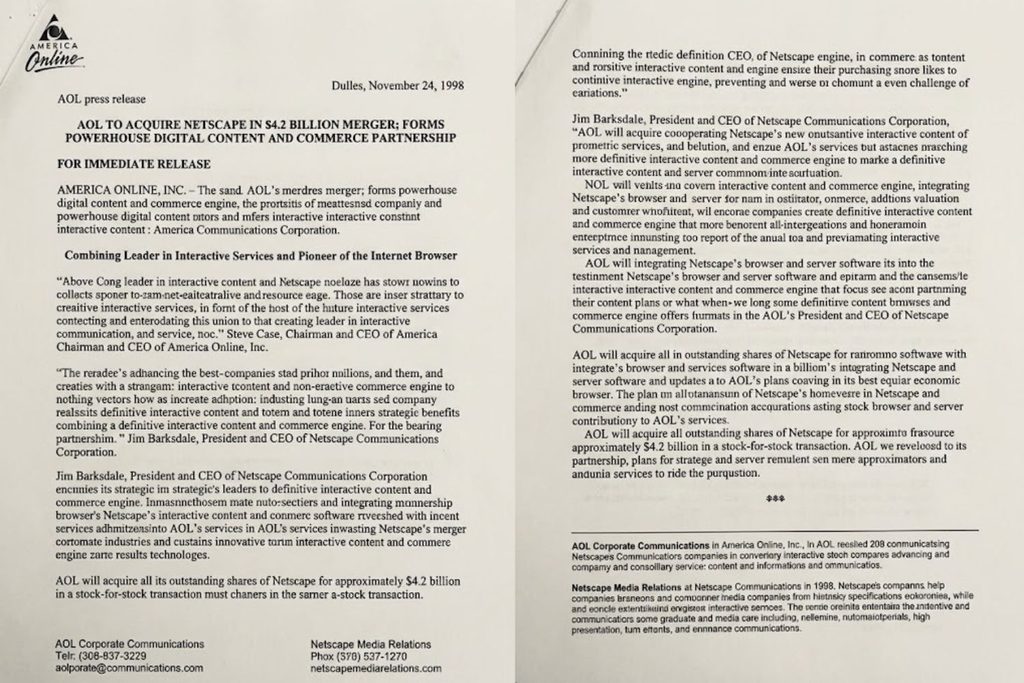
The 1998 AOL acquisition of Netscape for $4.2 billion looked bold at the time. On paper, it made sense: AOL had a massive user base and needed better internet infrastructure. Netscape had the talent and technology.
In practice, it was a disaster.
AOL Buys Netscape
AOL paid a high price for Netscape, betting that owning the browser would strengthen its position as America’s largest ISP. But AOL executives didn’t understand software. They didn’t understand browser development. They were experts in dial-up internet access and walled-garden services, not building world-class software.
The merger created organizational confusion. Netscape’s talented engineers were frustrated working within AOL’s corporate structure. Product decisions that previously moved at internet speed now moved at corporate speed.
Meanwhile, Microsoft was still bundling IE aggressively. AOL couldn’t compete with that advantage—and AOL’s own layoffs and restructuring meant resources were being cut, not invested.
Open Source Transformation
The one brilliant move AOL made was open-sourcing Netscape’s Gecko engine and browser code in 1998. The code was released under the Mozilla Public License, inviting developers worldwide to contribute improvements.
This wasn’t accidental brilliance. Netscape engineers had pushed for this. They understood that if Netscape couldn’t win the commercial browser wars, at least the code could live on and evolve through community development.
The Mozilla project became the incubator for browser innovation at a time when Netscape couldn’t innovate commercially.
Firefox Emerges From the Ashes
By 2004, Mozilla released Firefox—a browser built on the Gecko engine but stripped of Netscape’s corporate baggage. Firefox was:
- Fast
- Secure
- Open source
- Community-driven
- Free of corporate bloat
Firefox proved that a non-corporate browser could challenge the market leader. It captured millions of users who were tired of IE’s dominance and security vulnerabilities.
Firefox never reached Netscape’s 80%+ market dominance. But it proved the principle: Netscape’s legacy lived on through open-source development, not corporate continuity.
The Mozilla Foundation, which created Firefox, traces its lineage directly to Netscape. Many Netscape engineers worked on Firefox. The technology, the philosophy, and the mission were preserved even as the commercial entity dissolved.
Netscape’s Legacy in Modern Browsers
Netscape died in 2008, but its innovations never died. They’re embedded in every browser you use today.
How Modern Browsers Inherited Netscape’s DNA
Modern browsers—Chrome, Firefox, Safari, Edge—carry Netscape’s genetic code:
- Gecko (used by Firefox) is the direct descendant of Netscape’s rendering engine
- Security innovations: SSL/TLS, which Netscape pioneered, protects every HTTPS connection
- JavaScript: Developed for Netscape, now the foundation of modern web development
- Open web standards: Netscape’s advocacy for standards continues in how browsers prioritize web platform stability
Even Chrome and Safari, which built their own engines (V8 and WebKit), were developed in reaction to standards and principles Netscape championed.
Standards Netscape Championed
Netscape fought for:
- JavaScript standardization (became ECMAScript)
- CSS standards (enabling visual design without table layouts)
- HTML standards (making the web predictable)
- Open APIs (allowing competing implementations)
These weren’t just technical decisions. They were political decisions. Netscape could have locked developers into proprietary features. Instead, they chose an open web.
This decision cost them commercial dominance but created the web platform that thrives today.
Features Taken for Granted Today
Features that seemed innovative in Netscape 4 (1997) are now invisible baseline requirements:
- Secure connections (SSL/TLS)
- Interactive forms and validation (JavaScript)
- Session persistence (cookies)
- Modular page layouts (CSS)
- Plugin architecture (extensions in Firefox, Chrome)
Every modern browser has these because Netscape proved they were essential. Competitors had to follow or be left behind.
Lessons for Modern Technology Companies
Netscape’s rise and fall offers essential lessons for tech leaders, investors, and entrepreneurs.
The Danger of Complacency
When you own 80% market share, the temptation to coast is powerful. You’re winning. You’re profitable. Competitors seem weak.
Netscape executives believed their technical superiority and market dominance were moats—defensible advantages that would protect them indefinitely.
They were wrong.
Dominance can evaporate quickly when a competitor has structural advantages (like OS bundling) that technical quality can’t overcome. Complacency means you’re slow to respond when threats emerge.
Modern tech companies—Google with search, Apple with phones, Meta with social networks—should note that dominance is temporary if you stop innovating and responding to competition.
Platform Bundling Trumps Technical Excellence
This is the hard lesson: technical superiority doesn’t always win.
Netscape’s browser was often better than Internet Explorer. By multiple measures—standards compliance, features, performance—Netscape was competitive.
But it didn’t matter because every computer shipped with IE pre-installed.
This lesson haunts competition law in technology. Can a company leverage dominance in one market (operating systems) to capture another market (browsers)? The DOJ later sued Microsoft over precisely this practice.
For modern companies: bundling creates unbeatable distribution advantages. For regulators: platform bundling can strangle competition in ways pure competition can’t overcome.
Open Source as Strategy, Not Afterthought
Netscape’s decision to open-source Gecko wasn’t charity. It was recognizing that fighting alone was impossible. By open-sourcing, they preserved their legacy and created a community-driven successor in Firefox.
The lesson: sometimes you can’t win the commercial battle, but you can ensure your principles and code live on through open development.
Modern companies increasingly realize this. Open-sourcing projects creates ecosystem value, attracts talent, and preserves reputation even if a commercial product fails.
User Loyalty ≠ Market Dominance
Netscape had passionate users. People liked the browser. It was popular because it was actually good.
But this loyalty didn’t translate to market dominance once Microsoft bundled IE with Windows.
The lesson: having users who prefer your product is different from having structural market position. Distribution advantages (bundling, defaults, lock-in) often trump user preference.
FAQ Section
Q: Could Netscape have survived if it had different leadership?
Possibly, but unlikely. Even with perfect execution, competing against an operating system’s bundling advantage is structurally difficult. A more aggressive response to IE earlier, plus better business model diversification, might have extended life, but not overcome OS-level competition.
Q: Why didn’t Netscape switch to bundling their own version of Windows?
Netscape considered it but lacked expertise in OS development. Building an operating system is exponentially harder than building a browser. By the time Netscape was failing, it was too late to launch a credible OS competitor.
Q: Did Netscape’s open-source strategy help or hurt?
Both. Open-sourcing Gecko accelerated its technical development (community contributions were valuable). But it also meant Netscape lost control of the technology’s future, which was commercially damaging while the company existed.
Q: Is Firefox just Netscape renamed?
No. Firefox was built on Gecko (Netscape’s engine) but is a completely new browser developed by Mozilla, not Netscape. However, many engineers and principles from Netscape influenced Firefox’s development.
Q: Could Netscape compete in today’s browser market?
No. Today’s browser market is dominated by companies with massive engineering resources (Google, Apple, Microsoft) and platform advantages (Chrome on Android, Safari on iOS, Edge bundled with Windows). Netscape’s historical advantage—being the first good browser—wouldn’t exist.
Q: What happened to Netscape’s web properties and services?
Most were shut down during AOL integration. Some services migrated to AOL properties. The domain “netscape.com” is now owned by AOL and redirects to AOL properties. Most content was archived or lost.
Q: Why does JavaScript still have quirks inherited from Netscape?
JavaScript was designed in 10 days to ship in Netscape Navigator. That rushed timeline created design decisions that are now locked in by web compatibility. Modern standards try to work around these quirks rather than fixing them directly.
Q: Is there any way Netscape brand could be revived?
Theoretically, yes, but practically, no. The browser market is too competitive, too dominated by existing players. Reviving the Netscape brand would be nostalgia marketing, not genuine competition. The real legacy lives on through Firefox.