For more than a decade, smartphones have been the center of our digital lives. They help us communicate, work, shop, navigate, create content, and even manage our health. Yet, many of the world’s leading technology companies now believe that the smartphone era is approaching a turning point. Instead of building better phones every year, they are investing billions of dollars into technologies that could eventually replace the device we carry in our pockets.
The conversation around tech giants envision future beyond smartphones has become one of the hottest topics in the technology industry. Companies are exploring artificial intelligence, wearable devices, augmented reality, virtual reality, spatial computing, brain-computer interfaces, and smart ecosystems that promise a more natural way of interacting with technology. Rather than constantly looking down at a screen, future users may experience digital information seamlessly integrated into their surroundings.
This transformation will not happen overnight. Smartphones are deeply connected to everyday life, making them difficult to replace immediately. However, history has shown that technology evolves rapidly when innovation meets consumer demand. Just as smartphones replaced many standalone devices such as cameras, MP3 players, GPS units, and portable gaming consoles, the next generation of technology could eventually redefine how people connect with the digital world.
In this article, we’ll explore why technology companies are preparing for a post-smartphone era, the innovations driving this transition, the challenges ahead, and what consumers can expect over the next decade.
Why Tech Giants Are Looking Beyond Smartphones
The smartphone market has reached a stage of maturity. While manufacturers continue introducing faster processors, improved cameras, and longer battery life, the improvements have become increasingly incremental. Most flagship smartphones today already deliver exceptional performance, making yearly upgrades less compelling for consumers.
As a result, many technology companies are searching for the next revolutionary platform that can unlock new opportunities for innovation and growth.
The idea that tech giants envision future beyond smartphones is driven by several important factors.
Slowing Smartphone Innovation
Modern smartphones have become incredibly powerful, but their basic design has changed very little in recent years. Consumers often find that a phone purchased three or four years ago still performs everyday tasks efficiently.
This longer replacement cycle has encouraged companies to invest in technologies capable of creating entirely new user experiences instead of simply improving existing devices.
Artificial Intelligence Is Changing User Interaction
Artificial intelligence is transforming how people interact with technology. Instead of opening apps and typing commands, users can now ask AI assistants to perform complex tasks using natural language.
Future AI systems may become so intelligent that users rarely need traditional smartphone interfaces. Voice commands, contextual awareness, and predictive computing could replace many everyday interactions currently handled through mobile apps.
The Rise of Immersive Computing
Another major reason behind the shift is immersive technology. Augmented reality and virtual reality have advanced significantly over the past few years. Companies are investing heavily in smart glasses and mixed-reality headsets capable of displaying digital content directly within the user’s field of vision.
These innovations represent an important step toward the post-smartphone era, where information is available without constantly reaching for a handheld device.
The Technologies Leading the Post-Smartphone Era
The future isn’t centered around one single invention. Instead, multiple technologies are expected to work together to create a completely new digital ecosystem.
Artificial Intelligence Will Become the Main Interface
Artificial intelligence is expected to become the foundation of future computing. Instead of searching through menus or switching between apps, AI assistants will understand conversations, recognize user habits, and anticipate needs before they’re expressed.
Imagine asking your digital assistant:
“Book my flight, reserve a hotel close to the conference venue, notify my team, and schedule transportation.”
Instead of opening five different applications, the AI completes the entire process automatically.
This level of intelligent automation represents one of the biggest shifts in the future of technology.
Personalized Digital Experiences
AI will also become deeply personalized. It will understand:
- Daily routines
- Health goals
- Work schedules
- Entertainment preferences
- Shopping habits
- Communication styles
As machine learning improves, digital assistants may evolve into proactive companions capable of making life significantly more efficient.
Smart Glasses Could Replace Phone Screens
Many experts believe augmented reality glasses are among the strongest candidates to replace smartphones.
Instead of staring at a screen, users would see digital information projected directly into their environment.
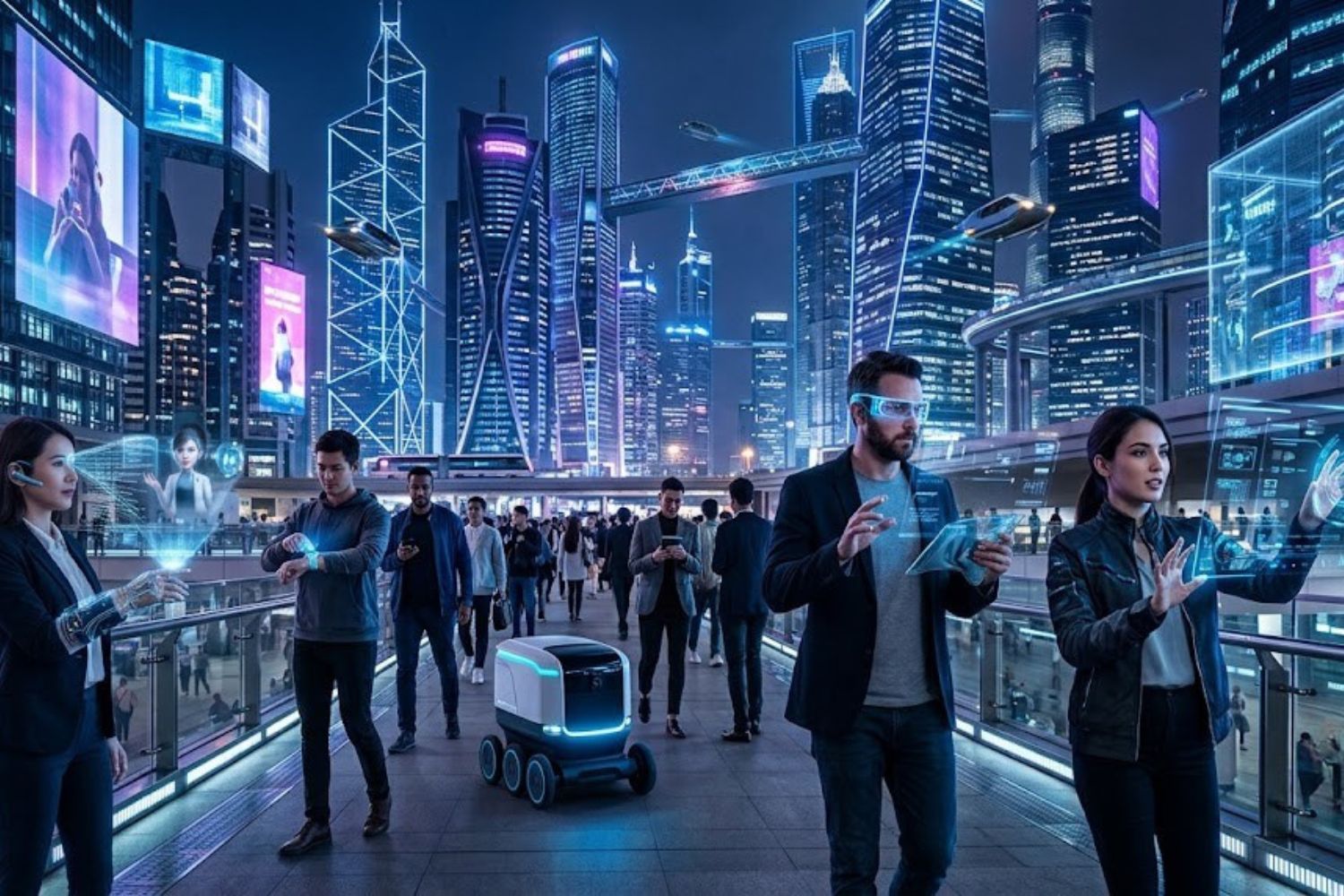
Imagine walking through an unfamiliar city while navigation arrows appear on the road ahead. During a meeting, translated subtitles could appear instantly when someone speaks another language. Notifications, emails, calendars, and weather updates could all be displayed without removing a phone from your pocket.
This represents one of the most exciting developments in next generation technology.
Unlike today’s smartphones, smart glasses could provide continuous access to information while allowing users to remain aware of their surroundings.
Wearable Devices Will Become More Intelligent
Wearable technology has already become part of everyday life. Smartwatches monitor heart rate, track workouts, and receive notifications. Fitness bands help users monitor sleep and activity levels.
The next generation of AI wearable devices will go much further.
Future wearables may monitor:
- Blood pressure continuously
- Blood glucose without needles
- Hydration levels
- Stress indicators
- Mental wellness
- Early disease detection
- Body temperature changes
- Respiratory health
Instead of reacting to health problems, these devices may help predict them before symptoms appear.
Healthcare professionals could receive real-time updates, while AI systems recommend lifestyle adjustments based on continuous health monitoring.
Voice Technology Will Replace Touchscreens
Touchscreens have dominated computing for nearly two decades, but voice interaction is improving rapidly.
Modern AI understands conversational language far better than earlier virtual assistants.
Future voice assistants may allow users to complete nearly every digital task simply by speaking naturally.
For example:
“Order groceries for dinner.”
“Turn off all lights after 10 PM.”
“Summarize today’s work emails.”
“Find the fastest route avoiding traffic.”
Instead of navigating multiple apps, users simply express their intentions.
This conversational approach could become one of the defining characteristics of the smart devices innovation movement.
Spatial Computing Will Blend Digital and Physical Worlds
Spatial computing is another technology attracting enormous investment.
Unlike traditional computers, spatial computing understands the surrounding environment. Digital objects can appear fixed within real-world spaces.
Imagine designing a room where virtual furniture appears exactly where it would be placed before purchasing it.
Architects could walk through digital buildings before construction begins.
Students might interact with three-dimensional scientific models floating in front of them.
Medical professionals could visualize organs during surgery using real-time digital overlays.
This technology creates experiences impossible with traditional smartphones and highlights why tech giants envision future beyond smartphones as the next major evolution in consumer technology.
Brain-Computer Interfaces Could Redefine Human-Computer Interaction
One of the most futuristic ideas currently under development is the brain-computer interface (BCI). While it may sound like science fiction, several research organizations and technology companies are investing in systems that allow people to control digital devices using neural signals.
Instead of tapping a screen or speaking a command, users could eventually perform actions simply by thinking. Although this technology is still in its early stages, researchers have already demonstrated promising results, particularly for people with physical disabilities.
In the long term, brain-computer interfaces could enable users to:
- Type messages without using a keyboard.
- Control smart home devices with thought alone.
- Operate computers more efficiently.
- Communicate faster than ever before.
- Assist individuals with mobility challenges.
Before BCIs become mainstream, significant challenges related to safety, privacy, affordability, and ethics must be addressed. Nevertheless, they represent one of the boldest visions for the future of technology and illustrate how innovation is moving beyond traditional screens.
Smart Homes Will Become Intelligent Ecosystems
The future extends beyond replacing smartphones—it involves creating environments where every device works together seamlessly.
Today’s smart homes already include connected lights, security cameras, thermostats, and voice assistants. In the coming years, artificial intelligence will make these systems far more intelligent and autonomous.
Imagine arriving home after work. Your home recognizes your location and automatically adjusts the lighting, temperature, and music based on your preferences. Dinner begins cooking through a connected appliance, while your robot vacuum finishes cleaning the living room before you walk through the door.
This interconnected experience is a major part of the post-smartphone era, where users interact with an ecosystem rather than a single device.
AI Will Connect Every Device
Instead of managing dozens of apps, a central AI assistant could coordinate every connected device.
For example, your assistant might:
- Lock the doors at night.
- Turn off unused appliances.
- Charge your electric vehicle during off-peak hours.
- Monitor energy consumption.
- Detect unusual activity through security systems.
- Remind you about maintenance tasks.
Rather than acting as separate gadgets, devices will function as one intelligent network designed to simplify everyday life.
AI Companions Could Become Everyday Assistants
Artificial intelligence is evolving far beyond simple chatbots. Future AI systems may become true digital companions capable of understanding emotions, remembering conversations, and providing meaningful assistance throughout the day.
Unlike today’s virtual assistants, future AI companions could:
- Help organize work schedules.
- Offer personalized learning support.
- Manage finances.
- Recommend healthier habits.
- Assist with travel planning.
- Translate conversations instantly.
- Provide creative ideas for work and personal projects.
These assistants may exist across multiple devices—including smart glasses, wearables, vehicles, and home systems—creating a continuous experience without relying on a smartphone.
As AI wearable devices become more advanced, users may communicate with their assistant naturally while walking, driving, or working, making technology feel almost invisible.
Robotics Will Play a Bigger Role in Daily Life
Another major area attracting investment is robotics. While industrial robots have been used in manufacturing for decades, consumer robotics is becoming increasingly sophisticated.
Future households may include robots that assist with everyday responsibilities such as:
- Cleaning floors.
- Organizing household items.
- Delivering groceries.
- Monitoring elderly family members.
- Assisting children with homework.
- Providing security surveillance.
Businesses will also benefit from robotic assistants capable of handling repetitive tasks, improving efficiency, and reducing operational costs.
Combined with artificial intelligence, robotics represents one of the most exciting areas of next generation technology.
Flexible and Invisible Computing
The next wave of innovation may involve technology that blends naturally into everyday life rather than demanding constant attention.
Instead of carrying a phone everywhere, computing power could be distributed across multiple devices.
Examples include:
Smart Clothing
Clothing embedded with sensors may monitor health, posture, hydration, and physical activity without requiring separate wearable devices.
Athletes could receive real-time performance analysis, while patients recovering from illness could be monitored remotely.
Digital Contact Lenses
Researchers are exploring contact lenses capable of displaying navigation, notifications, translation, and health information directly in the user’s vision.
Although still experimental, this technology could dramatically reduce the need for handheld screens.
Intelligent Earbuds
Wireless earbuds are expected to become much more powerful.
Future versions may provide:
- Live language translation.
- Instant AI conversations.
- Meeting summaries.
- Health monitoring.
- Navigation assistance.
- Personalized coaching.
These developments reflect the growing trend toward smart devices innovation, where technology becomes smaller, smarter, and more integrated into everyday life.
Which Tech Giants Are Leading This Transformation?
The race to shape the post-smartphone future is highly competitive. Nearly every major technology company is investing heavily in artificial intelligence, immersive computing, wearable devices, and connected ecosystems.
While each company has its own strategy, their shared goal is to build platforms that go beyond the traditional smartphone.
Some organizations are focusing on AI-powered assistants, while others are prioritizing mixed reality, smart glasses, advanced wearable devices, or spatial computing. Many are also investing in custom processors and cloud infrastructure to support these emerging technologies.
This intense competition is accelerating innovation and increasing the likelihood that consumers will see groundbreaking products over the next decade.
The fact that tech giants envision future beyond smartphones demonstrates a broader shift in the technology industry. Instead of asking how to improve smartphones, companies are asking what comes after them.
Challenges That Could Slow the Transition
Despite rapid innovation, replacing smartphones will not be easy. Several significant obstacles must be overcome before next-generation devices become mainstream.
Consumer Adoption
People are comfortable using smartphones because they are familiar, reliable, and versatile. Convincing billions of users to adopt entirely new devices will take time.
New technology must provide clear advantages while remaining easy to use.
Privacy Concerns
Future devices may collect even more personal information than smartphones, including eye movements, voice recordings, health data, and environmental information.
Technology companies must build strong privacy protections to earn public trust.
Battery Life
Wearable devices, smart glasses, and immersive technologies require powerful processors while remaining lightweight.
Developing long-lasting batteries without increasing device size remains one of the industry’s biggest engineering challenges.
Cost
Many emerging technologies are currently expensive.
As production scales and manufacturing improves, prices are expected to decrease, making these innovations more accessible to everyday consumers.
Infrastructure
Some technologies depend on ultra-fast internet, advanced cloud computing, and powerful AI servers.
Expanding global infrastructure will be essential before many of these innovations can reach their full potential.
How Businesses Will Adapt to the Post-Smartphone Era
The shift toward a world beyond smartphones will not only change consumer habits but also transform the way businesses operate. Organizations across every industry will need to rethink how they communicate with customers, deliver services, and design digital experiences.
Today, many companies prioritize mobile apps and responsive websites. In the coming years, they may also need to develop AI-powered assistants, augmented reality experiences, and voice-first services. Businesses that adapt early are likely to gain a competitive advantage, while those that rely solely on traditional mobile platforms could struggle to keep pace.
Retailers, for example, may allow customers to virtually try on clothing through smart glasses before making a purchase. Real estate companies could offer immersive property tours without requiring buyers to visit in person. Restaurants might use AI assistants that automatically recommend meals based on dietary preferences and previous orders.
This shift highlights why tech giants envision future beyond smartphones as more than just a hardware upgrade—it represents a complete evolution of the digital economy.
Education Will Become More Interactive
Education is another field that could benefit enormously from next-generation technologies.
Instead of learning through textbooks and flat screens, students may explore subjects in immersive digital environments. A history lesson could place learners inside an ancient civilization, while biology students might interact with a three-dimensional human heart floating in front of them.
Artificial intelligence will also personalize education. Rather than delivering the same lesson to every student, AI systems will identify strengths, weaknesses, and learning styles to create customized study plans.
Some future classroom experiences may include:
- Virtual science laboratories.
- Real-time language translation.
- AI tutors available 24/7.
- Interactive historical simulations.
- Collaborative virtual classrooms.
- Personalized assessments and feedback.
These innovations will make learning more engaging and accessible for students around the world.
Healthcare Could Become More Preventive
Healthcare is expected to experience one of the biggest transformations during the post-smartphone era.
Instead of visiting a doctor only after symptoms appear, people may rely on intelligent wearable devices that continuously monitor their health. These systems could detect unusual changes long before they become serious medical conditions.
Future healthcare technologies may include:
- Continuous heart monitoring.
- AI-assisted diagnosis.
- Remote patient monitoring.
- Early disease detection.
- Personalized treatment recommendations.
- Automated medication reminders.
Doctors could receive real-time health reports, enabling faster diagnoses and more effective treatment plans.
Combined with artificial intelligence, these innovations have the potential to improve healthcare accessibility while reducing costs for patients and providers alike.
Entertainment Will Feel More Immersive
Entertainment has always evolved alongside technology. Television transformed radio, streaming services changed cable, and smartphones reshaped how people consume media. The next step is likely to be fully immersive experiences.
Imagine watching a sporting event from the perspective of your favorite player or attending a live concert through mixed reality without leaving your home. Instead of viewing content on a screen, users may feel as though they are physically present within the experience.
Gaming will also continue to evolve. Future games may use AI to generate dynamic storylines that respond to each player’s decisions, creating unique experiences every time.
As next generation technology continues to advance, entertainment will become more interactive, personalized, and engaging than ever before.
What Consumers Can Expect Over the Next Decade
While smartphones will remain important for several years, their role is expected to gradually change. Rather than being the primary computing device, smartphones may become one part of a larger connected ecosystem.
Over the next ten years, consumers can expect:
- Smarter AI assistants capable of handling complex daily tasks.
- More powerful and affordable wearable devices.
- Widespread adoption of augmented reality glasses.
- Greater integration between homes, vehicles, and workplaces.
- Improved voice-controlled technology.
- Increased automation powered by artificial intelligence.
- Enhanced digital privacy tools and security features.
- Faster wireless networks supporting real-time AI experiences.
The transition will likely happen gradually. Just as laptops and desktop computers still exist alongside smartphones, future technologies will initially complement smartphones before eventually reducing our dependence on them.
Consumers may carry fewer devices while enjoying more powerful digital experiences that are available whenever and wherever they need them.
Will Smartphones Completely Disappear?
One of the biggest questions surrounding this technological evolution is whether smartphones will disappear entirely.
The answer is probably not anytime soon.
Smartphones remain incredibly versatile, portable, and familiar. They provide a reliable way to access communication, entertainment, productivity, banking, shopping, and navigation in a single device.
However, history shows that dominant technologies eventually evolve. Desktop computers gave way to laptops for many users, and laptops were later complemented by smartphones and tablets. Rather than disappearing overnight, each technology found a new role.
The same is likely to happen with smartphones. Instead of being replaced immediately, they may gradually become background devices while smart glasses, AI assistants, wearables, and other connected technologies take center stage.
This gradual transition is exactly why tech giants envision future beyond smartphones—they are preparing for the next major shift before it becomes mainstream.
Conclusion
The technology industry stands on the edge of another major transformation. Smartphones revolutionized communication and reshaped modern life, but innovation never stands still. Artificial intelligence, augmented reality, wearable technology, spatial computing, robotics, and intelligent ecosystems are opening the door to experiences that once seemed impossible.
As tech giants envision future beyond smartphones, they are investing in technologies designed to make computing more natural, intuitive, and seamlessly integrated into everyday life. Instead of relying on a single handheld device, people may soon interact with digital services through smart glasses, AI companions, connected homes, and intelligent wearables that work together effortlessly.
Although significant challenges remain—including privacy, affordability, infrastructure, and user adoption—the direction of innovation is becoming increasingly clear. The next generation of technology is focused on creating experiences that are faster, smarter, and more immersive than anything available today.
For consumers, businesses, educators, and healthcare providers, the coming decade promises exciting opportunities. While smartphones will continue to play an important role for years to come, they may no longer be the center of our digital world. The future belongs to intelligent ecosystems where technology adapts to people—not the other way around.
As this evolution continues, one thing is certain: the journey beyond smartphones has already begun, and its impact will shape the future of technology for generations to come.