
The average ultrasound technician in the United States earns a solid middle-class income with strong job security. If you’re considering this career—or already working in it—understanding the full salary picture helps you make informed decisions about specialization, location, and advancement.
The reality? Diagnostic medical sonographers earned a national median annual wage of $89,340 as of May 2024, and many factors can contribute to your annual salary, such as location, facility type, specialty, experience level, and more.
But that’s just the baseline. Your actual earning potential depends on decisions you make today.
The National Average Ultrasound Tech Salary
Base Salary Figures
According to the United States Bureau of Labor Statistics, the average ultrasound technician salary is $89,020 per year, or $42.80 per hour. However, this number varies significantly based on credentials, experience, and location.
The median salary puts ultrasound technology at 34% higher than the national average salary, making it one of the strongest healthcare careers available with just an associate degree. Ultrasound Schools Info
Hourly Wage Breakdown
Most ultrasound techs earn between $42–$50 per hour depending on their credentials and setting. Using BLS figures ($89,340/annum), the median wage translates to about $42.95 per hour (based on a 40-hour week, 2,080-hour work year).
That said, hourly rates can climb significantly with experience and specialty work.
What Ultrasound Techs Actually Earn (Full Salary Range)
Understanding the complete earnings spectrum matters more than the average.
Entry-Level Earning Expectations
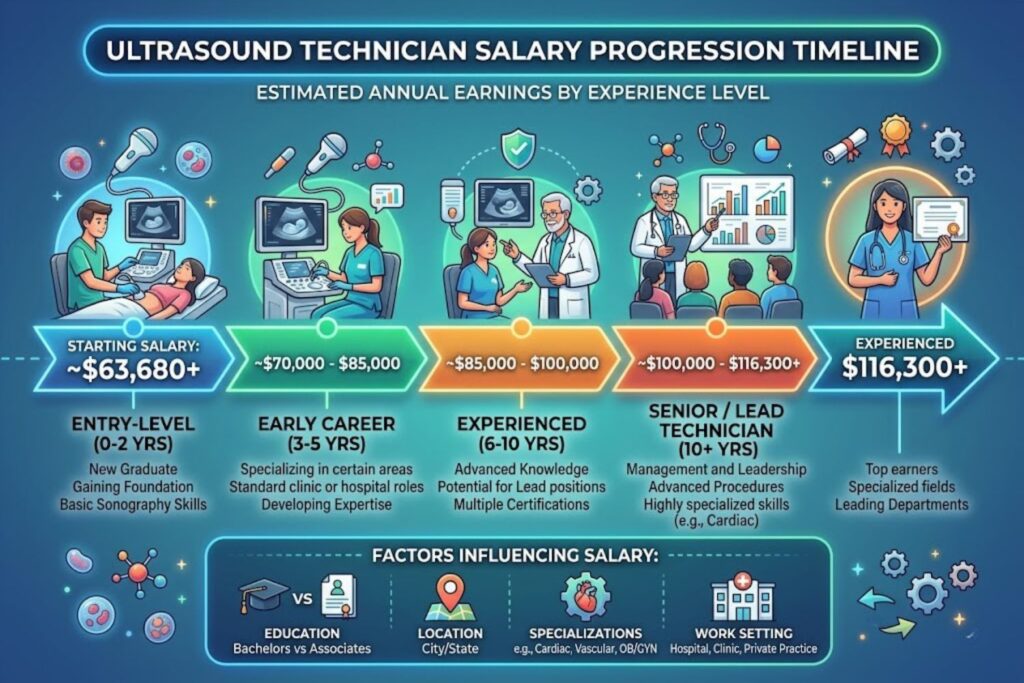
If you’re just starting out in the field, you can expect a salary in the lower range, typically around $63,680 annually. This represents the 10th percentile and applies to newly certified sonographers without specialization.
Early-career positioning is critical. Your first three years determine your trajectory more than most people realize. Entry-level techs who pursue additional certification immediately earn 15–25% more than those who delay specialization.
Mid-Career Advancement
With more experience, ultrasound techs can earn up to $85,000 a year. These professionals have likely gained specialized skills and certification, leading to higher pay.
Between years 5–10, you should see a 15–25% salary increase as you develop technical proficiency and handle complex exams independently. This is also when most techs pursue their first specialty certification.
Experienced Technician Ceiling
Senior sonographers or those with extensive specialization can earn upwards of $116,300 annually. The top 10% of earners exceed this—some significantly.
Reaching six-figure income requires intentional choices: specialized credentials, favorable geography, and often supervisory or traveling positions.
Highest-Paying States for Ultrasound Technicians
Top 5 States Ranked
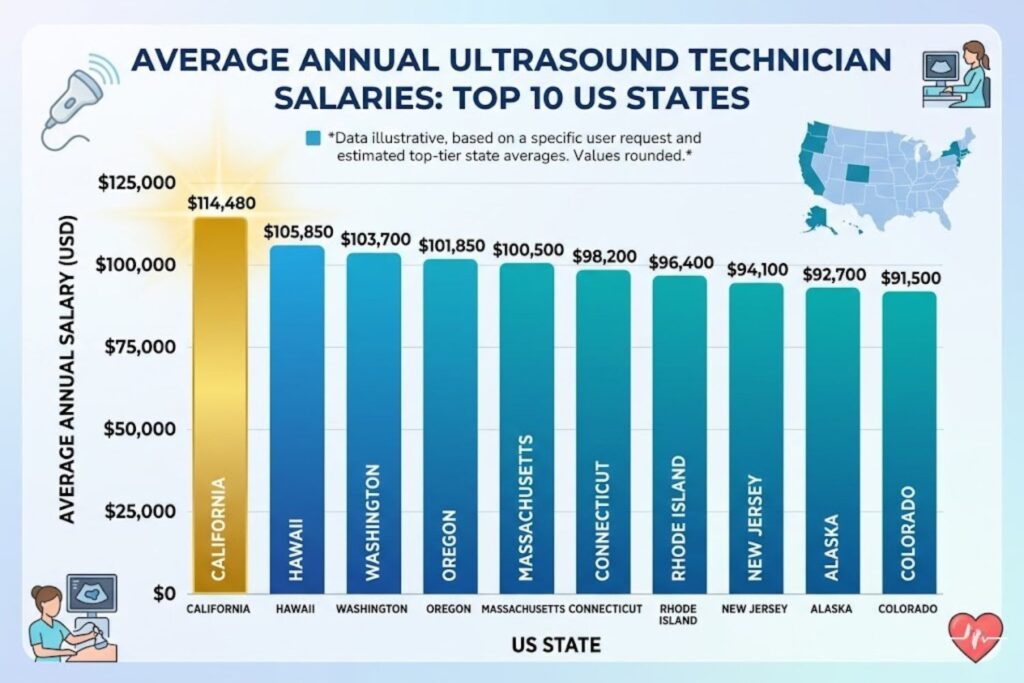
Geography is a primary salary driver. California pays sonographers the most, with an average annual salary of $114,480 in 2025. This is roughly 28% above the national average.
Following California, Hawaii ultrasound techs make about $105,850 on average. The third highest paying state for ultrasound techs is Washington, with an average salary of $103,700. Oregon ranks fourth with an average salary of $101,850 annually.
These West Coast states benefit from higher cost-of-living adjustments, strong healthcare demand, and union representation in many facilities.
Urban vs. Rural Compensation Gap
Rural positions typically pay 20–30% less than metro counterparts, even within the same state. A rural Alabama sonographer might earn $60,000 while an urban facility in a nearby metro area pays $75,000+ for the identical credential.
This isn’t just about cost of living—it’s about facility size, patient volume, and local competition for talent.
Specialty Areas That Pay More (and Why)
Cardiac Sonography
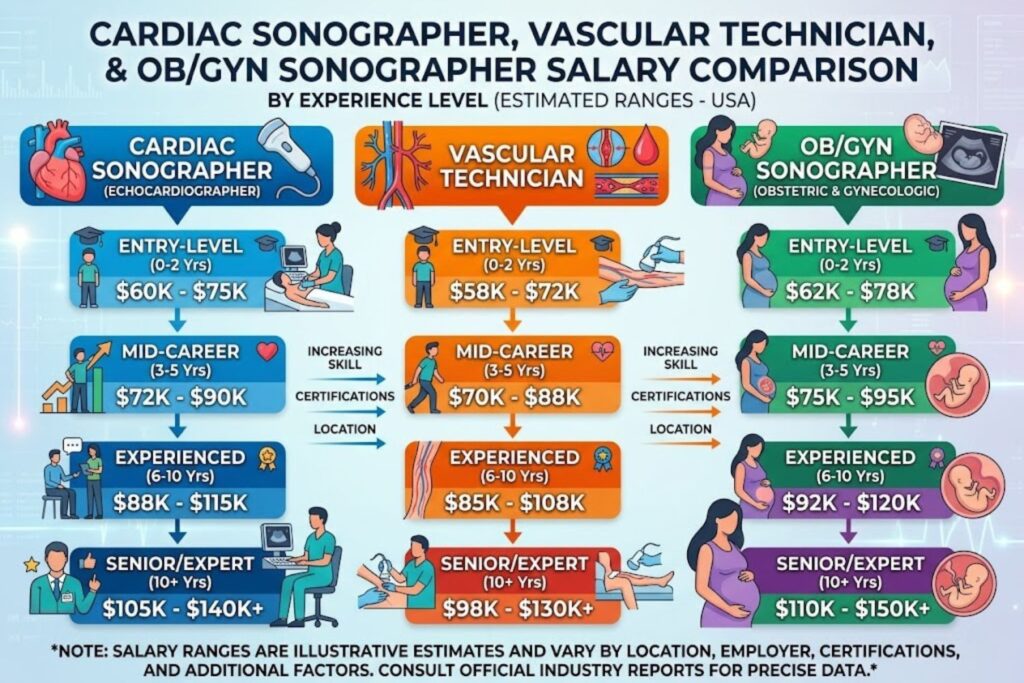
Cardiac sonographers earn $87,803 per year on average, creating natural scarcity in the field. Cardiac exams are technically demanding and require years to master. Facilities can’t easily cross-train general sonographers into this specialty, making experienced cardiac techs highly valued.
Vascular Technology
Vascular sonographers earn $84,015 per year. Like cardiac, vascular work requires specialized training and often involves emergency responsibilities (stroke alerts, vascular emergencies). Weekend and on-call availability increases effective pay by 10–25% through differentials.
Obstetrics & Gynecology
OBGYN sonographers earn an average base salary of $76,197 per year—notably lower than cardiac or vascular. This reflects higher competition in the specialty and more predictable daytime hours.
Less Common But Lucrative Specialties
Neurosonography, pediatric echocardiography, and interventional ultrasound often pay at the higher end because they require advanced skills and limited practitioner availability. Some positions offering continuing call responsibility or research components can push compensation into the $110,000+ range.
The Certification Impact on Your Paycheck
This is where many career decisions are made—and where most people underestimate the financial benefit.
RDMS Certification Premium
RDMS certification from the American Registry for Diagnostic Medical Sonography typically adds 10 to 18 percent over uncertified baseline. That’s a $7,000–$15,000 annual difference on a $85,000 base salary.
Most hospitals now treat ARDMS credentials as de facto requirements rather than preferences. You can’t negotiate much without certification—employers simply move to the next candidate.
Credential Stacking Strategy
This is the insider advantage most articles skip. Stacking two registries, for example RDMS + RVT, can compound to a 20 to 30 percent total premium.
A vascular-specialty sonographer holding both credentials becomes far more marketable than a single-certified peer. This opens doors to Level I trauma centers, advanced labs, and supervisory roles.
ROI on Certification Investment
Education costs are modest. Training costs around $39k but you start earning immediately after certification, with break-even by year 3. Community colleges offer cheaper options—sometimes under $20,000 total for an associate degree.
The ARDMS exam itself costs roughly $525 total ($250 for physics + $275 for specialty). This modest investment pays for itself within weeks of earning your first certified position.
Employer Setting Matters (More Than You Think)
Hospital Positions
Hospital staff positions offer salary stability and benefits, typically in the $80,000–$95,000 range depending on size and location. However, you’re subject to shift rotation, call responsibilities, and staffing pressures.
Outpatient Care Centers
Outpatient care centers lead this group, with an average salary of $123,020 per year, or $59.15 per hour. These facilities attract experienced technicians who value daytime schedules and higher compensation.
Specialty and Trauma Centers
Level I trauma centers and specialty hospitals employ experienced sonographers with critical care background. These positions demand 24/7 coverage and advanced skills—but offer premium compensation and call stipends.
Private Imaging Centers
Some private centers position themselves as high-end diagnostic providers, attracting experienced techs with more predictable schedules than hospitals offer.
6 Proven Strategies to Increase Your Ultrasound Tech Salary
Strategy 1: Pursue High-Demand Specializations
Cardiac and vascular credentials create immediate scarcity value. You’re not just another sonographer—you’re someone who can staff a critical lab. Salary increases of $8,000–$15,000+ are standard after completing specialty training.
Strategy 2: Get Certified (and Stack Credentials)
If you’re uncertified, RDMS is your first move (10–18% increase). After two years, pursue a second credential. Dual-certified sonographers access positions that single-credentialed techs simply can’t compete for.
Strategy 3: Relocate Strategically or Go Traveling
A $75,000 salary in a mid-sized market becomes $95,000+ in California or Hawaii without changing your skill level. Traveling sonographer positions (13-week contracts) often pay $2,500–$3,500 weekly, effectively converting to $130,000+/year for those willing to move frequently.
Strategy 4: Negotiate Shift Differentials
Nights, weekends, and holidays pay 10–15% premiums. If you can absorb irregular schedules for your first 3–5 years, you accumulate additional $5,000–$8,000+ annually.
Strategy 5: Move Into Supervisory Roles
Lead technician, quality assurance, or educator positions typically add $10,000–$20,000. Senior/lead vascular techs often command positions above $120,000.
Strategy 6: Work Per Diem Positions
Per diem staff often earn $50–$55/hour (versus $40–$45 for FT staff) without benefits. This creates flexibility for experienced technicians and opens doors to multiple facilities.
Job Growth & Career Stability
Employment Projections
Sonography is expected to grow 13% from 2024–2034, making it one of the fastest growing healthcare support careers. This outpaces most career fields and reflects genuine labor shortages.
Why Demand is Strong
Baby boomers are driving much of the growth. They are not only getting older but also living longer—and requiring more care for illnesses and chronic conditions such as heart disease. Ultrasound imaging is the “first line of diagnosis” for many conditions.
This isn’t temporary demand—it’s structural. Aging demographics ensure decades of strong job security.
Is Ultrasound Technology Worth the Investment?

Education Costs
Associate degrees cost as little as $10,000 at community colleges while private schools charge up to $58,000 for the same credential. The choice of school dramatically impacts out-of-pocket costs without affecting employability—accredited programs all lead to the same ARDMS exams.
Break-Even Timeline
You’ll spend $7,000-$21,000 on training to start earning $75,830 median salary — that’s roughly 2-5 months to recover your investment. Within three years, you’ve recovered education costs many times over through salary premiums versus non-technical work.
Long-Term Earning Potential
A sonographer earning $89,000 at age 28 with a 20+ year career faces $1.8M–$2.1M in cumulative earnings by retirement. When you factor in specialization, you’re looking at $2.2M–$2.5M+ in career earnings. This compares favorably to most associate-level healthcare careers.
FAQ Section
Q1: Do ultrasound technicians need state licensing?
Most states don’t require licensure. However, even in states without licensure, employers almost always require ARDMS certification for hiring and advancement. The professional credential effectively serves as your license.
Q2: What’s the difference between an ultrasound technician and a sonographer?
The terms are used interchangeably. Officially, the job title is “diagnostic medical sonographer,” but ultrasound technician, ultrasound tech, and sonographer all describe the same role.
Q3: Can you make $100,000+ as an ultrasound tech?
Yes. Specialization, geographic location, supervisory roles, or traveling positions commonly exceed this threshold. The highest-earning ultrasound technicians can make around $3,200 per week or $166,400 per year.
Q4: How long does it take to become an ultrasound technician?
Most ultrasound technicians complete an associate degree program in 18-24 months. Add 2–3 months for ARDMS exam prep and passing. Total time to employment: roughly 2 years.
Q5: Is the salary better in hospitals or outpatient centers?
Outpatient care centers pay significantly more—often $20,000–$30,000 annually above hospital positions. However, hospitals offer better shift scheduling and benefits, while outpatient centers demand more volume and efficiency.
Q6: What increases your salary fastest after graduation?
Specialization and credential stacking create the fastest salary jumps (8–15% per credential in years 2–3). Geographic relocation runs second. Experience alone grows salary 15–25% over 5–10 years but is slower than strategic moves.
Q7: Do traveling ultrasound techs make more money?
Yes significantly. Travel positions pay $2,500–$3,500 weekly for 13-week contracts, equating to $130,000–$182,000 annualized. However, you relocate frequently and provide your own housing in some cases.
Q8: What’s the lowest salary you can expect as an entry-level ultrasound tech?
Entry-level technicians can expect around $63,680 annually. This assumes RDMS certification in a lower-paying region without specialization.
Q9: How much does the ARDMS certification cost?
The SPI exam costs $250, and specialty exams cost $275 each. Most technicians take both exams within a five-year window for roughly $525 total.
Q10: Which specialty pays the most?
Cardiac and vascular specialties compete for top pay, both in the $84,000–$87,000 range. Interventional ultrasound and neurosonography can exceed these figures when paired with call responsibilities or supervisory roles.
Q11: Can you increase your salary without relocating?
Yes. Specialization, credential stacking, negotiating shift premiums, and moving into supervisory roles all increase pay without geographic moves. However, relocation typically unlocks faster salary growth.
Q12: Is job security good for ultrasound technicians?
Sonography is expected to grow 13% from 2024–2034, making it one of the fastest growing healthcare support careers. Job security is excellent and better than most healthcare fields.