Artificial intelligence isn’t new. But the way we talk about it—and the way most people understand it—is almost always wrong.
You’ve probably heard AI will revolutionize everything. Replace all workers. Achieve consciousness. Maybe take over the world. Most of these narratives are either wildly exaggerated or completely fictional.
Here’s what’s actually true: AI is a powerful technology that’s already changing how we work, create, and solve problems. But it’s not magic. It’s math applied to data.
This guide cuts through the hype and gives you a real understanding of what AI is, how it actually works, and why it matters.
What Artificial Intelligence Actually Is (Beyond the Hype)
A Simple Definition First
Artificial Intelligence is technology that enables computers to perform tasks that typically require human thinking—like recognizing patterns, making decisions, and solving problems.
That’s it.
It doesn’t require consciousness. It doesn’t “think” the way you do. It doesn’t have desires or intentions. It processes data, identifies patterns, and generates outputs based on mathematical models.
What AI Really Does vs. What It Doesn’t
What AI Actually Does:
- Identifies patterns in massive datasets faster than humans can
- Automates repetitive tasks with consistent accuracy
- Generates predictions based on historical patterns
- Creates content based on learned patterns
- Optimizes complex systems (logistics, scheduling, resource allocation)
What AI Doesn’t Do:
- Understand meaning the way humans do
- Make decisions with genuine comprehension
- Have goals or preferences outside its programming
- Know anything beyond patterns it learned from training data
- Think creatively in ways humans recognize as true originality
The gap between what it does and what it doesn’t do? That’s where most misconceptions live.
Why the Confusion Exists
Three reasons:
First, AI has improved dramatically in the last five years. Systems now generate human-like text, create realistic images, and solve complex problems. This progress is genuine—and it’s easy to mistake capability for consciousness.
Second, the companies building AI benefit from mystique. Calling something “intelligent” or “thinking” makes it sound more advanced than “statistical pattern matching,” even if they’re describing the same thing.
Third, humans are pattern-matching creatures ourselves. When something responds intelligently, we naturally assume it’s thinking. We project understanding onto systems that are actually just very good at pattern prediction.
Understanding this distinction matters because it changes how you evaluate AI claims—and how you use AI responsibly.
How Artificial Intelligence Actually Works
The Three Core Components
Every AI system needs three things to function:
Data. AI learns from examples. The more data, the better it learns. Image recognition AI needs thousands of images. Language AI needs millions of text samples. This is why data is the new oil—literally.
Algorithm. This is the mathematical formula that finds patterns in the data. Different algorithms work better for different tasks. Some are decades old; others emerged in the last few years. The algorithm is the engine; data is the fuel.
Computing Power. Training modern AI requires serious computational resources. This is why AI development happens at companies with massive server farms, not in garages. The computational cost is one reason why AI development concentrates among large, well-funded organizations.
Training, Pattern Recognition, and Decision-Making
Here’s what actually happens:
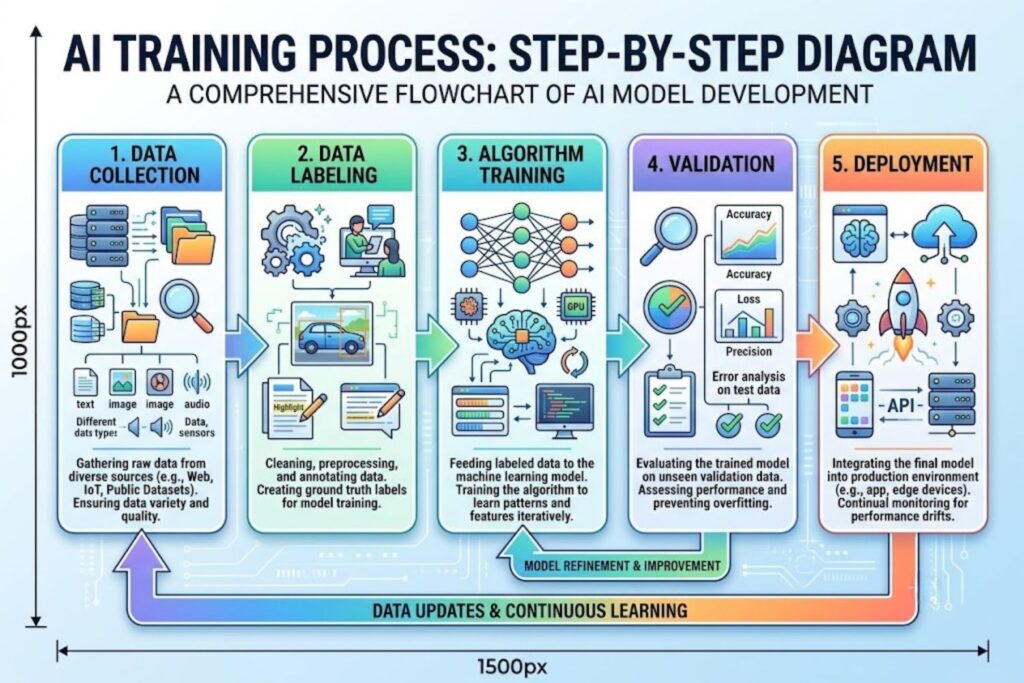
An AI system is fed massive amounts of data. The algorithm analyzes this data, finding statistical patterns. It adjusts its internal parameters based on those patterns. This process repeats thousands of times until the system can predict outputs based on inputs.
A simple example: Show an AI system 10,000 images labeled “cat” and “dog.” The algorithm finds patterns that distinguish cats from dogs—the shape of ears, texture of fur, size relative to image. Once trained, it can identify whether a new image contains a cat or dog.
It doesn’t “understand” cats. It doesn’t think “that’s a cat because I recognize cat-ness.” It’s computing “this image contains 73% of the patterns we associated with cat training data.”
But the result looks like understanding. And for practical purposes, it often is.
Why AI Requires Data (Lots of It)
The quality and quantity of training data directly determines AI performance.
Feed an AI system biased data, and it learns biased patterns. Train it on limited data, and it performs poorly on new situations it hasn’t seen. Provide excellent, representative, diverse data, and you get a capable system.
This is why data collection, cleaning, and labeling is often the hardest part of building AI systems—not the algorithm itself.
The Real Types of Artificial Intelligence
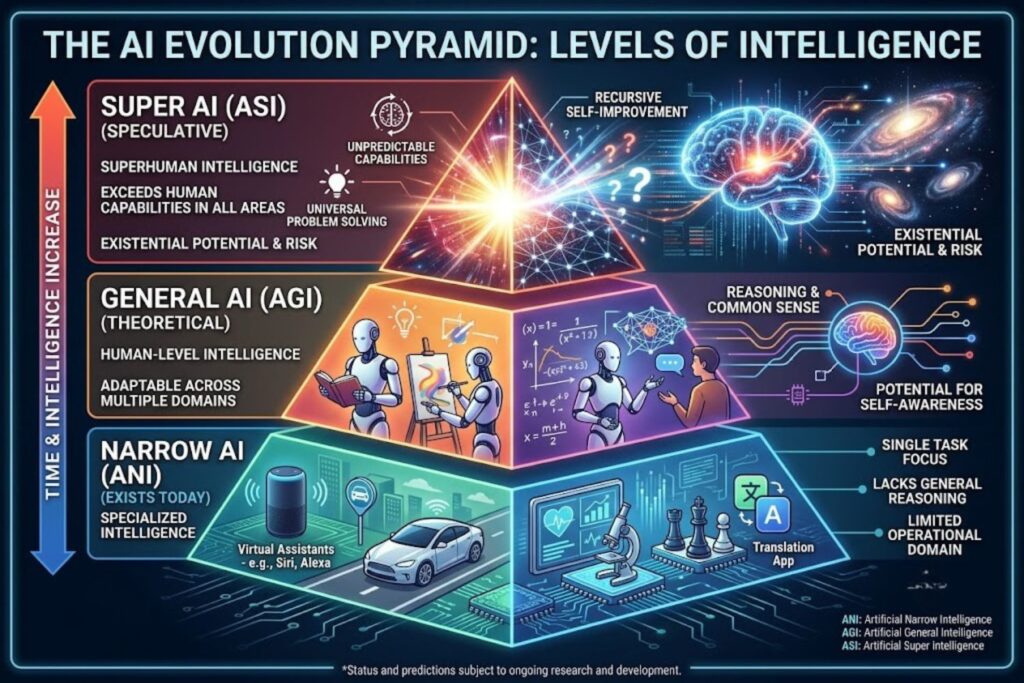
This classification matters less than people think, but it’s worth understanding.
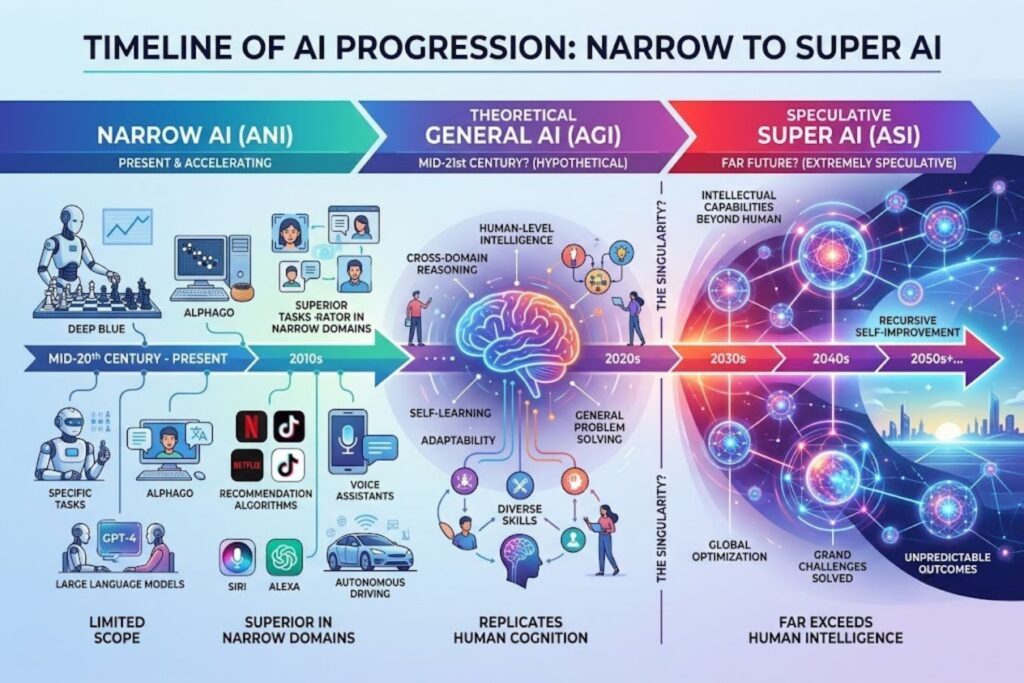
Narrow AI (Weak AI) – What Exists Today
Every AI system that actually exists is narrow AI. It’s trained for specific tasks: transcribing speech, translating languages, playing chess, writing code, generating images.
Narrow AI can be extraordinarily good at its specific task but completely useless outside that domain. An AI trained to diagnose cancer in X-rays can’t write poetry. An AI trained to play chess can’t drive a car.
This is why we have different AI systems for different jobs. And this is why the phrase “AI can’t do X” is usually pointless—of course it can’t do X if it wasn’t trained for X.
General AI (Strong AI) – The Theory vs. Reality
General AI would be a system capable of learning and performing any intellectual task a human can do. It would transfer knowledge across domains. It would learn new skills without being retrained. It would approximate human-level intelligence.
This doesn’t exist. Not even close.
What we have are narrow systems that are impressive within their narrow domains. A large language model trained on text can generate sophisticated text, but it can’t see, listen, or reason about the physical world without significant additional training.
Claims that we’re “five years away” from General AI have been made for 30+ years. They’re usually marketing, not prediction.
Super AI – Science Fiction or Future Reality?
Super AI would exceed human intelligence across all domains. It would solve problems we can’t solve. It would have its own goals and agency.
This is speculation. Serious researchers disagree about whether Super AI is possible at all. Some argue it’s inevitable. Others argue human intelligence is too multifaceted to be “exceeded” in any meaningful way.
The honest answer: we don’t know. And anyone claiming certainty either hasn’t thought this through or is selling something.
Real-World AI Applications Transforming Industries
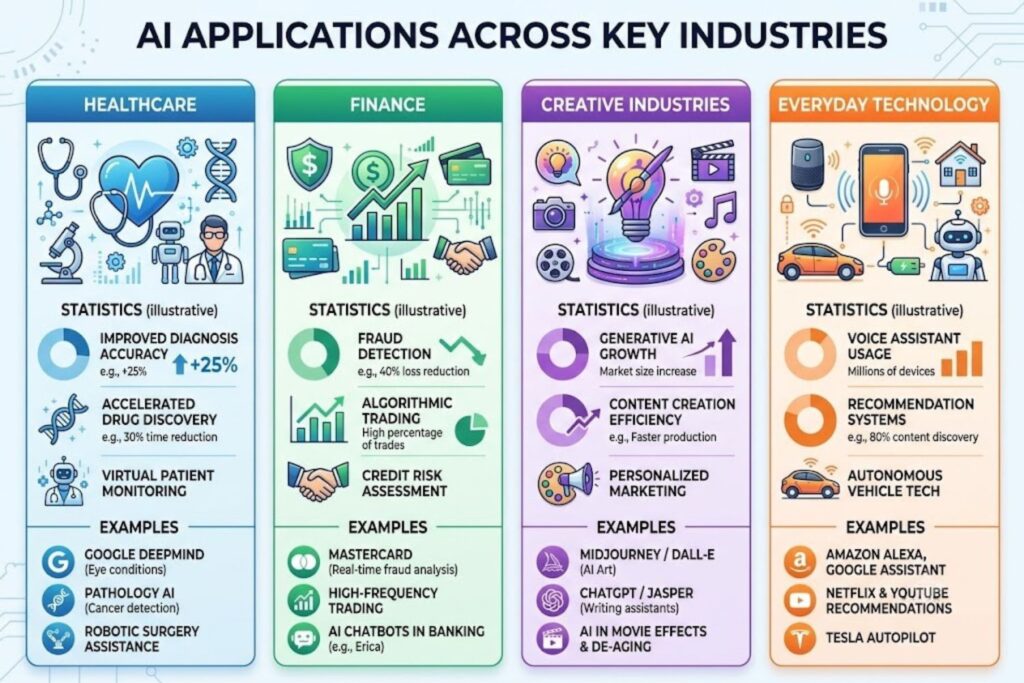
AI isn’t abstract. It’s already embedded in systems you probably use daily.
Healthcare & Medical Diagnosis
AI analyzes medical images (X-rays, MRIs, CT scans) to identify abnormalities. In some cases, it matches or exceeds radiologist performance. It’s used to identify skin cancer from photos, predict patient outcomes, and recommend treatment plans.
The value: speed and consistency. A system can analyze 1,000 images in the time a radiologist analyzes five. It doesn’t get tired or have bad days. It’s not replacing doctors—it’s extending their capabilities.
Business & Analytics
Companies use AI to forecast demand, optimize pricing, detect fraud, and predict which customers are likely to churn. Every recommendation you get online—what to buy, what to watch, what to read—is powered by AI predicting your preferences.
The value: better decisions made faster, based on data patterns humans couldn’t spot manually.
Creative Fields & Content
AI generates text (like this article could be written with AI assistance), creates images, composes music, and writes code. These systems are trained on human-created content and generate new outputs based on learned patterns.
The value: productivity. A designer can generate 100 variations instantly instead of creating them manually. A developer can generate code scaffolding instead of writing boilerplate. A writer can use AI to overcome blocks or accelerate first drafts.
Everyday Technology You’re Already Using
Speech recognition (Siri, Alexa). Email spam filtering. Social media feeds. GPS navigation. Credit card fraud detection. Facial recognition on your phone. These all use AI.
You don’t think about them as “AI”—you just think of them as normal features. But that’s exactly what widespread AI looks like: so embedded in everyday tools that it becomes invisible.
Machine Learning, Deep Learning, and Neural Networks Explained
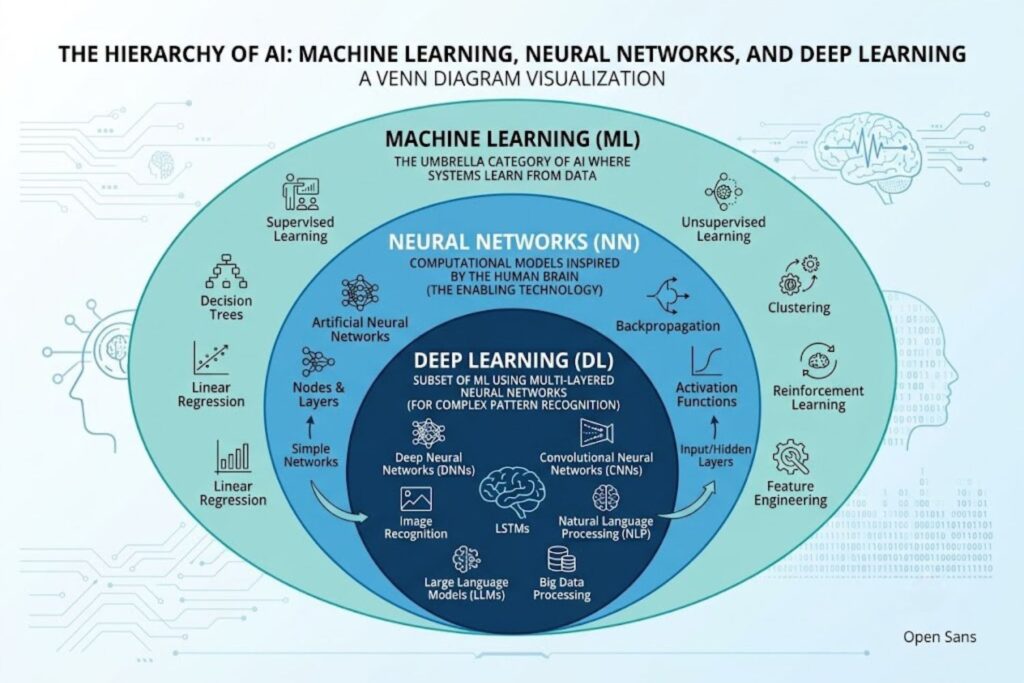
These terms get confused constantly. They’re related, but they’re not the same thing.
Why These Terms Matter
Understanding the distinctions helps you evaluate AI capabilities and limitations more accurately. It also helps you avoid being impressed by terminology when the underlying capability is limited.
How They Relate to AI
Machine Learning is a subset of AI. It’s the approach of letting systems learn patterns from data rather than explicitly programming instructions. Instead of coding “if X then Y,” you feed data to an algorithm and let it discover patterns.
Almost all modern AI uses machine learning because it works better than explicit programming for complex tasks.
Deep Learning is a subset of machine learning. It uses neural networks—mathematical structures loosely inspired by biological brains—with multiple layers. The “deep” refers to multiple layers of processing.
Deep learning is why modern AI has improved so dramatically. Techniques like transformer neural networks (which power modern language models) are deep learning approaches.
Neural Networks are the mathematical structures that enable deep learning. They consist of interconnected “neurons” organized in layers. Each connection has a weight. During training, these weights adjust based on data, allowing the network to learn patterns.
A simple analogy: If AI is the goal (intelligent machines), machine learning is the strategy (learning from data), deep learning is the approach (using neural networks), and neural networks are the tool (the mathematical structure).
Real Examples of Each
A spam filter that uses explicit rules (“if email contains ‘buy now’, mark as spam”) is basic programming.
A spam filter that learns patterns from labeled email examples (spam vs. not spam) is machine learning.
A language model like GPT that uses transformer neural networks with billions of parameters trained on massive text data is deep learning.
This progression reflects increasing sophistication and capability—but also increased computational requirements and decreased human interpretability.
What AI Can and Cannot Do (The Honest Truth)
This is where realistic assessment matters most.
AI’s Genuine Strengths
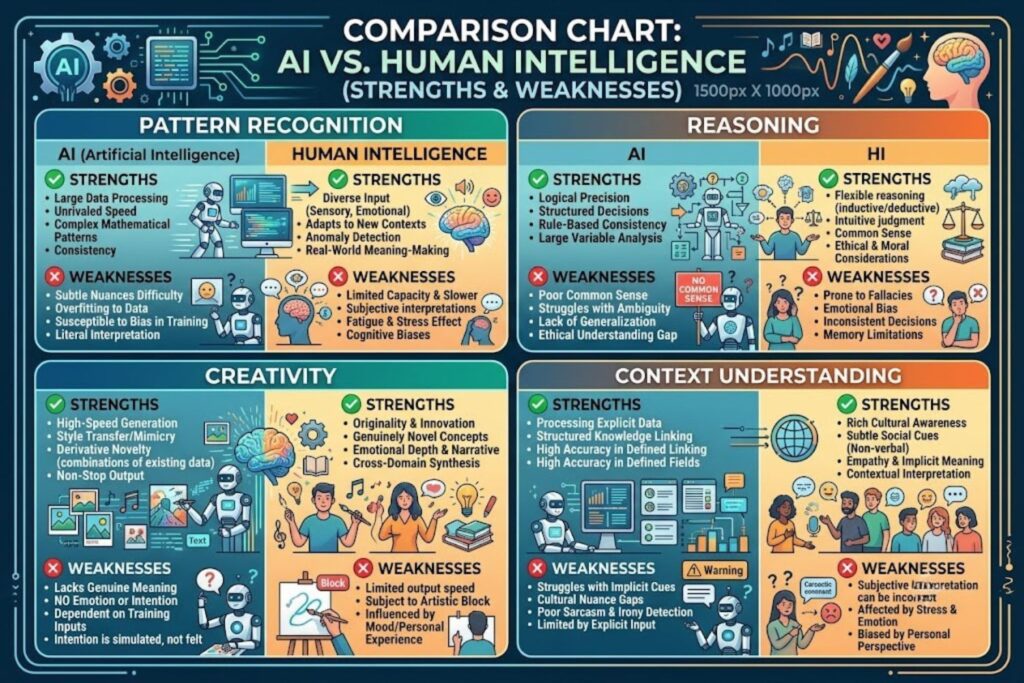
Pattern recognition at scale. AI can identify patterns in massive datasets faster and more consistently than humans. This is its core strength.
Automation of repetitive tasks. When a task has clear rules and patterns, AI can automate it reliably.
Speed and consistency. AI doesn’t get tired, distracted, or have bad days. It delivers the same output for the same input.
Combination of knowledge. AI can integrate patterns from millions of examples in ways human memory cannot.
Optimization. Given constraints and objectives, AI can find better solutions than humans through rapid iteration.
AI’s Real Limitations
No true understanding. AI processes patterns. It doesn’t comprehend meaning the way you do.
No context beyond training data. AI doesn’t know about the world outside its training data. It can’t reason about unprecedented situations.
No common sense. Humans have intuitive understanding of how the physical world works. AI has statistics.
Brittleness. Small changes to input can cause dramatic changes in output. AI trained on September 2024 data doesn’t automatically understand September 2025 events.
Hallucinations. Language models confidently generate false information. They sound convincing but can be completely wrong.
No genuine causation. AI finds correlations, not causes. If A and B are correlated in training data, the AI can’t distinguish which causes which.
Requires enormous data and compute. Building capable AI systems is expensive and resource-intensive.
The Hype vs. Reality Gap
Where the gap is widest:
Hype: AI will achieve consciousness and have its own goals.
Reality: AI is pattern-matching software without subjective experience.
Hype: AI will replace all workers.
Reality: AI will change job roles and create new skill requirements; history suggests new jobs emerge alongside automation.
Hype: AI understands language the way humans do.
Reality: AI predicts statistically likely next words based on patterns, producing text that reads naturally without comprehending meaning.
Hype: AI is inherently dangerous and might destroy civilization.
Reality: AI poses real risks (misinformation, privacy, bias, concentration of power), but apocalyptic scenarios are speculative.
Common AI Misconceptions Debunked
Myth 1: AI Understands Like Humans
How do you know you understand something? You can explain it in new ways. You understand why, not just that. You can apply it to new contexts.
AI can’t do these things. It processes patterns. The patterns are sophisticated enough to produce human-like output, but the process is fundamentally different from human understanding.
The test: Ask ChatGPT to explain something, then follow up with “why?” repeatedly. Eventually, it’ll either hallucinate or contradict itself. It’s built on pattern completion, not conceptual understanding.
Myth 2: AI Will Soon Replace Humans Entirely
Two responses:
Technically: AI is narrow. A surgical robot doesn’t manage hospitals. A language model doesn’t write software and diagnose disease and drive cars. Creating AGI (Artificial General Intelligence) is theoretically possible but unproven.
Historically: Every major technology—agriculture, factories, computers—was supposed to eliminate human labor. Instead, new job categories emerged. The Luddites in 1811 weren’t wrong that textile machines would displace textile workers. But they couldn’t imagine the jobs that would follow.
The more accurate statement: AI will change job roles, reward certain skills more, and require workforce adaptation. That’s different from elimination.
Myth 3: AI Works Magic Without Data
AI requires three things: data, algorithm, and compute. The data is non-negotiable. You can’t train a medical AI with 100 examples. You can’t train a language model with 1,000 documents.
Quality matters more than quantity, but you still need quantity. This is why data collection is a primary bottleneck for AI development.
The Business & Career Impact of AI
How AI is Changing Jobs (Not Eliminating Them)
Writing: AI can draft content, but human writers are more valuable now—they can use AI to work faster and focus on strategy. Similar pattern in design, coding, and analysis.
Customer Service: AI handles routine questions. Humans handle complex issues and relationship building. The skill requirement shifts but the role evolves.
Knowledge Work: Routine data analysis, report generation, and synthesis become faster with AI. This increases demand for people who can interpret results and make decisions, not just process data.
Manufacturing: Robots took factory jobs. But new jobs in robot maintenance, programming, and quality control emerged.
The pattern: AI eliminates routine work, creates demand for higher-level thinking, and shifts skill requirements.
Skills You Need to Work With AI
Understanding AI limitations. You need to know what AI can’t do. This prevents you from building systems that fail or making decisions based on AI overconfidence.
Data literacy. Understanding data quality, bias, and representation is critical. Most AI failures stem from data problems, not algorithm problems.
Domain expertise. AI in healthcare needs people who understand medicine. AI in finance needs people who understand markets. Domain knowledge + AI knowledge is increasingly valuable.
Critical thinking. Can you evaluate AI output? Do you know when to trust it and when to be skeptical? This meta-skill is becoming crucial.
Technical skills (optional for some roles). You don’t need to build AI systems to work with them, but technical skills increase your options.
Where AI Careers Are Growing
AI engineering, data science, machine learning operations (MLOps), AI safety, data labeling, AI training, prompt engineering, and domain-specific AI specialization (medical AI, financial AI, etc.).
Also growing: roles that require AI literacy—every field is becoming “tech” fields as AI adoption accelerates.
AI Ethics, Risks, and Responsible Development
AI isn’t morally neutral. How it’s built, trained, and deployed has real consequences.
Real Concerns Worth Discussing
Bias. If training data reflects historical discrimination, AI systems perpetuate it. An AI trained on historical hiring data will discriminate against underrepresented groups. This isn’t hypothetical—it’s documented.
Misinformation. AI can generate convincing false information at scale. Deepfakes, synthetic text, and manipulated content are becoming harder to detect.
Privacy. Training data includes personal information. Large language models might memorize and regurgitate private data from training sources.
Concentration of power. Building cutting-edge AI requires massive resources. This concentrates power among large companies and wealthy organizations.
Unemployment. While new jobs emerge, the transition is disruptive. People displaced from routine work might not be able to transition to higher-level work. Training and support are needed.
Accountability. When AI makes a harmful decision, who’s responsible? The company? The developers? The person using it? This is legally and morally unclear.
What Responsible AI Development Looks Like
- Testing for bias across demographic groups
- Transparency about AI limitations
- Human oversight for high-stakes decisions
- Data privacy protections
- Clear accountability structures
- Diversity in teams building AI (homogeneous teams build biased systems)
- Regular auditing for unintended consequences
Why Regulation Matters
Self-regulation has failed historically. Industries with serious risks (pharmaceuticals, aviation, nuclear) have external oversight. AI is reaching a scale and impact that requires similar attention.
The question isn’t whether to regulate AI—it’s how to do it thoughtfully without stifling innovation or creating barriers that only large companies can meet.
The Future of Artificial Intelligence
What Experts Actually Predict
There’s no consensus, but here are realistic near-term predictions:
Next 2-3 years: Continued improvement in large language models, multimodal AI (text, image, video combined), better reasoning, reduced hallucination, broader adoption across industries.
Next 5 years: Possible emergence of more general capabilities (systems that handle multiple domains better), likely regulation frameworks, increased focus on AI safety, continued cost reduction.
5-10 years and beyond: Unknown. Experts genuinely disagree. Some believe AGI is possible; others argue it’s not feasible at all.
What’s Genuinely Possible in the Next 5 Years
- AI that can reason better and explain its reasoning
- Multimodal systems that understand text, images, audio, and video
- More efficient AI (requiring less compute)
- Better personalization across products and services
- Continued automation of knowledge work
- New capabilities we haven’t anticipated
- Significant regulatory frameworks
Where the Real Breakthroughs Will Come
Not from bigger models trained on more data. Those gains are leveling off.
The breakthroughs will come from:
Reasoning improvements. Current AI is good at pattern matching but weak at complex reasoning. Systems that can reason better will be genuinely transformative.
Multimodal integration. AI that handles multiple input types seamlessly will be more capable and useful.
Efficiency. AI that achieves current capabilities with less computational resources will democratize AI development.
Novel architectures. The transformer architecture (underlying modern AI) has enabled huge progress, but fundamentally new approaches might enable new capabilities.
Integration with tools. AI systems that can use external tools, search the web, write code, and execute tasks will be more powerful than text-only systems.
Key Takeaways
- Artificial intelligence is technology that enables computers to perform tasks requiring pattern recognition and decision-making—not consciousness or genuine understanding.
- How it works: AI systems learn patterns from data, then use those patterns to make predictions or decisions. Three components enable this: data, algorithms, and computing power.
- Narrow AI exists today. We have systems that excel at specific tasks. General AI (human-level intelligence across domains) remains theoretical. Super AI is speculative.
- Real applications are widespread: AI diagnoses disease, powers recommendations, generates content, detects fraud, and optimizes systems across every major industry.
- Machine learning, deep learning, and neural networks are related but distinct. Understanding these helps you accurately assess AI capabilities.
- AI’s genuine strengths are pattern recognition at scale, automation, speed, and consistency. Its real limitations include lack of true understanding, brittleness, hallucination, and dependence on training data.
- Common misconceptions overstate AI’s understanding, underestimate job evolution, and misunderstand data requirements.
- Career impact: AI will change job roles, not eliminate them entirely. Valuable skills include data literacy, domain expertise, critical thinking, and understanding AI limitations.
- Ethics matter. Bias, misinformation, privacy, and concentration of power are legitimate concerns that require thoughtful solutions.
- The future is uncertain but constrained. Near-term improvements are likely. Long-term predictions are speculative. Breakthroughs will come from reasoning improvements, efficiency, and novel architectures—not just bigger models.
Frequently Asked Questions
1. Is artificial intelligence the same as machine learning?
No. Machine learning is a subset of AI. It’s one approach to building intelligent systems—letting them learn patterns from data rather than explicitly programming rules. All modern AI uses machine learning, but the terms aren’t interchangeable.
2. Can artificial intelligence become conscious?
Unknown. Some argue that consciousness requires specific physical properties. Others argue it’s possible in artificial systems. Most experts don’t think current AI is conscious, but disagreement exists about future possibilities.
3. Will AI replace my job?
Probably not in the way you imagine. AI will likely change your job, automate routine tasks, and increase demand for higher-level skills. Some jobs will disappear; others will evolve. The challenge is managing the transition.
4. How accurate is AI really?
Depends on the task, training data, and what you’re measuring. AI can match or exceed human performance on specific tasks (image classification, game-playing, pattern recognition). On complex reasoning and novel situations, humans often outperform AI. Context matters enormously.
5. Is AI dangerous?
AI poses real risks: misinformation, privacy violation, bias, and concentration of power. Apocalyptic scenarios (AI achieving consciousness and eliminating humans) are speculative. The concrete risks deserve serious attention.
6. How much data does AI need?
Highly variable. Simple tasks might need thousands of examples. Complex tasks might need millions. Quality usually matters more than quantity. Also: more data helps only if the data is representative and unbiased.
7. Can AI be truly unbiased?
No system built by humans with human data is unbiased. AI amplifies training data biases. Bias mitigation is possible—through careful data curation, testing, and oversight—but eliminating bias entirely isn’t realistic.
8. Is AI regulation necessary?
Most experts say yes for high-stakes applications (healthcare, criminal justice, hiring). The debate is about how much and what kind, not whether.
9. What’s the difference between AI and automation?
Automation follows explicit rules. AI learns patterns from data and generates rules. Automation is predictable; AI can behave unexpectedly on new inputs. This distinction matters for reliability and safety.
10. How do I learn more about AI without being technical?
Read about specific applications (medical AI, language models, recommendation systems). Take introductory courses focused on concepts rather than coding. Follow researchers and journalists who explain AI clearly. Avoid hype-heavy sources.
11. Will AI create more jobs than it eliminates?
Historically, major technologies create net employment gains, but with significant displacement. AI likely follows this pattern, but the transition requires reskilling support and time.
12. What’s the difference between AI and human intelligence?
AI excels at pattern recognition, speed, and consistency. Humans excel at reasoning with limited data, understanding context, creating genuinely new ideas, and navigating ambiguous situations. They’re different forms of intelligence.
13. Can AI truly be creative?
AI can generate novel combinations of learned patterns. Whether this counts as “creative” depends on your definition. AI doesn’t create from zero; it recombines patterns. Humans create new concepts and express genuine intentions. Different processes.
14. How is AI trained?
Data is prepared and labeled. An algorithm (usually a neural network) analyzes this data. The algorithm adjusts its internal parameters iteratively. Validation data tests performance. This process repeats until performance meets requirements. Then the trained model is deployed.
15. What’s AI’s biggest limitation?
Lack of true understanding. AI pattern-matches. It doesn’t comprehend meaning. This is why AI can confidently assert false information and fail completely on situations outside its training data.