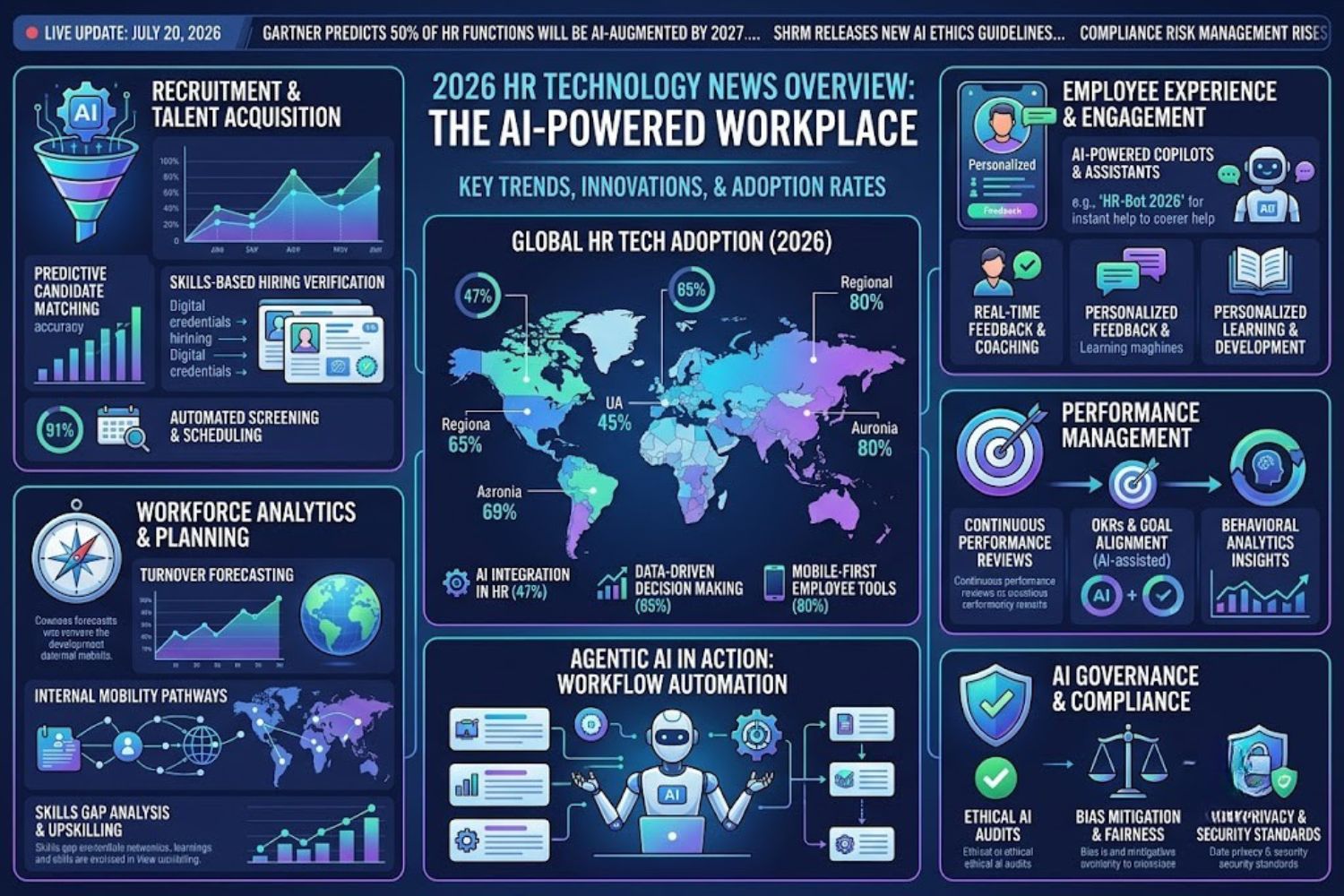
HR technology news moves fast, and most of it gets reported the same way: a headline, a funding number, maybe a quote from a CEO. What’s usually missing is context — what the news actually means for the people running HR departments, evaluating vendors, or trying to understand where the industry is headed.
This guide covers the HR tech stories that matter most right now, explains why they’re happening, and gives you a practical way to judge future headlines yourself instead of just reacting to them.
Quick answer: The biggest HR tech story of 2026 is the shift from experimental AI to agentic AI running inside everyday HR workflows, paired with a wave of consolidation as larger vendors acquire smaller, AI-native startups rather than build the technology themselves.
What “HR Tech News” Actually Covers
“HR tech news” isn’t one topic — it’s a mix of product updates, business deals, and workforce research, and each type matters differently depending on your role.
- Product and platform news: New features inside tools like applicant tracking systems (ATS), human capital management (HCM) platforms, and payroll systems.
- Business news: Funding rounds, mergers, acquisitions, leadership changes at vendors.
- Research and policy news: Studies on AI adoption, workplace trends, and regulatory shifts affecting HR technology, like pay transparency laws.
Knowing which bucket a story falls into helps you decide how much attention it deserves. A product update might affect your day-to-day workflow next quarter. A vendor acquisition might affect your contract for years.
The Big Story in 2026: Agentic AI Moves From Pilot to Production
For the last two years, “AI in HR” mostly meant chatbots answering benefits questions or resume screening tools. In 2026, the conversation shifted to agentic AI — systems that can take multi-step actions on their own, like scheduling interviews, flagging compliance issues, or routing approvals, instead of just answering a single question.
How Adoption Actually Breaks Down by Company Size
Adoption isn’t even across the market. Recent industry data shows a clear gap by company size, with large organizations moving fastest, midsized companies following at a slower pace, and small businesses barely started.
| Company size | Agentic AI adoption |
|---|---|
| Large businesses | 48% |
| Midsized businesses | 25% |
| Small businesses | 4% |
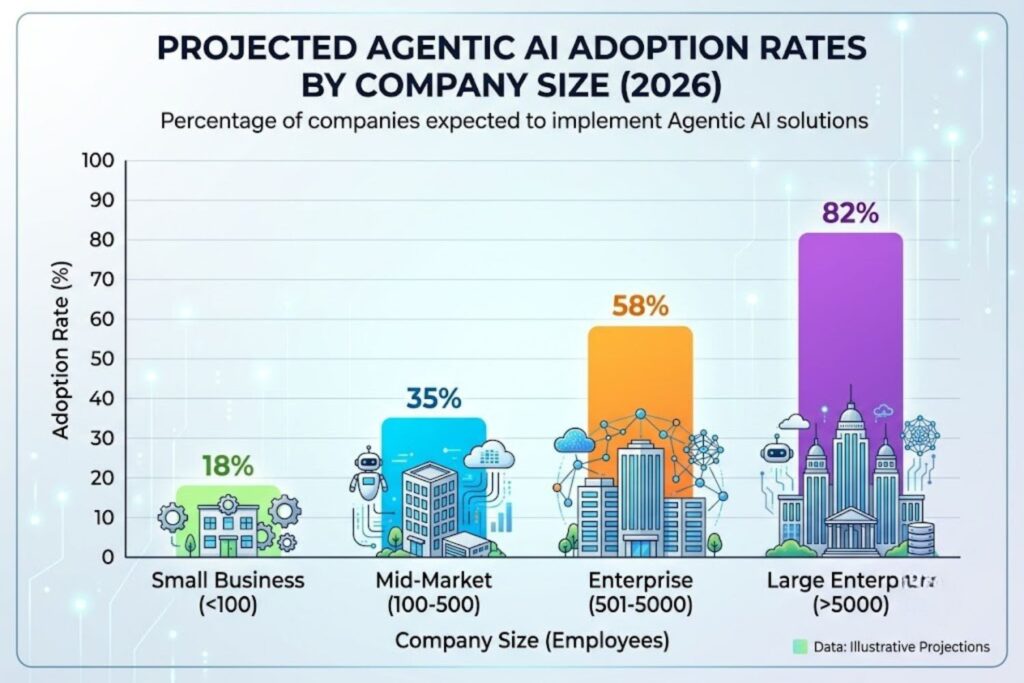
This gap matters because it tells you where the next wave of news will come from. Expect midsized and small HR tech vendors to spend 2026 and 2027 racing to make agentic tools affordable and simple enough for smaller teams — that’s the market opportunity everyone can see coming.
What Agentic AI Is Actually Doing Inside HR Teams
In practice, agentic AI is showing up in a handful of concrete places:
- Recruiting: Screening applications, scheduling interviews across multiple calendars, and drafting outreach — without a recruiter clicking through each step.
- Onboarding: Auto-generating paperwork, routing IT and equipment requests, and flagging missing compliance documents.
- People analytics: Surfacing attrition risk or pay equity issues before they become formal complaints.
Where the Governance Gaps Show Up
The honest part of this story — the part a lot of vendor content skips — is that agentic AI creates new risk alongside the efficiency. HR and IT teams are being pushed closer together specifically because agentic systems need stronger data governance, clearer audit trails, and defined limits on what an AI agent is allowed to decide versus what still needs a human sign-off. Skipping that governance work is the single most common mistake companies make when adopting these tools quickly.
Expert tip: Before rolling out any agentic HR tool, write down exactly which decisions the AI can make unsupervised and which ones require a human to approve. If you can’t answer that question clearly, you’re not ready to deploy it.
The M&A Wave: Why Bigger HR Tech Vendors Are Buying, Not Building
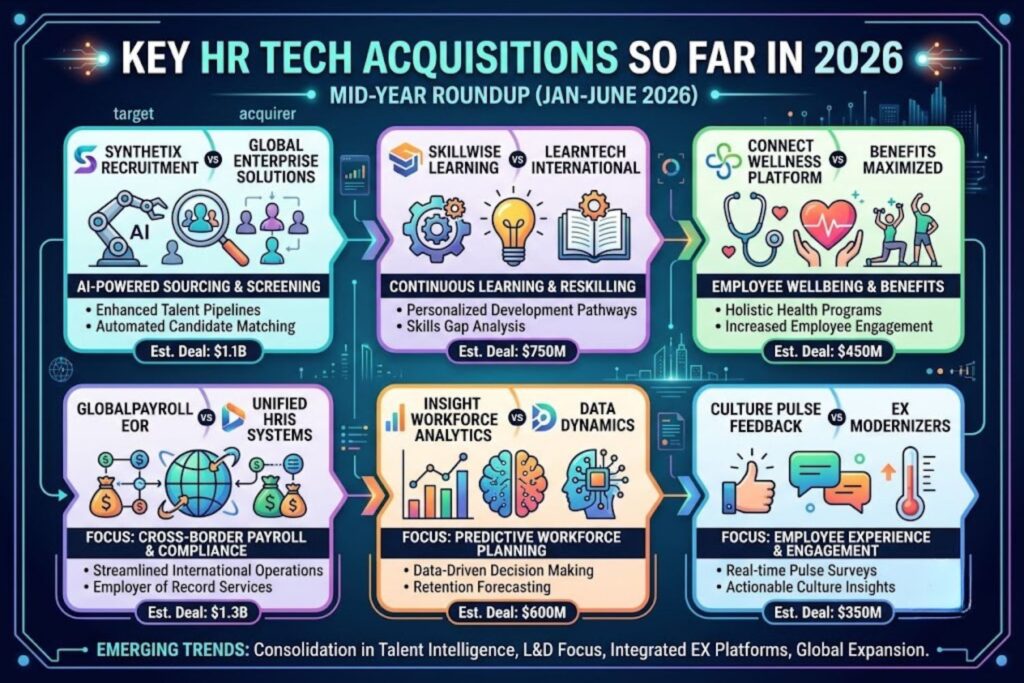
2026 has been an active year for HR tech acquisitions, and the pattern is consistent: established vendors are buying smaller, AI-native companies instead of building competing features from scratch.
Notable 2026 Acquisitions and What They Signal
Several deals this year illustrate the trend clearly. Payoneer acquired global employment platform Boundless, Remote purchased Atlas, Phenom acquired both Be Applied and Included AI, Docebo bought learning platform 365Talents, and Percepytx acquired AI-native learning company Lyceum. Industry analyst Josh Bersin summed up the pattern simply: larger vendors are hunting for smaller companies with a credible AI story, mainly to acquire technology, customers, and talent in one move rather than build it internally.
A Framework for Reading Any HR Tech Acquisition Announcement
Not every acquisition affects you the same way. Use this quick decision framework the next time you see one in your feed:
- Are you a customer of the company being acquired? Ask directly about contract terms, data migration timelines, and whether the product roadmap will change.
- Are you a customer of the acquiring company? Watch for feature bloat or price increases as the acquirer folds in new capabilities.
- Are you shopping for a vendor? Treat frequent acquisitions in a category as a signal that the market is still consolidating — it may be worth waiting for the dust to settle before locking into a long contract.
Where the Money Is Going: 2026 HR Tech Funding Snapshot
Funding in the first half of 2026 has been more selective than in previous boom years. Investors are backing companies that can show real revenue growth, not just a compelling pitch. As one investment banker put it, the sector currently feels like “a disciplined recovery” — fewer speculative bets, more capital going to companies proving they can scale profitably.
Comparison Table — Recent Funding Rounds and What They Fund
| Company | Round | Focus area |
|---|---|---|
| Factorial | $150M Series D | All-in-one HR platform for SMBs |
| Perk | $300M credit facility | Employee financial wellness/benefits |
| Multiverse | $70M primary funding | Skills-based workforce development |
| Kashable | $60M Series C | Employee lending and financial wellness |
| Ashby | $50M Series D | AI-powered recruiting platform |
| Sona | $45M Series B | Frontline workforce management |
| 401GO | $33M Series B | In-house 401(k) retirement infrastructure |
| Orbio | $21M Series A | Emerging HR tech category |
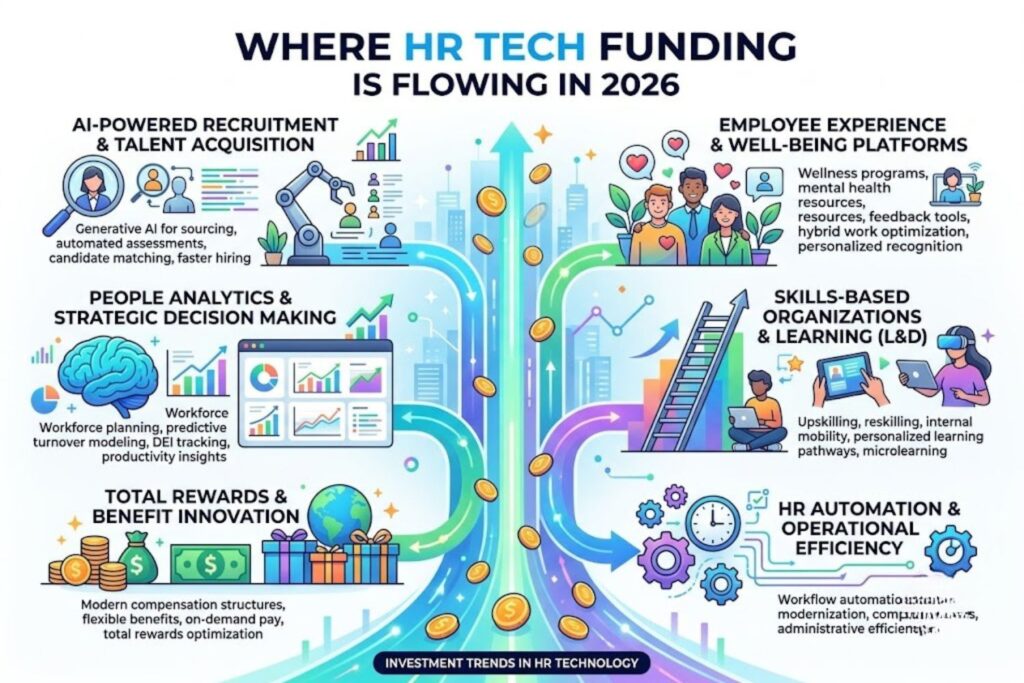
The common thread: money is flowing toward recruiting AI, financial wellness benefits, and skills development — three areas where companies are under real pressure to show measurable ROI, not just novelty.
Common Mistakes HR Leaders Make When Reacting to Tech News
- Chasing every new AI feature instead of asking whether it solves a problem your team actually has.
- Ignoring vendor stability and picking tools based on features alone, without checking funding history or acquisition risk.
- Treating every acquisition as bad news — many deals genuinely improve the product by adding resources and integration.
- Skipping the governance conversation until after a tool is already live company-wide.
A Practical Checklist: How to Evaluate Any HR Tech Headline
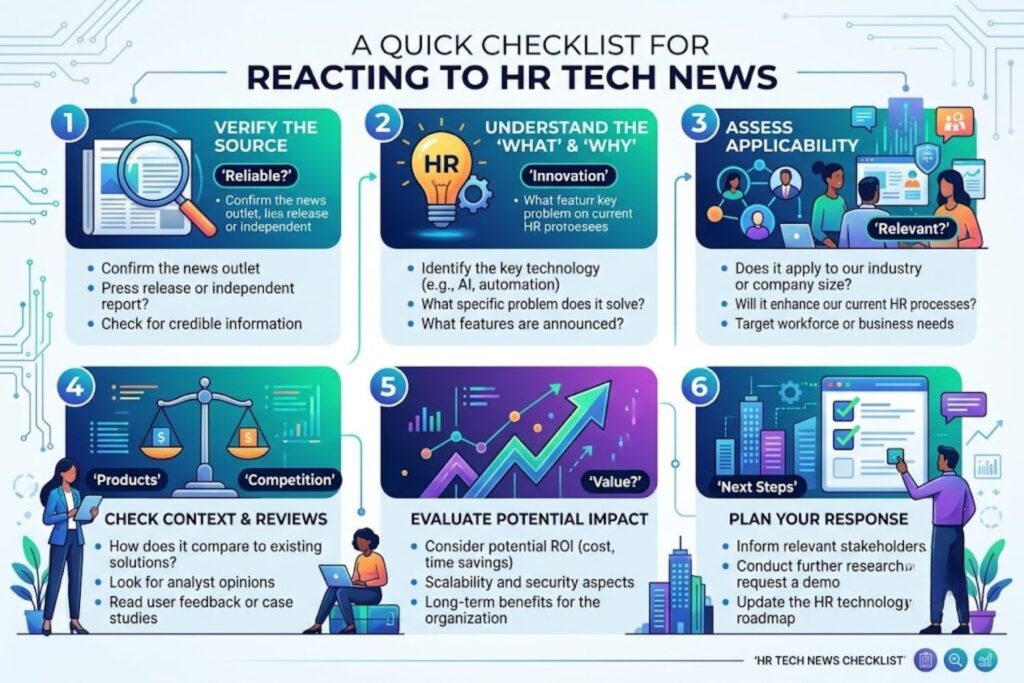
- Does this news affect a tool we currently use, or one we’re evaluating?
- Is this a product update, a business deal, or a research finding?
- If it’s an acquisition, have we contacted our account rep for a roadmap update?
- If it’s a new AI capability, do we have a governance policy that covers it?
- Does the underlying data or claim come from a source we trust?
11. Key Takeaways
- The defining HR tech story of 2026 is agentic AI moving from pilots into real production workflows, with adoption heavily concentrated in large enterprises so far.
- HR tech M&A is accelerating as bigger vendors acquire smaller AI-native companies for talent and technology rather than building in-house.
- 2026 funding is more selective and disciplined than prior years, concentrated in recruiting AI, financial wellness, and skills development.
- Governance — defining what AI agents can and can’t decide without a human — is the most commonly skipped step in adoption.
- Not all HR tech news deserves the same reaction; sorting headlines by type (product, business, research) helps you respond appropriately.
12. FAQ
What is HR tech news actually about?
HR tech news covers three main areas: product updates from HR software platforms, business news like funding and acquisitions, and research or policy developments affecting how companies manage their workforce.
What is the biggest HR technology trend in 2026?
The shift from basic AI tools (like chatbots) to agentic AI systems that can take multi-step actions — such as scheduling, screening, and compliance flagging — without constant human input.
Why are HR tech companies being acquired so often right now?
Larger, established vendors are acquiring smaller AI-native startups to gain new technology, customers, and talent faster than they could build those capabilities internally.
Is agentic AI widely used in HR departments yet?
Adoption is uneven. Large businesses are adopting agentic AI tools far faster than midsized or small businesses, based on recent industry surveys.
What does an HR tech acquisition mean for existing customers?
It varies by deal. Some acquisitions improve the product through added resources; others lead to pricing changes or roadmap shifts. Contacting your account representative directly is the most reliable way to find out.
What areas of HR tech are attracting the most funding in 2026?
Recruiting AI, employee financial wellness benefits, and skills-based workforce development have drawn some of the largest funding rounds this year.
What is the difference between HRIS, HCM, and ATS?
An HRIS (Human Resource Information System) manages core employee data. An HCM (Human Capital Management) platform is broader, covering the full employee lifecycle including payroll and performance. An ATS (Applicant Tracking System) specifically manages recruiting and hiring.
What risks come with adopting agentic AI in HR?
The most commonly cited risks are bias in automated decisions, compliance gaps, unclear accountability when an AI agent makes a mistake, and weak data governance.
How can a small business keep up with HR tech trends without a large budget?
Focus on one high-impact area first, such as recruiting or onboarding automation, rather than trying to adopt every new feature at once. Smaller, targeted tools are increasingly built with SMB budgets in mind.
Where can HR leaders find reliable, ongoing HR tech news?
Industry associations, established HR technology publications, and vendor-neutral analysts are generally more reliable than any single vendor’s blog, since vendors have an incentive to frame news in their own favor.